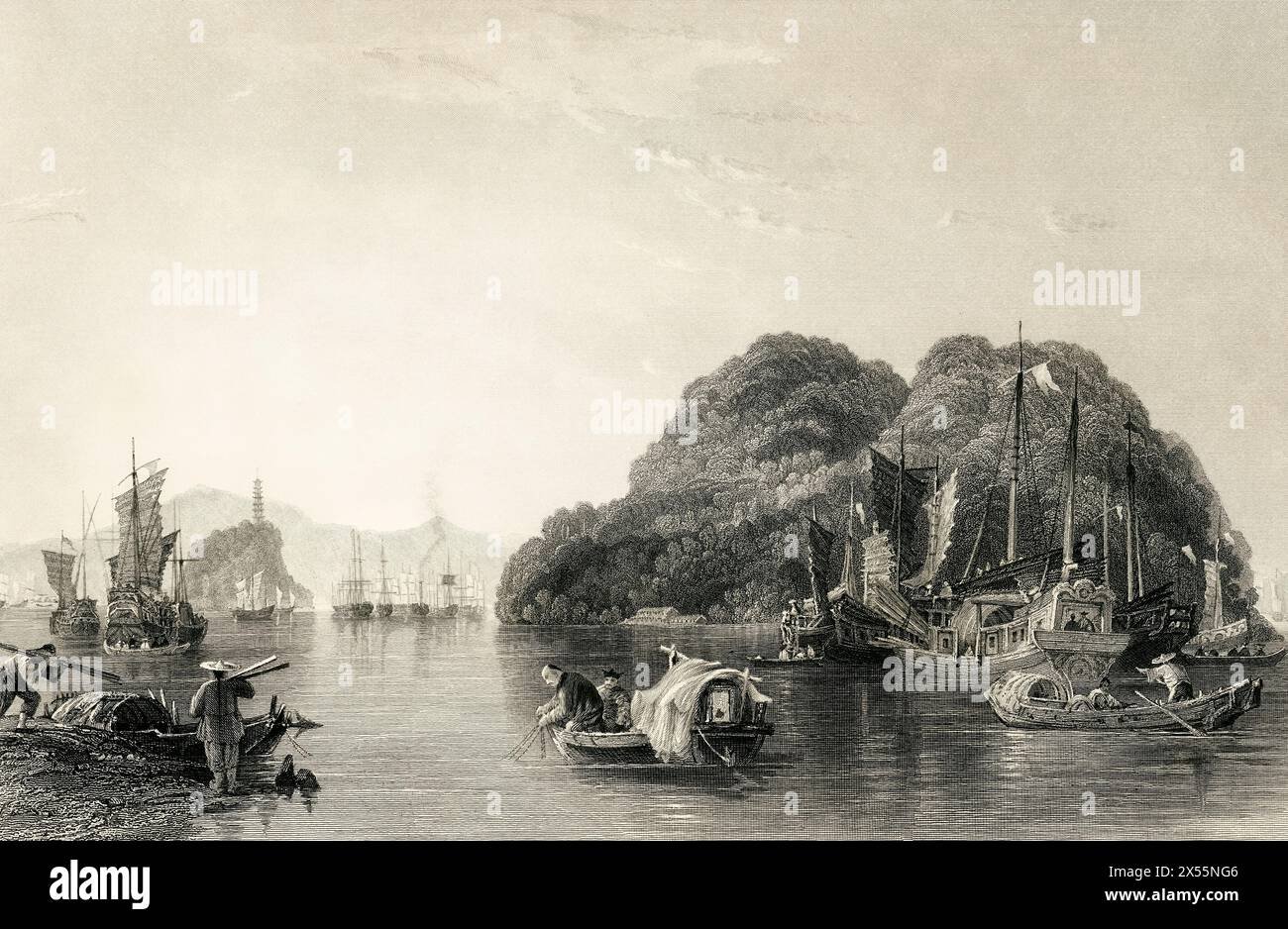
SILVER ISLAND, ON THE YANG-TSE-KEANG
Cover Image: Yin-shan, or Silver Island, on the Yang-tse-Keang / Yangtze River ChongMing ShangHai China / Drawn by T. Allom Engraved by W.H.Capone – ALAMY Image ID:2X55NG6
*Yin-shan, or Silver Island, on the Yang-tse-Keang / Yangtze River ChongMing ShangHai China / Drawn by T. Allom Engraved by W.H.Capone.
These Islands that, empurpled bright,
Floated amid the livelier light;
And mountains, that like giants stand
To sentinel th’ enchanted land.
The Island.
WITHIN view of the Golden Island, and on the bright bosom of that wide expanse of waters westward of Chin-keang-foo, the Yin-shan, or Silver Island, rises with much beauty and grandeur, from the surface; less lofty and precipitous, less adorned also with pagodas and palaces, than its more favoured rival, Silver Island is nevertheless possessed of features both pleasing and picturesque. The richest foliage clothes its sides and summit; cottages and villas peep forth from the dense masses of deep verdure that conceal its form, and, from the great depth of water close to shore, the scene is uniformly enriched by the accompaniment of large barges and trading-junks at anchor all around, their forms being distinctly relieved upon the verdant surface behind them.
The fleet of Queen Victoria having anchored close to these isles of beauty, and a strong detachment having been landed at Ching-keang-foo, Chinese infatuation was from that moment dissipated. The stranger had found a highway to the best cities in the bosom of the empire; and social intercourse with foreigners had always been considered by Chinese rulers, as an experiment too dangerous to be tried. No sooner, therefore, had an easy victory crowned with success the British arms, than the government prudently resolved upon submitting to whatever conditions the conquerors thought it expedient to propose. The capture of the Golden and Silver Islands, the occupation of the wide expanse of waters that encircle them, by a British force, decided the contest between England and the Chinese empire.
It is about six hundred years ago, since a Temple to Fo was erected here, and a Hall of Learning attached to it; and so great was its sanctity at that period, or shortly after, that the praise of its priests, and the natural beauties of their rocky domain, became the theme of Lew-yan’s most celebrated songs. This prince and poet first employs the more ancient name Keen-too-shan, or hill of solid earth, in his poems, but subsequently, in speaking of the comparative beauties of the sister isles, introduces the epithets Yin-shan and Kin-shan.
An enthusiast who once dwelt here, in the temple founded under the Yuan dynasty, pretended to powers never committed to the control of erring mortality. He professed to render the persons of his consultees proof against the point of the dagger—the flame of the fire—the strain of the rack. This avocation was successful in filling his treasury; the victims of his imposture, probably, being unwilling to acknowledge how completely they had been duped. But, just when he imagined his throne to be established, the emperor, who had been informed of his guilt, put him to death by that cruel process called “Ling-chy,” or cutting into ten thousand pieces.
![[VOL IV] THE VALLEY OF CHUSAN](https://i0.wp.com/arclumiva.com/wp-content/uploads/2025/09/valley-of-ting-hai-chusan-dinghai-zhoushan-zhejiang-china-drawn-by-t-allom-engraved-by-s-bradshaw-2X55NJ3.jpg?resize=870%2C570&ssl=1)
![[VOL IV] ANCIENT BRIDGE, CHAPOO](https://i0.wp.com/arclumiva.com/wp-content/uploads/2025/09/ancient-bridge-chapoo-haiyan-jiaxing-zhejiang-china-drawn-by-t-allom-engraved-by-rsands-2X55NHK.jpg?resize=600%2C600&ssl=1)
![[VOL IV] HONG-KONG, FROM KOW-LOON](https://i0.wp.com/arclumiva.com/wp-content/uploads/2025/09/hong-kong-from-kow-loon-kowloon-hong-kong-china-drawn-by-t-allom-engraved-by-sfisher-2X55NGM.jpg?resize=600%2C600&ssl=1)
![[VOL IV] CHINESE BOATMAN ECONOMIZING TIME AND LABOUR, POO-KEOU](https://i0.wp.com/arclumiva.com/wp-content/uploads/2025/09/chinese-boatman-economizing-time-labour-poo-kow-nanjing-jiangsu-china-drawn-by-t-allom-engraved-by-awillmore-2X55NGD.jpg?resize=600%2C600&ssl=1)