THE TUNG-TING-SHAN
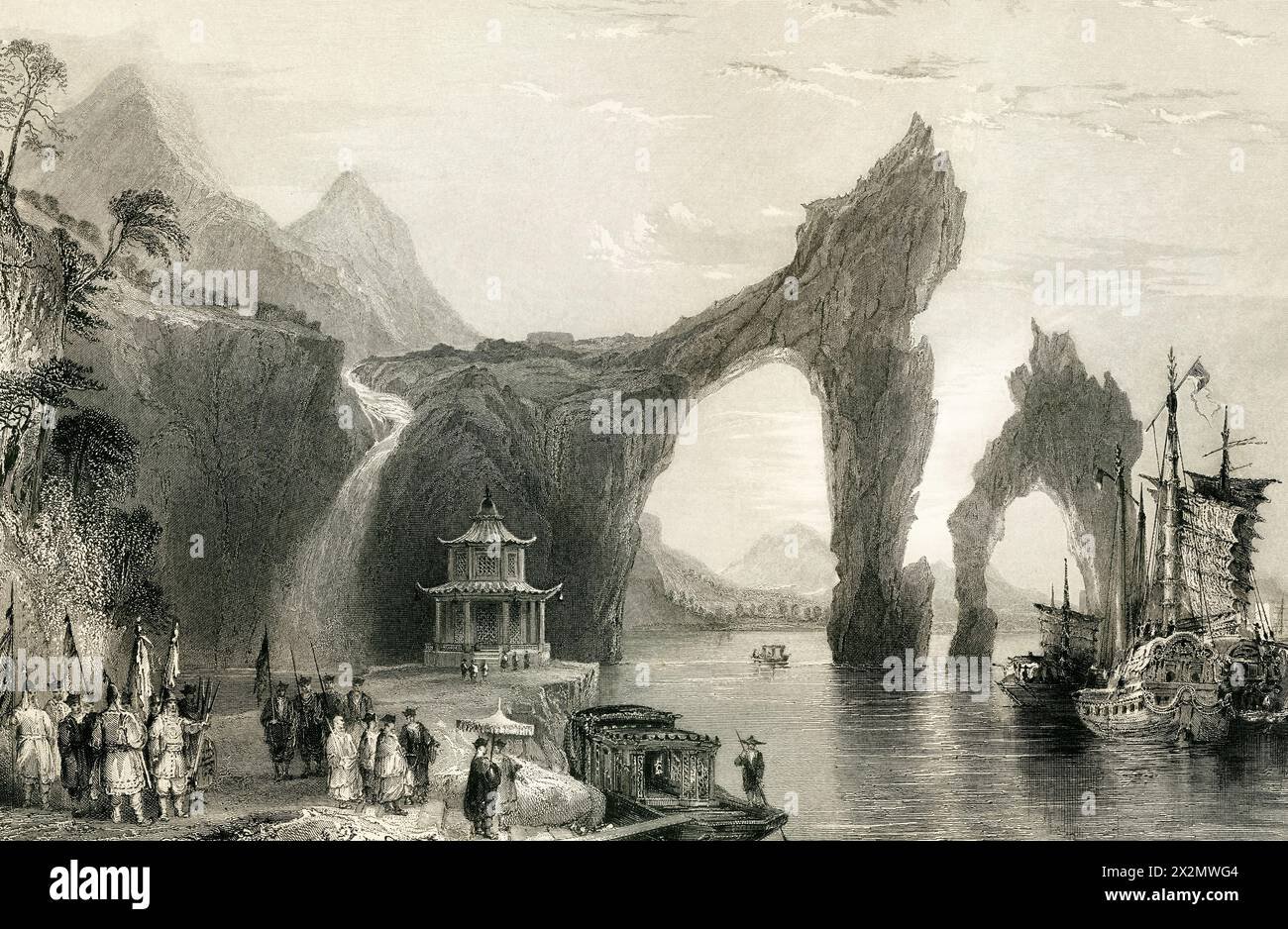
Cover Image: The Tung-Ting-Shan Lake Tai(Tai Hu)/ SuZhou JiangSu China / Drawn by T.Allom Engraved by J.Sands – ALAMY Image ID:2X2MWG4
*Dongting Mountain is located in the southwest of Suzhou City, Jiangsu Province, in the southeastern part of Lake Tai(Tai Hu). Dongting Mountain is not a single mountain but a name collectively referring to Dongting East Mountain and Dongting West Mountain. In this illustration, Dongting East Mountain is a peninsula extending into Lake Tai.
“Here in this grotto of the wave-worn shore,
They pass’d the tropic’s red meridian o’er;
Nor long the hours—they never paus’d o’er time,
Unbroken by the clock’s funereal chime,
Which deals the daily pittance of our span,
And points and mocks with iron laugh at man.”
The Island.
THE mountains that encircle and hang over Tae-hoo, or the Great Lake, to the southeast of the city of Nan-king, partake of the same picturesque, or rather grotesque character, which pervades the sublime scenery of the Seven-star-hills. Limestone is the predominant rock, and wherever this formation comes into immediate contact either with the waves of the sea, or the rapid current of the river, it yields readily to their action, allowing itself to be fashioned afresh, or worn still farther, by every new impression. Along the Yang-tze-keang and the Pei-ho, wherever the limestone forms the river’s boundary, caverns, picturesque promontories, detached rocks, and fertile islets, are of constant occurrence; and, in the mountain districts, where the violence of the falling torrent would overcome more obstinate material, the forms which the limestone receives are of endless variety. One of the most abrupt and precipitous hills in the Great Lake district, and situated about thirty miles north of the city of Soo-chou-foo, is the Tung-ting-shan, called also Lin-ûh-shan, and Paou-shan. Its circuit extends upwards of a hundred and fifty miles, and embraces within it the most beautiful and romantic scenery in China Proper. In the quaint phraseology of Chinese tourists we are told, that “on the north-west are forty-four hills, amongst which the most conspicuous in appearance, the most celebrated in history, is the Ma-t’sih; forty-one hills lie towards the east, above which the western Tung-ting raises his dark front to the clouds; and, of the forty-seven hills that are seen to the east precisely, the eastern Tung-ting is the loftiest and most massive.” Upon the charms of this latter district they have exhausted all the laudatory formulae of their language; and their admiration of the landscapes that are presented in the valleys of this group of hills, is almost boundless. The shade of its groves, the verdure of its valleys, the sequestered sites of its cottages, the prominent splendour of its palaces, the glittering radiance of its temples’ roofs, are said to distribute light like the stars of heaven, while the grand edifices themselves are arranged with all the regularity of chessmen. This mixture of the sublime and ridiculous, two sentiments more nearly allied than is generally imagined, pervade every object in the Chinese empire—their religion, laws, public and private customs—and must, therefore, be naturally expected in their descriptive writings; besides, in the Chinese landscape, the association has a real and constant existence.
While the natives delight in the beauties of Eastern Tung-ting, European taste will find more enjoyment in the repose of the picture to be seen amid the hollows of Tung-ting-shan. Undisturbed, and undisfigured by palaces of haughty mandarins, or shrines of idolatry placed at measured distances, the picturesque crests, and summits, and brows, and steeps, of this lone region, retain the vesture in which nature clothed them. Luxuriant woods wave on the loftiest cliffs, and the verdure in which each valley is clad presents a contrast the most striking, to the sterility of the crags that often overhang them. On the bank of some bright rivulet, and adjacent either to its entrance or its exit from a sheltered vale, a village is occasionally seen, in a position the most romantic that imagination can conjure up; and, so entire does the seclusion seem, that its peaceful inhabitants appear to form a separate and independent community. Particular eminences in the surrounding group are connected with the legendary lore of the mountaineers, and the Shang-fang, and the Hea-fang rocks, are beheld with an obvious degree of respect; while others, such as the Kung-lung-tow, Kin-yih-too, Choo-chow-shan, and Peao-meaou peaks, are almost equally venerated. Each form’s not merely a guide to the mountain-wanderer, an index in gauging the weather, a favourite haunt upon a festive day, but each also is involved in some tale of love, or horror, or superstition, that lends to it just such a beautiful interest, as the cloud that occasionally enwraps its pinnacle.
Of the ancient stories amid these hills, few traces can now be discovered by the searching eye of curiosity; the sacrificing mound, Meao-kung, and the rude wall that crosses the Lin-ûh ravine, will probably continue for ages undescribed by antiquaries, even tradition being silent as to the object or the authors of the latter. The mound was, no doubt, the scene of those inhuman massacres, that disgraced the character of Paganism much more than the stupid theories to which its votaries gave assent. Although, however, the antiquary and historian shall find no recompense for their enthusiastic labours in this wild region, the traveller, the man of taste, the admirer of nature will be delighted with its charms. The landscape here unites the most opposing characteristics; the most peaceful, dreamy scenery is rapidly succeeded by passages of sublimity; and the noise of the foaming cataract, and the brightness and the sparkling of its sunlit spray, are exchanged in an instant for the placid surface of the lake—the stillness that sleeps on it, and the darkness that reigns over it.
One of the most remarkable objects, or rather natural curiosities, of the Ting-tung-shan, is the Shih-kung-shan, or “Gentleman of the Rock,” a projection from the mountain-side into the Great Lake. Its resemblance to an old man standing in the water explains the origin of its appellation: and the mountaineers say, that it possesses the remarkable property, of never being completely revealed even when the waters are lowest, nor entirely immersed when they are highest. It is tolerably certain that the waters never will reach the summit of this singular rocky formation, an elevation of two hundred feet above the average height of the lake; and equally probable that their surface will never fall to the foot of the rock, a depth of about fifty feet. Pleasure-junks and trading-boats of large dimensions sail through the great opening of this natural arcade.On a little peninsula that projects into the rocky basin of a splendid cataract, and not many yards from the Shih-kung-shan, is one of those picturesque structures designated Tsoo-táng, or Halls of Ancestors. “Here, instead of idols, the niches are filled with tablets to the honour of those worthies of the district, who in their lifetime were distinguished by talent or virtue. Posthumous admission into one of these temples is a sort of minor apotheosis, and reflects great honour on the descendants, who become, of course, anxious to obtain such a distinction for their predecessors.” Mr. Allom has represented the barge of a mandarin, in waiting to receive the great man and his retinue, just returning from the Hall of Ancestors, where they are supposed to have been invoking and making offerings to the departed spirit of their illustrious progenitors. This introduction cannot fail to prove so far instructive, by conveying, in the most effective manner, a faithful representation of a practice at once ancient, grave, and interesting. Chinese historians inform us, that it was in the fastnesses of the Tung-ting-shan, and in the ravine of Lin-ûh, already mentioned, that Lin-wei was shut up by his son-in-law, Heu-leu, the prince of Woo; and where, after a detention of seventeen days by his unnatural relative, he consented, to surrender to him the book of Yeu, the great emperor of China, who dispersed the Chinese deluge. When this celebrated monarch was seated on the throne, he found leisure to compose a learned work, entitled “The true Doctrine of Mountains and Seas, in which are laid down their situations; also, all mines of gold, silver, and iron; besides all the varieties of fish produced in the many rivers.” Above the ravine rises the Seaou-hea, to the shaded glens of which the King of Woo retired to avoid the intense heat of summer in his dominions; and also the Ming-jui, or Bright Moon Walk, where he delighted to indulge himself by moonlight. The natural productions of this admired glen are numerous and beautiful, but none of them is more remarkable than a species of orange-tree, Kûrîh, which bears a bright scarlet flower, and blows in the depth of the hoar-frost of autumn. When the luxuriant pines that wave on the hills, the verdant bamboos that adorn the lower heights, the kéèn, a delicate aquatic plant that decorates the waters, and the sumptuous orange trees, are all in leaf and flower, the colouring of the landscape is unrivalled. The climate also is genial, and it is said, that all the flowers that enamel this vale uniformly regard the sun in their mode of expansion.
![[VOL IV] THE VALLEY OF CHUSAN](https://i0.wp.com/arclumiva.com/wp-content/uploads/2025/09/valley-of-ting-hai-chusan-dinghai-zhoushan-zhejiang-china-drawn-by-t-allom-engraved-by-s-bradshaw-2X55NJ3.jpg?resize=870%2C570&ssl=1)
![[VOL IV] ANCIENT BRIDGE, CHAPOO](https://i0.wp.com/arclumiva.com/wp-content/uploads/2025/09/ancient-bridge-chapoo-haiyan-jiaxing-zhejiang-china-drawn-by-t-allom-engraved-by-rsands-2X55NHK.jpg?resize=600%2C600&ssl=1)
![[VOL IV] HONG-KONG, FROM KOW-LOON](https://i0.wp.com/arclumiva.com/wp-content/uploads/2025/09/hong-kong-from-kow-loon-kowloon-hong-kong-china-drawn-by-t-allom-engraved-by-sfisher-2X55NGM.jpg?resize=600%2C600&ssl=1)
![[VOL IV] CHINESE BOATMAN ECONOMIZING TIME AND LABOUR, POO-KEOU](https://i0.wp.com/arclumiva.com/wp-content/uploads/2025/09/chinese-boatman-economizing-time-labour-poo-kow-nanjing-jiangsu-china-drawn-by-t-allom-engraved-by-awillmore-2X55NGD.jpg?resize=600%2C600&ssl=1)