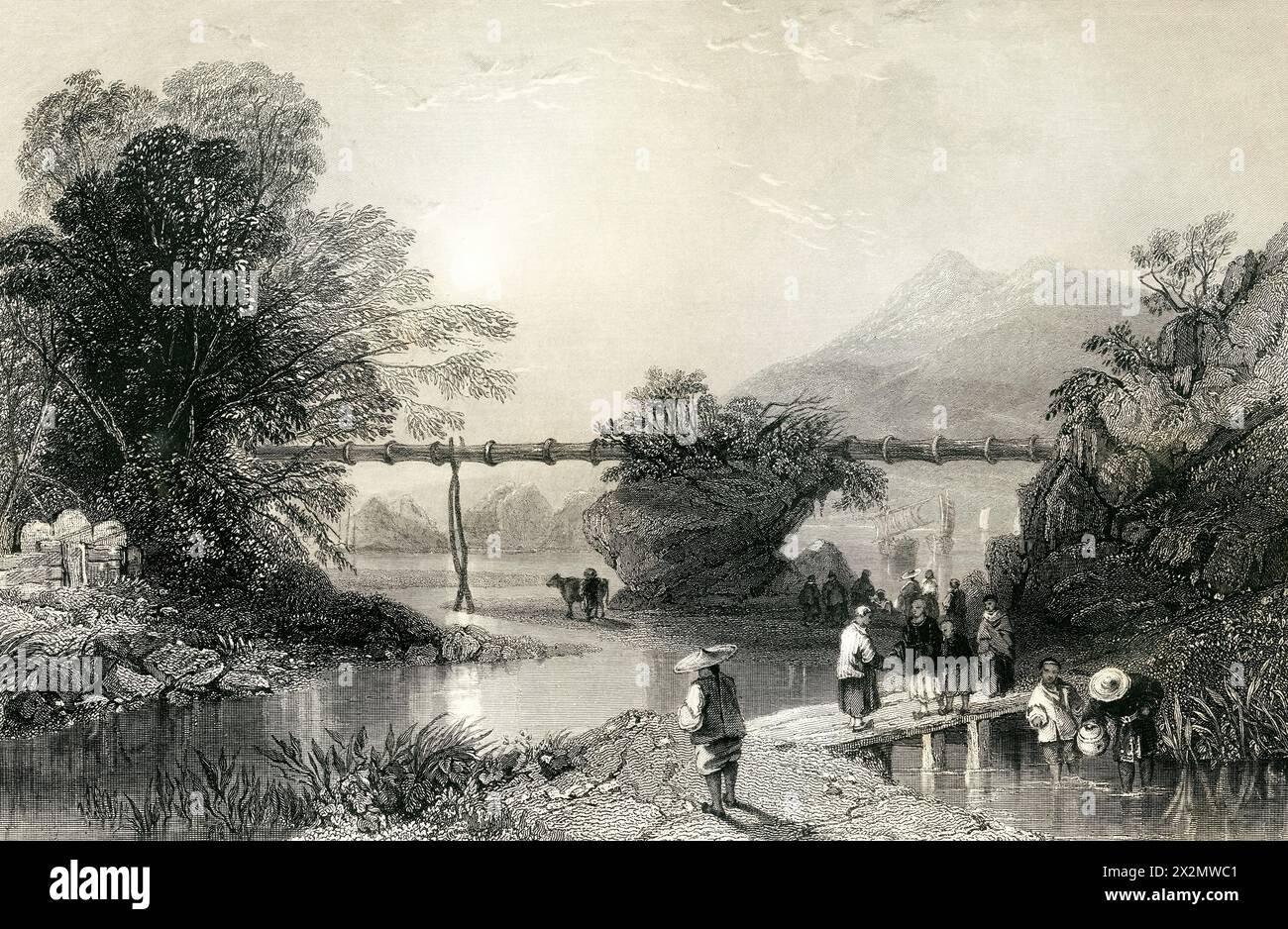
BAMBOO AQUEDUCT AT HONG-KONG
Cover Image: Bamboo Aqueduct at Hong-Kong / HongKong China / Drawn by Unknown Engraved by H.Adlard – ALAMY Image ID:2X2MWC1
*This illustration shows a water pipe made of bamboo, used for agricultural irrigation or drinking water.
Could painter wish for fairer scene
Than beetling cliffs ‘mid bowers of green,
With rivulet below;
Methinks a sylvan aqueduct,
This happy genius might instruct
Across the wave to throw.
C. J. C.
FEW areas so limited include so many scenes of sylvan beauty as the sunny island of Hong-Kong. The country immediately behind Queen’s town is peculiarly rich in romantic little glens, or in level tracts, adorned with masses of rock, in the fissures of which the noblest forest-trees have found sufficient soil for their support.
These wood-crowned crags rise abruptly from wide-spread rice-grounds that closely encircle them; so that every spot in the varied surface of the isle is either reduced beneath the government of industry, or made tributary to the beauty of the landscape. There is one narrow gorge, down which a rivulet sluggishly glides towards the open sea, overhung by huge blocks of granite, piled up to a considerable height, and with a regularity resembling a work of art. A clump of luxuriant trees bestows upon it an interest of the utmost value to the picture; but its bold, rugged, and obtrusive attitude, contrasts strongly and singularly with the cultivated character of the surrounding view. Habitual industry has so far tutored the mind of every Chinaman, that this barren rock which lends shelter and ornament to the landscape, is made still further useful as the pillar for sustaining a simple aqueduct, by which water is conveyed across the gorge, and employed in the irrigation of a distant arid plain, which otherwise would have been doomed to eternal sterility. This work of art is an example of the perseverance which characterizes Chinese industry, and the accustomed tact and aptitude with which it employs the most slender means, and appropriates the most unaccommodating materials.
The surface of Hong-Kong is undulating, the climate sultry, the soil shallow; of the first quality advantage has been taken by encouraging the growth of timber in the glens, within which the loveliest hamlets may be seen embosomed; the shade and the shelter of foliage mitigate, in some degree, the ferocity of a tropical sun; and industry, unequalled in any other kingdom, has converted a soil the most discouraging into one the most productive. It is for agricultural purposes, chiefly, that such primitive contrivances as the bamboo aqueduct are employed; but the value and utility of this tree are so universally understood in the eastern parts of Asia, that, even were other materials present, they very probably would be repudiated.
The bamboo-cane(*Bambusa Arundinacea.) is a very beautiful and a very elegant species of reed, hollow, round, straight, having knots on the stem at every ten or twelve inches, alternate branches, spear-shaped leaves, and sometimes attaining a height of forty feet. A native of the tropical regions of both hemispheres, it however attains more complete maturity in the east, where it is held in the highest estimation, and devoted to infinite uses. We have shown in the illustration that the stem, when bored, is made a conduit for water; the strongest serve as stakes to fence enclosures of every sort, and as poles for pavilions and doolies, in which masters are commonly carried by their servants in Oriental countries; the leaves are generally placed round the tea exported from China to Europe, and the young shoots of the tree have long served in Great Britain as favourite walking-sticks. The Malays preserve the young and tender shoots in vinegar and pepper, to be eaten with other food; and the Chinese steep the shoots and leaves in water, form them into a pulp, and from it manufacture paper. Baskets, boxes, and other articles made from this valuable reed, as well as a frame-work which enables the poorest with one of these bamboo life-preservers, or swimming apparatus; it consists of four reeds crossed horizontally, leaving a space in the middle for the body; it is slipped over the head, and secured by a cord to the waist. Simplicity is in all cases, but especially in those where presence of mind is likely to forsake us, of the first importance; and no floating apparatus can exceed the Chinese in this chief quality, so none comes better recommended to the mariner.
Nor do the advantages of the bamboo terminate with these now described. It is employed for masts, poles, sails, cables, rigging, and caulking; and, when insubordination makes its appearance amongst the crew, it is the instrument in the hand of power which cures or extinguishes it. Some only of its rural purposes have already noticed; it is also introduced to embellish the garden of the prince—to cover the cottage of the peasant; it is employed in carts, wheelbarrows, water-wheels, sacking to hold grain, and various other objects. Besides serving for aqueducts from hill to hill, bridges to continue land-transit are successfully and gracefully formed of this beautiful tree. In Java, “the bridges were universally constructed of bamboo, and covered with bamboo mats; their lightness and elasticity give them the appearance of being insecure; this is, however, by no means the case, unless suffered to remain too long without repair: the sudden and frequent swelling of the small streams, from heavy showers, would undermine bridges of more solid construction, which, from being of more expensive materials, would not be so readily or so attentively repaired.”( *Journal of an Embassy to China, by Sir Henry Ellis.) There are few objects or purposes to which Chinese industry cannot appropriate the bamboo-cane; its extensive application to architecture, agriculture, navigation, manufactures, and even as food, have been described; its appropriation to domestic conveniences is equally universal. Almost every article of furniture in a Chinese habitation is made from the bamboo: chairs, tables, screens, bedsteads, bedding, paper, various kitchen utensils; and it is by the friction of two pieces of cane that the servants obtain light or fire at early dawn in almost every house in China.
![[VOL IV] THE VALLEY OF CHUSAN](https://i0.wp.com/arclumiva.com/wp-content/uploads/2025/09/valley-of-ting-hai-chusan-dinghai-zhoushan-zhejiang-china-drawn-by-t-allom-engraved-by-s-bradshaw-2X55NJ3.jpg?resize=870%2C570&ssl=1)
![[VOL IV] ANCIENT BRIDGE, CHAPOO](https://i0.wp.com/arclumiva.com/wp-content/uploads/2025/09/ancient-bridge-chapoo-haiyan-jiaxing-zhejiang-china-drawn-by-t-allom-engraved-by-rsands-2X55NHK.jpg?resize=600%2C600&ssl=1)
![[VOL IV] HONG-KONG, FROM KOW-LOON](https://i0.wp.com/arclumiva.com/wp-content/uploads/2025/09/hong-kong-from-kow-loon-kowloon-hong-kong-china-drawn-by-t-allom-engraved-by-sfisher-2X55NGM.jpg?resize=600%2C600&ssl=1)
![[VOL IV] CHINESE BOATMAN ECONOMIZING TIME AND LABOUR, POO-KEOU](https://i0.wp.com/arclumiva.com/wp-content/uploads/2025/09/chinese-boatman-economizing-time-labour-poo-kow-nanjing-jiangsu-china-drawn-by-t-allom-engraved-by-awillmore-2X55NGD.jpg?resize=600%2C600&ssl=1)