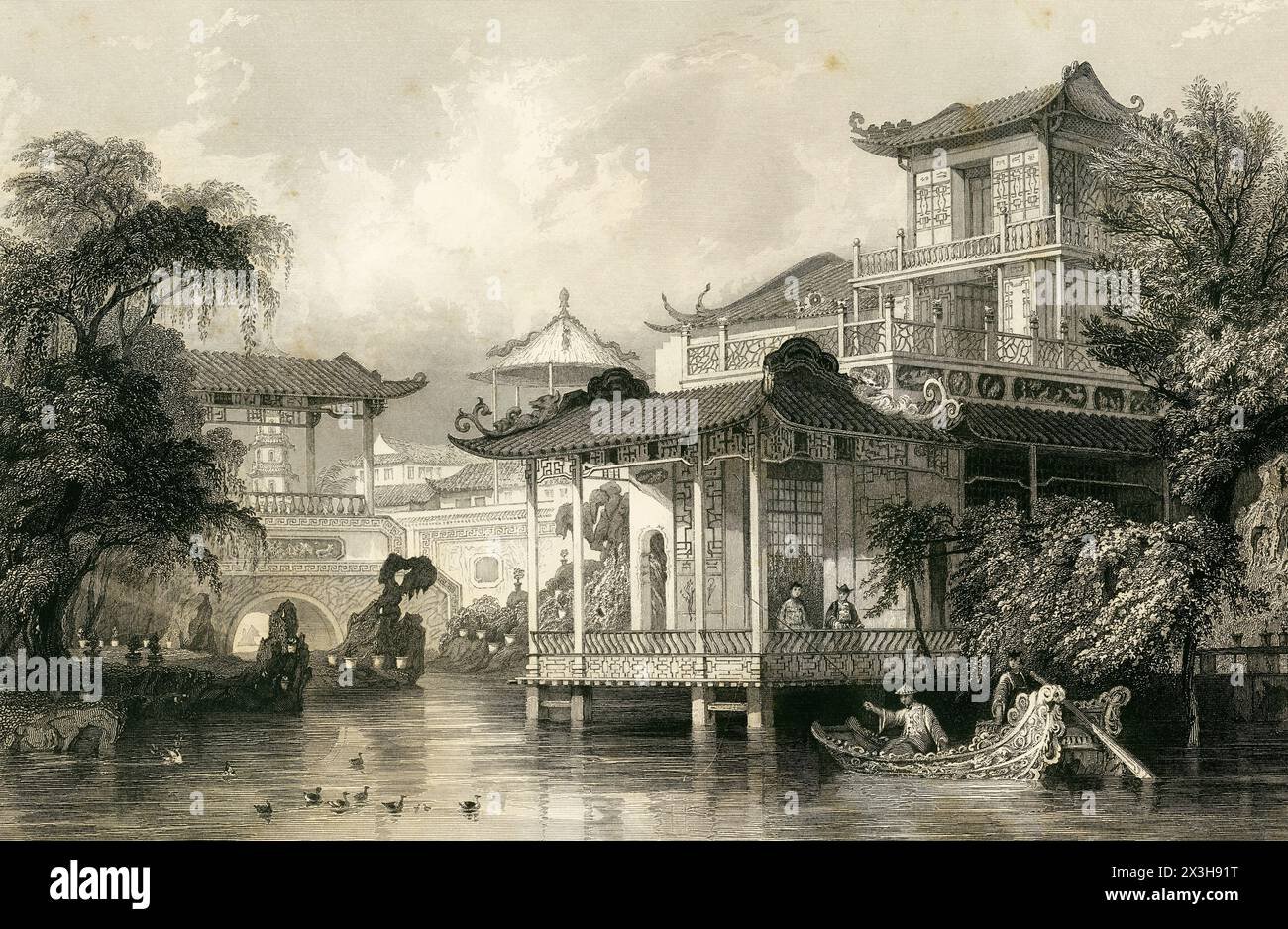
HOUSE OF A CHINESE MERCHANT, NEAR CANTON
Cover Image: House of a Chinese Merchant, Canton / GuangZhou GuangDong China / Drawn by T.Allom Engraved by W.H.Capone – ALAMY Image ID:2X3H91T
*Canseequa was a businessman from Hunan. After his death, this luxurious mansion was sold to pay off debts. / From a Drawing in the possession of Sir Geo. Staunton, Bart.
In the midst a fountain
Playeth day and night
Each small wave a mirror
For the changing light.L.E.L.
A CHINESE villa is an assemblage of buildings of various dimensions and designs, brought together without any apparent method, but displaying a fruitful imagination and an exhaustless fancy. The exterior parts are of that gloomy mural character, which prevails in all those countries where the softer sex are held in a mild but degrading imprisonment, by both parents and husbands; but within, the aspect at least, breathes pleasure and tranquillity. Although no regular order of art is discoverable in Chinese architecture, an analysis of its parts and comparison of examples will lead immediately to the detection of much system, and explain the necessity for what may appear superfluous. Having no idea of balancing materials according to those mathematical principles on which our great stone arches and sublime cathedrals are constructed, and continuing most preposterously to lay the roofing-beams in a position at right angles to that adopted by our builders, they do not venture to form a roof of great span or dimensions. Since then he cannot have a broad roof, the Chinaman is content with a house in proportion; and if he possesses wealth enough to maintain a large establishment, instead of one great mansion, he causes many small buildings to be erected within the space enclosed for the seclusion and enjoyment of his family. The necessary narrowness also of their roofs leaves no alternative, when a spacious apartment is required, but the introduction of pillars, hence the endless repetition of this feature in their houses. A veranda is sustained by pillars, behind which rises the main building, generally one story in height; but, when the grounds are so spacious that a second or third story may be raised, without affording the females of the family an opportunity of seeing or being seen, the addition is oft-times made. In the southern provinces, where the original of the accompanying view exists, the veranda is requisite for shade; the front of each apartment is open, save the intervention of a lattice-work gilt and brightly painted; and even in the upper rooms, the door is the only medium of light and air. The pillars which sustain the roof of every apartment are of pine wood, sometimes carved, more frequently plain but painted, and the rafters are covered with glazed tiles, of a concave form, and laid like roofing tiles in England; the bright blue colour of the bricks in the walls is relieved by scrolling and seaming of white paint, with an excellent effect. Whether Europeans view the Chinese roof as a beauty or deformity, it is upon this part of the building the architect expends his best abilities. The gables are grotesquely adorned with scroll-work and gilded dragons; nor is his license limited, unless by the variety of patterns which the flowers of the field, the birds of the air, and the beasts of the forest include. But the genius of the artist must extend beyond mere architectural decoration; he must also be able to introduce within the villa an artificial lake, adorn its banks with rock-work and pleasure-grounds, and associate the wildest productions of untamed nature with the most gorgeous creations of art. Bridges, canals, fountains, grottoes, rocks worn or wrought into the most extravagant forms, and either insulated in the water or starting from the flower-beds, are the usual objects with which villa pleasure-grounds are decorated; and the fancy that is displayed in their disposition, to foreigners must necessarily appear most admirable, and is amazingly difficult of successful imitation. “For rural retreats,” writes Mr. Lay, “I should delight to see the Chinese style adopted; since, with our crystal canals and our noble plantations, we should have a cluster of abodes that would appear as if they had been fitted up for wood-nymphs, and beings of a different day. But, a builder, in order to be qualified for such a work, must have travelled in China, and, by an instinctive enthusiasm, have imbibed Chinese feeling, otherwise he would not catch that freedom and that unbounded playfulness so conspicuous in all their edifices of any cost or extent.”
END OF VOL. I.
LONDON: H. FISHER, SON, AND CO., PRINTERS.
![[VOL IV] THE VALLEY OF CHUSAN](https://i0.wp.com/arclumiva.com/wp-content/uploads/2025/09/valley-of-ting-hai-chusan-dinghai-zhoushan-zhejiang-china-drawn-by-t-allom-engraved-by-s-bradshaw-2X55NJ3.jpg?resize=870%2C570&ssl=1)
![[VOL IV] ANCIENT BRIDGE, CHAPOO](https://i0.wp.com/arclumiva.com/wp-content/uploads/2025/09/ancient-bridge-chapoo-haiyan-jiaxing-zhejiang-china-drawn-by-t-allom-engraved-by-rsands-2X55NHK.jpg?resize=600%2C600&ssl=1)
![[VOL IV] HONG-KONG, FROM KOW-LOON](https://i0.wp.com/arclumiva.com/wp-content/uploads/2025/09/hong-kong-from-kow-loon-kowloon-hong-kong-china-drawn-by-t-allom-engraved-by-sfisher-2X55NGM.jpg?resize=600%2C600&ssl=1)
![[VOL IV] CHINESE BOATMAN ECONOMIZING TIME AND LABOUR, POO-KEOU](https://i0.wp.com/arclumiva.com/wp-content/uploads/2025/09/chinese-boatman-economizing-time-labour-poo-kow-nanjing-jiangsu-china-drawn-by-t-allom-engraved-by-awillmore-2X55NGD.jpg?resize=600%2C600&ssl=1)