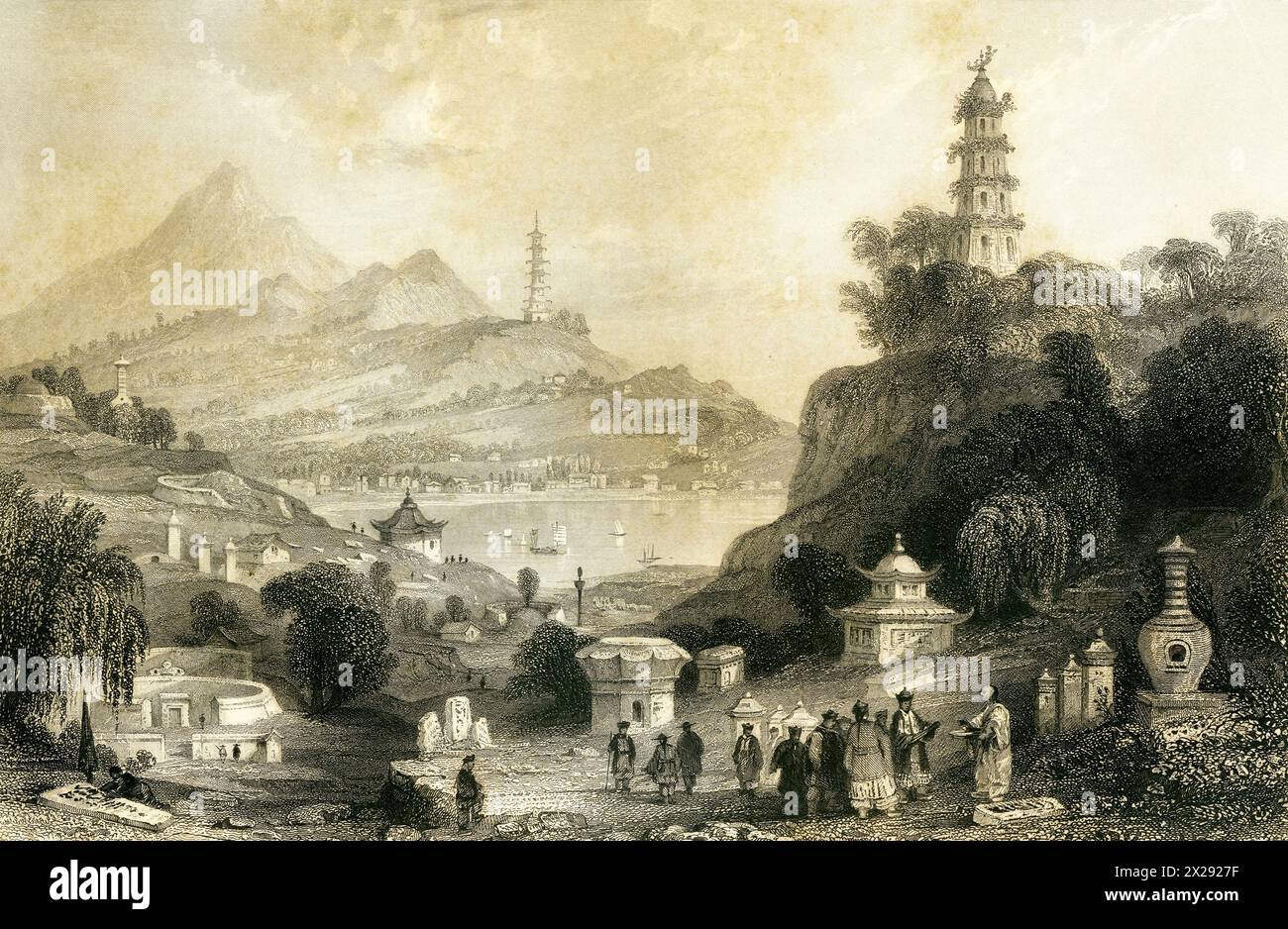
LAKE SEE-HOO. FROM THE VALE OF TOMBS.
Cover Image: Lake See-Hoo, and Temple of the Thundering Winds, from the Vale of Tombs West Lake / HangZhou ZheJiang China /Drawn by T.Allom Engraved by J.C.Bentley – ALAMY Image ID:2X2927F
*West Lake is situated to the east of Hangzhou city, surrounded by mountains on the other three sides. It is a national scenic area known for its clear waters, lush mountains, picturesque lake views, and rich historical, cultural, and artistic heritage. To this day, it is still adorned with historical sites and pleasant scenery.
Life’s link’d with death; our joys and griefs entwine;
E’en realms Celestial own the vulgar lot:
Yon bright green glades with laughing myriads shine,
In yon dark glen, there sires by millions rot;
Nor one flower lies See-Hoo’s fair margin blooms,
Though mirror’d on its wave The Vale of Tombs.C. J. C.
At a brief distance west from the great city of Hang-chow-foo, once the capital of Southern China, there is a lake celebrated for its extent, the clearness of its waters, and romantic character of the surrounding scenery. Its picturesque shores present a length of about twenty miles, broken at one time by a projecting promontory, at another by a retiring bay, while its ever-tranquil and transparent surface is adorned by two wooded islets, that float with gracefulness upon its smooth bright bosom. The little harbour of Lake See-Hoo, the ancient Ming-Shing, is connected with Hang-chow by a broad and well-paved causeway, yet insufficient, occasionally, for the accommodation of the numerous votaries of pleasure, that hasten to while away many an hour of their existence amidst the fascinating scenery of these elysian waters. The shores in general are fertile, and the attractions of the place having drawn hither the wealthy mandarins from the city, every spot of land, from the water’s edge to the foot of the bold mountains that form a noble amphitheatre around, is occupied by light aerial buildings, villas, palaces, temples, pleasure-grounds, and gardens, or in some other way appropriated to the ministration of luxury, or service of leisure. Like the Laguna of Venice, the face of these waters is crowded day and night with pleasure-boats of every grade; the most sumptuous yachts are generally followed by a floating kitchen in which the banquet is prepared, one always including those delicious silver eels, with which the clear waters of the See-Hoo abound; and, to Chinese society, from which all interchange of intellectual conversation is wholly rejected, the accompaniment of the floating cuisine is indispensably requisite.* Females are excluded from all participation in these enjoyments, their appearance in such expeditions being deemed derogatory to the privacy and separateness of the sexes in China—a circumstance that sufficiently demonstrates the degraded condition of society in the Celestial empire. How miserable and insipid that social state, where intellectual intercourse between the sexes is prohibited! What a censure is cast by man upon himself, by this prejudgment of wickedness or weakness in every created being! Here, then, the subtlest sentiments, the noblest feelings, the play of softer passions, are told strangers, and reason and philosophy comparatively fallen. In countries where the mental faculties have received that cultivation of which they are susceptible, whenever years shall have weakened the desire of joining the gay and glittering circle of female youth and beauty, or inclination have led to the severe exercises of the intellectual powers, numerous resources are still in reserve, and a relish for society will still be retained by those who value “the feast of reason and the flow of soul.” No such class, however, exists in China; there the tenor of conversation is mean, coarse, and grovelling, touching local grievances—the injustice of the mandarins—the stratagem of some wily merchant or fraudulent tradesman. Perhaps the female character might sustain a loss of purity and grace by more free admission into society so constituted—the Chinaman probably exercises a sound discretion in excluding the fair sex from such a vicious atmosphere.
In addition to the silent satisfaction derived from the motion of their gaudy barges on the tranquil surface of the See-Hoo, the pleasures of the table are immediately indulged in; smoking leads its aid, and the optimum saturates those who are too stolid by nature to share in the charms and the vices of the gaming-table.
While their faculties remain undimmed by the vicious habits of this extraordinary people, these voyagers in search of pleasure enjoy one of the richest prospects in Southern China. The banks that rise with such gentle acclivity, are decked all round with flowering water-lilies, the purple poppy enriches the lowest margin of the land, beyond which rise in gradual dignity the camphor, the tallow-tree, and the arbor-vitae. These are the fairest amongst the indigenous productions of this locality:—the changeable and Syrian roses, the common lilac, the paper mulberry, juniper, cotton-plant, balsams in great variety, amaranthus, and aquatic-lilies: the fruits known in Europe also abound, many of which, however, are of an inferior quality. These beautiful specimens of the vegetable kingdom adorn the deep fertile vales that run up between the mountains; and the contrast they form with the forest-trees around, give additional value to their properties—the bright green foliage of the camphor harmonizes happily with the purple of the tallow, while the deep sombre verdure of the tree-of-life waves in melancholy grandeur over both. Numerous tributary streams descend from the mountains, and on their noisy career in the bosom of the calm See-Hoo; and, the visitation of the wooded glens through which they roll their rapid waters, constitutes a favourite amusement of the various boating-parties from the city. The close sylvan scenery here is much enhanced by the introduction of a multitude of bridges, that span the cataracts in the most precipitous places: and the construction of these useful works forms a constant object of Chinese industry, although these people have yet to learn that their labours in this sort are perfectly puerile, and infinitely below those monuments which the engineers of Europe have raised to architectural science in England and in France. Amidst the continuous range of temples, monasteries of the Ho-Shuang, or priests of Fo, mansions, villas, groves, gardens, bridges, and tombs, that encircle this fairy lake, the ruins of an imperial palace may still be traced. Originally ten miles in circumference, and enclosed with lofty brick walls, it was separated into three great courts, all looking out upon the lake. It was in the outer court that the emperor Foo-tsung frequently entertained ten thousand guests at a banquet, which lasted ten successive days; the second court was surrounded by the imperial apartments; and the third division included those of the ladies of the palace, besides gardens, fish-ponds, preserves for game, and other appendages to a residence of such state and magnitude. This sumptuous palace ceased to be the residence of the imperial house in the year 1275, when the empress mother, and the emperor Kung-tsung, a minor, having surrendered themselves to the Mongol Tartars, were delivered to Kublai-Khan, by whom they were banished to his hereditary kingdom. There the ex-emperor died the following year, and with him the Sung dynasty in China.
On the shore adjacent to each usual pier or landing-place, covered carriages, furnished with silk curtains, richly embroidered cushions, and other costly decorations, are in attendance, to convey the visitors to public gardens, and places of amusement at a little distance from the water. On the islands also near the centre of the lake, spacious buildings are erected, containing splendid apartments and gorgeous open pavilions. There marriages are celebrated, and the most sumptuous entertainments given on those and other occasions of joyousness.
But in the midst of life we are in death; for, while sounds of mirth re-echo round the shores, and pleasure seems to have here secured an undisturbed and everlasting reign, the dark cypress flings its lengthened shadows on the water, suggesting to its navigators of to-day something reflective of to-morrow.
“Dark tree, still sad when others’ grief is fled,
The only constant mourner o’er the dead.”
Full in the view of the light bark, in pursuit of lighter hopes and pleasures, opens the sad “Vale of Tombs,” consecrated to those who once joined in
“That chase of idle hopes and fears,
Begun in folly, closed in tears,”
participating in all the gratifications and the vanities of beauty and of youth. Rude in many customs and habits, the Chinese are too refined and sentimental in the reverence they pay the dead. “It is a matter of doubt whether the Chinese do not carry their veneration of the dead to the point of adoration.” Embossed in trees, and on the brow of a hill that descends with undulations to the water, monuments, tombs, and fantastic sepulchral honors, of infinite variety in design, materials, and workmanship, extend over an area of some miles in circumference. Along the numerous vistas formed by the tall cypress, occur at intervals, little buildings of square form, painted blue, and raised on white colonnades. These are the melancholy resting-places of many generations, the upper chambers of so many monuments. Mandarins and persons of rank and power are distinguished, even in death, from their fellow-men, by mausoleums raised on semilunar terraces, having panels of black marble in front, as a ground for the better display of posthumous praises written on them in letters of gold. Sarcophagi, altar-tombs, slabs, pillars, pyramids, obelisks, towers, every species of form that taste can suggest, or experience execute, is found in the Vale of Tombs, and raised by feelings little understood in any other country of our globe. Where means have been wanting to supply more costly materials, affectionate zeal has substituted memorials of either earth or wood, but in no instance is the offering of some recording testimony neglected by the survivors. Besides the tree long consecrated to the home of the dead, there are others in this romantic cemetery that seem to mourn over the grave of departed worth, and shelter its melancholy grandeur from the idler’s gaze. These are the weeping willow and the lignum-vitae, whose slender pendent branches, agitated by the breeze, brush away the mouldering fragments from the surface of each tablet, and present the inscription fair and fresh-looking for ever. Oftentimes, and at night, numbers of torches are perceived passing and re-passing along the chief avenues of the Vale of Tombs, but they do not excite amongst the inhabitants of the vicinity any unusual apprehension. They are borne by visitors to the graves of friends, relations, or parents; on these occasions, particularly at the seasons of spring and autumn, the sepulchral offerings are sweet and sprinkled with tinsel-paper, slips of silk, flowers, and various ornaments; while a supper of rice, fowls, or roasted pigs, is offered to the shades of those who sleep beneath, and a libation of wine at the same time poured upon the ground. As it is a leading maxim of Chinese faith to pay a reverential obedience to parents, these spectacles of sepulchral sacrifices are most frequently witnessed at the grave of a father or mother. In other instances the duty is often deputed to a friend or proxy, but in this case neber.
It is not unusual to see a widow, who has just concluded her just concluded her prayer-offering beside the cold bed of her once-loved husband, before she has risen from the attitude of supplication, engaged most anxiously in throwing the “sticks of fate” on his gravestone. Predestination is an universal doctrine in China, and the ancient custom of choosing or rather throwing lots, is still preserved with the most persevering fidelity. On the altar of every temple stands a wooden cup, filled with a number of small sticks marked at the ends with certain characters. The consultant taking up the cup shakes it until one of the sticks falls out; then ascertaining its mark, in the page of the book of fate which is suspended from the altar, and to which the lot refers, reads his future fortune. Such also the sticks of fate which the widows carry to their lost lords’ tombs, and from which they endeavour to learn whether they are doomed to a social or a solitary life in future. It is a superstition of very early growth, that the possessor of a lucky lot has the power of reading his destiny aright.
“By him the pure events of lots are given;
By him the prophet speaks the will of Heaven.”
One of the most conspicuous, ancient, and interesting objects on the banks of the See-Hoo is the Luy-fung-ta, or “Temple of the Thundering Winds.” It stands on the summit of a promontory that advances into the waters, and is materially different in the style of its architecture from the temples or pagodas commonly seen in the Chinese empire. From its tapering form, massive structure, and peculiarity of design, little doubt exists as to its great antiquity, and native authorities assert that its foundation is coeval with the age of Confucius, upwards of two thousand years since. Four stories have survived this great section of time, and, owing to the mildness of the climate, they may resist the ravages of other thousands of years, although no roof remains to aid their preservation. Cornices of double curves mark and separate the stories, which are ornamented with circular-headed windows, with architraves and corbels of red sandstone, a yellow species being employed in the walls. To decorate such venerable landmarks of old time the mantle of ivy is wanting, in the deep green folds of which it might defy the very deity to whom it was first consecrated. But this parasite, which poetry has dignified by making an attribute of antiquity, is unknown in China—grass, and wild flowers, and lichens of various kinds, alone finding soil sufficient for their tiny roots in the rents and the fissures of the masonry. The testimony of European travellers extends back with certainty to the time of Marco Polo, in the thirteenth century, at which period the Temple of the Thundering Winds on Lake See-Hoo stood at the height of one hundred and twenty feet above the level of the surrounding soil; an altitude which has not since been lowered by a single cubit.
*The following description of a Chinese dinner is from the pen of Captain Laloge, of the French navy.
“The first course was laid out in a great number of saucers of painted porcelain, and consisted of various relishes in a cold state—salted earth-worms, prepared and dried, but so cut up that I fortunately did not know what they were till I swallowed them; salted or smoked fish and ham, both of them cut into extremely small slices; besides which there was what they called Japan leather, a sort of darkish skin, hard and tough with a strong and far from agreeable taste, which seemed to have been macerated in water for some time. All these et cetera, including among the number a liquor, which I recognized to be soy, made from a Japan bean, and long since adopted by the wine-drinkers of Europe, to revive their faded appetites or tastes, were used as Seasoning to a great number of stews, which were contained in bowls, and succeeded each other uninterruptedly. All the dishes, without exception, swam in soup. On one side figured pigeons’ eggs cooked in gravy, together with ducks and fowls, very small, and immersed in a dark-colored sauce; on the other, little balls made of sharks’ fins, eggs prepared by heat (of which both the smell and taste seemed to us equally repulsive), immense grubs, a peculiar kind of sea-fish, crabs, and pounded shrimps.
“Seated at the right of our excellent Ampstryn, I was the object of his whole attention, but nevertheless found myself considerably at a loss how to use the two little ivory sticks, tipped with silver, which, together with a knife that had a long, narrow, and thin blade, formed the whole of my eating apparatus. I had great difficulty in seizing my prey in the midst of these several bowls filled with gravy; in vain I tried to hold, in imitation of my hosts, this substitute for a fork between the thumb and the two first fingers of the right hand; for the chopsticks slipped aside every moment, leaving behind them the unhappy little morsel which I so much coveted. It is true that the master of the house came to the relief of my inexperience (by which he was much entertained) with his two instruments, the extremities of which a few moments before had touched a much more genuine age and the use of snuff and tobacco had cruelly chased its good looks. However, I contrived to eat, with tolerable propriety, a soup prepared with the edible birds’ nests, in which the Chinese are such epicures. The substance thus served up is reduced into very thin filaments, transparent as isinglass, and resembling vermicelli, with little or no taste.
“At first I was much puzzled to find out how, with our chopsticks, we should be able to taste of the various soups which composed the greater part of the dinner, and had already called to mind the fable of the Fox and Stork, when two Chinese entertainers, dipping at once into the bowl with the little saucer placed at the side of each guest, showed us how to get rid of the difficulty.
“To the young guests, naturally lively, such a crowd of novelties presented an inexhaustible list of pleasantry, and though unintelligible to the worthy Hong merchant and his brother, the jokes seemed to delight them not at all the less. The wine, in the mean time, circulated freely, and the toasts followed each other in rapid succession. This liquor, which to my taste was by no means agreeable, is always taken hot; and in this state it approaches pretty nearly to Madeira, in colour as well as in taste; but it is not easy to get this way, for in spite of the necessity of frequently attending to the invitations of my host, this wine did not in the least affect my head. We drank it in little gilt cups, having the shape of an antique vase, with which perfect workmanship, and kept constantly filled by attendants holding large silver vessels like coffee-pots.
“After all these good things served upon the dinner, of which I gave me great pleasure to see the last, succeeded the second course, which was preceded by a little ceremony, of which the object seemed to be a trial of the guests’ appetites. Upon the edges of four bowls arranged in a square, three others were placed, filled with stews, and surmounted by an eighth, which thus formed the summit of a pyramid; and the custom is to touch none of these, although invited by the host. On the refusal of the party the whole disappeared, and the table was covered with articles in pastry and sugar, in the midst of which was a salad composed of the tender shoots of the bamboo, and some watery preparations that exhaled a most disagreeable odour.
“Up to this point, the relishes of which I first spoke had been the sole accompaniment of all the successive ragouts; they still served to season the bowls of plain rice, which the attendants now, for the first time, placed before each of the guests: it must be remembered that this was a formal dinner—rice forms a much more integral part of an every-day meal.
“I regarded with an air of considerable embarrassment the two little sticks, which, notwithstanding my experience acquired since the commencement of the repast, it seemed very doubtful whether I should be able to take my rice, grain by grain, according to the belief of Europeans regarding the Chinese custom. I therefore waited until my host should begin, to follow his example, foreseeing that, on this new occasion, some fresh discovery would serve to relieve us from the truly ludicrous embarrassment which we all displayed; this was done by plunging their chopsticks into the bowls of rice, held up to the mouth, which was opened to its full extent, and thus easily shovelling in the rice, not by grains, but by handfuls.”
![[VOL IV] THE VALLEY OF CHUSAN](https://i0.wp.com/arclumiva.com/wp-content/uploads/2025/09/valley-of-ting-hai-chusan-dinghai-zhoushan-zhejiang-china-drawn-by-t-allom-engraved-by-s-bradshaw-2X55NJ3.jpg?resize=870%2C570&ssl=1)
![[VOL IV] ANCIENT BRIDGE, CHAPOO](https://i0.wp.com/arclumiva.com/wp-content/uploads/2025/09/ancient-bridge-chapoo-haiyan-jiaxing-zhejiang-china-drawn-by-t-allom-engraved-by-rsands-2X55NHK.jpg?resize=600%2C600&ssl=1)
![[VOL IV] HONG-KONG, FROM KOW-LOON](https://i0.wp.com/arclumiva.com/wp-content/uploads/2025/09/hong-kong-from-kow-loon-kowloon-hong-kong-china-drawn-by-t-allom-engraved-by-sfisher-2X55NGM.jpg?resize=600%2C600&ssl=1)
![[VOL IV] CHINESE BOATMAN ECONOMIZING TIME AND LABOUR, POO-KEOU](https://i0.wp.com/arclumiva.com/wp-content/uploads/2025/09/chinese-boatman-economizing-time-labour-poo-kow-nanjing-jiangsu-china-drawn-by-t-allom-engraved-by-awillmore-2X55NGD.jpg?resize=600%2C600&ssl=1)