MILITARY STATION AT CHO-KIEN
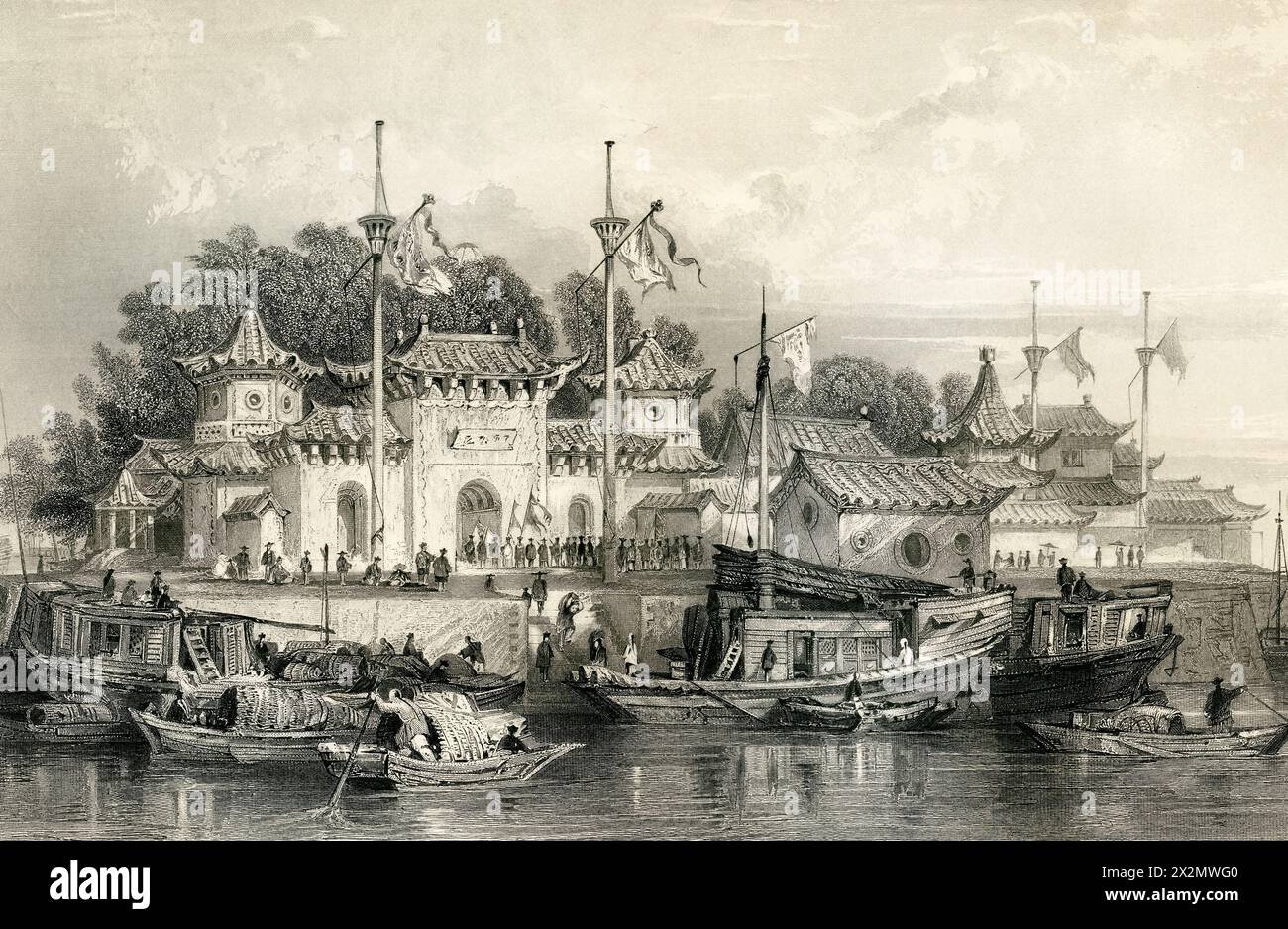
Cover Image: Military Station near the City of Chokian / China / Drawn by T.Allom Engraved by E.Brandard – ALAMY Image ID:2X2MWG0
*This illustration depicts a scene alongside the canal.
” That never set a squadron in the field,
Nor the division of a battle knows,
More than a spinster, –
Mere prattle without practice
Is all his soldiership.”
SHAKSPERE.
ON every navigable river, but especially on the Pei-ho, the northern feeder of the Imperial Canal, military stations are established; the magnitude or strength of each being proportioned to the populousness or traffic of the district. As rivers are the chief highways of China, these posts are analogous to our police-stations; and the troops lodged in them are not the regular military, but rather the local militia. Besides the maintenance of tranquillity, and enforcing the orders of government, the river-guard have other duties to perform, such as the exaction of tolls, preservation of unimpeded water-way, and care of the sluices. The accompanying view represents a station-house of the first class, where a guard of at least one hundred men is always maintained: whenever an imperial cortège, or the train of a mandarin of distinction, passes, it is their duty to give a military salute. This ceremony consists in the discharge of three short petards, kept for this purpose alone: they are fixed perpendicularly in the ground, a little powder is first put into the barrel, over which sand and earth are tightly rammed. When the ceremony is completed, the gorgeous dresses of the soldiers, including embroidered petticoats and satin boots, together with their arms and accoutrements, are restored to the armoury in the station-house, and there preserved until another public occasion shall demand another distribution. As for the soldiers themselves, if they be only the Chinese military police, the greater part resume their agricultural or manufacturing employments, retaining also their pay, which is equivalent to three-pence a day of our money. This little stipend, and some additional value which attaches to office in every country, prove so attractive, that the duty of a soldier is taken, rather than put upon the people—solicitation is used to obtain, instead of conscription to enforce the service.
The military pavilion at Cho-kien is always a picturesque object, and frequently presents a scene of much bustle and animation. The vicinity of a large and navigable river, covered with a multitude of boats, and of various kinds, including junks, flower-boats, sampans, pleasure-barges, chop-boats, and others, must necessarily present an endless variety of scene and incident. Here are continued arrivals and departures, frequent disputes between the junkmen and trackers, and occasional punishments of criminals from the surrounding country; for, although the imperial power is so overwhelming, that neighbouring states can offer it no serious resistance, amongst the Chinese themselves, and in the very heart of the empire, convulsions, insurrections, conspiracies, and tumults, are of hourly occurrence, and give ample employment to the standing police and the regular Tartar soldiers. In front of the pavilion are hoisted the national flags, yellow, white, red, and blue, or one of these colours bordered with the other if the garrison consist entirely of Tartar troops; but, green banners with red borders, or the reverse, in the centre of which is displayed the national gilt dragon, if of Chinese.
As there is a difference between the pay of the Tartar and Chinese soldiers, that is, between the regular and militia corps, so is there a distinction also in their dress and accoutrements. The Tartars, or Tigers of War, as the missionaries have styled them, are dressed in yellow—the imperial colour—striped in imitation of a tiger’s hide, and having ears also to their caps. This cap or head-gear, is made of split bamboo, so compactly interwoven as to be capable of resisting a violent blow; the shield is of the same material and workmanship, and the head or entire image of some monster is generally painted on it, to terrify, if not like that of Medusa, to petrify the foe. Every fifth soldier, when the line is formed, has a silk flag at his back, resting in a socket, and as these flutter in the breeze they present a very gay appearance. It may be asked, why repeat these flags so often, or why not furnish every man with one, as we do in lancer regiments? The Chinese have a peculiar fondness for the number five, derived from the structure of the hand; hence their soldiers are in companies of five, ten of which, a multiple of five, form a company of fifty, another multiple; eight of these companies compose a battalion, and each company has five principal, and five subaltern officers. On each soldier’s breast, that is, each man of the regular army, the word valour (yoong) is always inscribed; “which,” says a British officer who served in the late war with China, “might be all very well, if the same word were not also displayed on the same individual’s back, when he fled, and who, agreeably to the advice of Hudibras, reserved his courage for some future occasion.” The military police, who are always Chinese, wear around their necks and over their breasts, a badge inscribed with the words “robustious citizens.” The uniform of the latter is much less costly and regular than that of the Tiger of War, consisting principally of a blue jacket trimmed with red, or the reverse, over a long clumsy petticoat. The head is protected by a conical cap of bamboo, but sometimes of cloth and silk; while the Tiger is defended by a quilted toga of cloth, studded with metal buttons, and an iron helmet terminating in the shape of an inverted funnel, from the top of which a bunch of horse-hair depends. Their arms are as contemptible, as their uniform is unwieldy and inconvenient; they consist of match-locks, supported on cross sticks, which are generally in bad order, and badly supplied with flints, now substituted for matches, this valuable description of stone not being found in any part of China; there are no chalk-cliffs in the empire, so there is no matrix for the support and supply of gun-flints, and as to detonating caps, they are yet unknown to the military men in Cathay. It is said that their swords or scimiters are equal to the best from Spain, although their appearance is extremely rude and unfinished. In the late war, however, Commissioner Lin attempted an improvement in this department, by the introduction of double-sworded men, from which he calculated upon the annihilation of the English intruders. “These twin swords, when in the scabbard, appear as one thick clumsy weapon, about two feet in length; the guard for the hand continuing straight, rather beyond the ‘fort’ of the sword-turn towards the point, forming a hook about two inches long. When in use, the thumb of each hand is passed under this hook, on which the sword hangs, until a twist of the wrist brings the gripe within the grasp of the swordsman. Clashing and beating them together, and cutting the air in every direction, accompanying the action with abuse, noisy shouts, and hideous grimaces, these dread heroes advance, increasing their gesticulations, and distortions of visage, as they approach the enemy, when they expect the foe to become alarmed and fly before them.”(* Narrative of the Expedition to China, by Commander J. E. Bingham, R.N.)It does not appear, however, that this ridiculous introduction was entirely the invention of Lin, we only know that he was first became acquainted with its inefficacy and existence in our opposition to the force under his control.
It is not the sword and shield, or the ill-conditioned matchlock, that the Tartar soldier places his best reliance, but on that weapon to which he has been accustomed from childhood, and which is associated with his name and history from time immemorial. The Tartar’s bow is made of an elastic wood, cased in horn, and having a string of silken thread strongly twisted, and his arrows are straight, well finished, and armed at the points with a shank and spear of steel. It is usual to estimate the strength of the bow by the weight required to bend it, and the test applied in China is from eighty to ninety pounds. The string is placed behind an agate ring upon the right thumb, the first joint of which is bent forward, and kept in that position by pressing the middle joint of the fore-finger upon it. In this situation the string is drawn till the left arm is extended, and the right hand passes the right ear; the fore-finger is then withdrawn from the thumb, which instantly forces the string from the agate ring, and discharges the arrow with considerable force.
The dress or uniform of a Chinese army is inconvenient, and the weapons they employ entirely behind the age we live in; sufficient to repress sedition, secure internal peace, and aid in the execution of the wishes of government, these forces and weapons must still prove wholly unequal to the military discipline and means of destruction employed by the civilized nations of Europe; and the strength of Hercules, and the courage of Achilles, in such a contest, would have only ended in the ruin of their possessors. The Chinese, in fact, are wholly ignorant of the art of war, having, during many centuries, cultivated uninterruptedly the arts of peace, and these are the reciprocals of each other; while industry and happiness increased, despotism and military science retrograded. Chinese soldiers seem much better adapted to grace a dramatic pageant than to defend an invaded empire; and if any one shall be disposed to question the impartiality of this statement, let him only imagine the extravagance, if not the degradation, attendant on the ceremony of saluting an officer of rank—”when the whole regiment in line, clap their hands to their sides, fall on their knees, and utter a dismal howl; while a full band of music strikes out the air of etiquette.”
The strength of the imperial army, including the standing police or local militia, is estimated at 740,000 effective men, of whom 400,000 are cavalry, besides 30,000 seamen, who find employment in the navy. It is more correct, however, to state, that the Tartar corps, eight in number, and distinguished by the green standard, consist of 80,000 men, and constitute the only real regular army for defence or offence; but that upwards of 700,000 troops receive pay from the emperor as an enrolled and affianced soldiery. The commander-in-chief of this vast army is always a Tartar, but a Chinaman may hold the next rank to him. From the Tseang-kun to the lowest of his men, the discipline of the bastinado, and even of the cangue, or moveable pillory, is applicable; and, if the military code which is preserved in the imperial archives were strictly enforced, there is no reason to imagine that a brave, hardy, and persevering people, like the Chinese, would prove unequal in military prowess to any nation upon earth.
![[VOL IV] THE VALLEY OF CHUSAN](https://i0.wp.com/arclumiva.com/wp-content/uploads/2025/09/valley-of-ting-hai-chusan-dinghai-zhoushan-zhejiang-china-drawn-by-t-allom-engraved-by-s-bradshaw-2X55NJ3.jpg?resize=870%2C570&ssl=1)
![[VOL IV] ANCIENT BRIDGE, CHAPOO](https://i0.wp.com/arclumiva.com/wp-content/uploads/2025/09/ancient-bridge-chapoo-haiyan-jiaxing-zhejiang-china-drawn-by-t-allom-engraved-by-rsands-2X55NHK.jpg?resize=600%2C600&ssl=1)
![[VOL IV] HONG-KONG, FROM KOW-LOON](https://i0.wp.com/arclumiva.com/wp-content/uploads/2025/09/hong-kong-from-kow-loon-kowloon-hong-kong-china-drawn-by-t-allom-engraved-by-sfisher-2X55NGM.jpg?resize=600%2C600&ssl=1)
![[VOL IV] CHINESE BOATMAN ECONOMIZING TIME AND LABOUR, POO-KEOU](https://i0.wp.com/arclumiva.com/wp-content/uploads/2025/09/chinese-boatman-economizing-time-labour-poo-kow-nanjing-jiangsu-china-drawn-by-t-allom-engraved-by-awillmore-2X55NGD.jpg?resize=600%2C600&ssl=1)