RAREE-SHOW AT LIN-SIN-CHOO
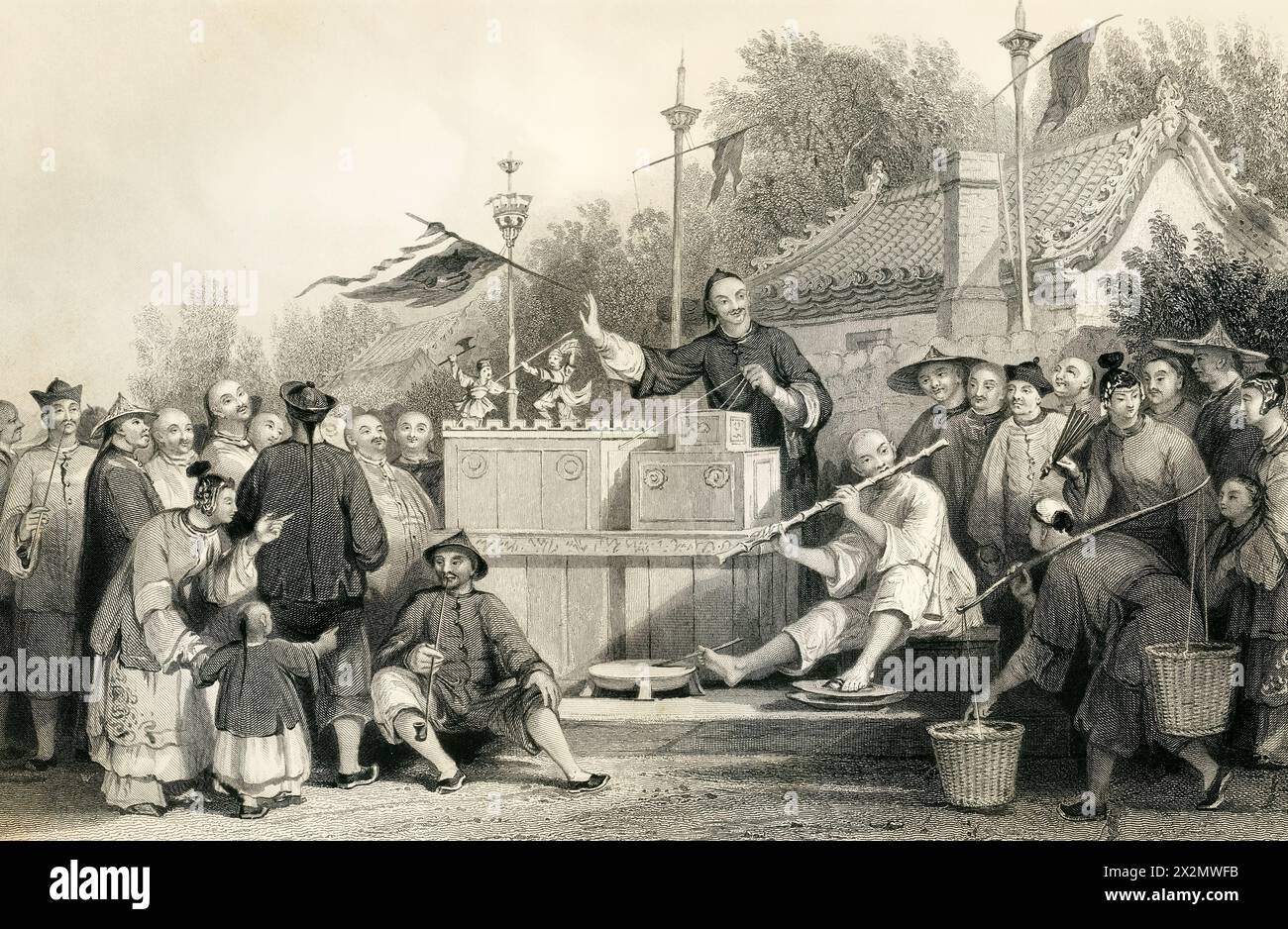
Cover Image: Raree Show at Lin-Sin-Choo / LiaoCheng Shandong China / Drawn by T.Allom Engraved by G.Paterson – ALAMY Image ID:2X2MWFB
*Lin-Sin-Choo(Lin Qing Zhou)is located within the boundaries of today’s Liaocheng City in Shandong Province. This illustration shows a scene of street performers.
“Why is a handsome wife adored
By every coxcomb but her lord? –
From yonder puppets’na inquire,
Who wisely hides his wood and wire.”SWIFT
THE IMPERIAL CANALcommences, correctly speaking, at the city of Lin-sin-choo,(* Also written Lintsinchow.)in the province of Shan-tung; but, a propensity to exaggeration has induced the Chinese to include, in their representation of its extent, all the navigable rivers, which form a large portion of this great line of inland navigation. They pretend that it originates northward at Tien-sing on the river Pei-ho, and terminates southward at Hang-chow-foo in the province of Kiang-nan, which is not exactly the case: for the north terminus of the Cha-ho, or “river of flood-gates,” is not higher up than Lin-sin-choo. There the Pei-ho communicates with the canal openly, and evenly, without lock or dam;—and, along its course, which, however, is improperly described as a reach of the canal, the gentle current is arrested at intervals by flood-gates of native invention; they consist of two stone piers or jetties, about thirty feet apart, between which loose planks are let down in guiding grooves. These partitions seldom occasion a difference of a foot in the level of the water, and, to protect and manage them, a strong body of soldiers, or military police, is always stationed near the banks. Their guard-houses are amongst the most interesting objects along the line of this sluggish river, which traverses a flat, swampy, and rather thinly-peopled country. The vicinity of Lin-sin-choo has long been the rendezvous of carriers, who here transfer their burdens from one description of junk to another,—exchange commodities, engage and dismiss trackers, or transact other matters, necessarily connected with an entrepôt so centrally situated for inland trade. Seated at the head of the Imperial Canal, the great commercial highway of the empire, this city has acquired and still possesses a degree of veneration; and, it is the opinion of European travellers that the splendid pagoda of nine stories, which here adorns the landscape, was erected to mark the entrance of the Cha-ho, and perhaps commemorate its opening. In this light it may be viewed as a beautiful monument of a great and useful public undertaking; but if its destination be analogous to those of all similar structures in this land of polytheism, it deserves like them to share the universal contempt of many creeds. In form, the pagoda of Lin-sin-choo is octagonal and pyramidal; the basement story is of porphyritic granite, the upper, of glazed bricks beautifully and exactly fitted together. A winding staircase of one hundred and eighty-three steps conducts to the highest stage, from whence a very extensive prospect is obtained over the meeting of the waters, of the admirable site at their conflux, and of the crowded streets of Lin-sin-choo. Although from this height, a hundred and fifty feet at least above the level of the Pei-ho, the city seems almost at the tower’s foot, yet the private dwellings and even the public buildings are scarcely discoverable, from the extraordinary number of gardens, shrubberies, and planted pleasure-grounds within the city walls. In the year 1793, this beautiful work of art, the tapering tower, was in a state of dilapidation, nor did any traces then exist of its ever having been dedicated to the idolatrous worship of the nation; but since that period it has been completely restored and beautified. The roof of each story projects, and on the cornice of the lowest are inscribed in legible letters, the dedicatory words, “O-me-to-fo,” which are also to be found in all the temples of Buddha, the projections themselves being richly carved and decorated. A niche in the basement story is filled with an image of Buddhist worship of recent admission, and another is preserved in the highest apartment. The roof, which is also profusely ornamented, is either of cast-iron or bell-metal.
The concourse of merchants, dealers, travellers, bargemen, in addition to the civic functionaries, and the number of retainers necessary to preserve order amongst a population that is constantly in transitu, present peculiar attractions to strolling players, jugglers, and mountebanks of all descriptions; and the streets of Lin-sin-choo are continually animated by the performances of these ministers of mirth. It is no inconsiderable addition to the accompanying picture of Chinese customs, to place the showman and the delighted group around him, in one of the sylvan avenues of this rus in urbe, an advantage of which Mr. Allom has most happily availed himself, combining, consequently, the singular scenery of these very primitive streets with the habits of their migratory population.
It has been elsewhere observed, that although the Chinese have stopped, and been contented with a limited degree of excellence, finish, or perfection in many admirable inventions, still mankind are indebted to them for the origin of those very discoveries which they have themselves neglected, or wanted ability to improve. The mariner’s compass, gunpowder, and the art of printing, most probably originated in China,although imitators now derive more advantage from these discoveries than the authors themselves; and it is from this ancient empire that the very amusements of the humbler classes, both on the European continent and in Great Britain, have obviously been derived. The Ombres Chinoises disclose their country sufficiently by their name; and in the automatic figures of the Chinese raree-showmen are recognized the originals of the Fantecchini of Italy, and the Punch and Judy of more western countries. The figures of the Italian puppet-show derive their motions from springs attached to their legs, arms, and heads, the mode in which the dancing puppets of the Chinese are also worked, so that the identity of these two species of exhibition is complete. Between the English showman and his Eastern prototype, the resemblance is, if possible, more exact; and the words in which a Chinese author has described the operation require no change in their application to the performances at Bartholomew Fair. “The Chinese showman produces a succession of pictures to the perspective glass, by means of small strings, and relates a story and description of each subject as he presents it.” This account applies to the old-fashioned exhibition of the camera-obscura, which was to be seen, at one period, at all the public crossings in the streets of London.
It has been shown that the Fantochini and camera-obscuras are of Chinese origin, it remains still to be proved that it is to the same ingenious people England owes the popular exhibition of Punch, although it has received considerable alteration in its passage to us through Italy and Central Europe. “The Chinese Punch is performed by a person mounted on a stool, and concealed, as far as the ankle, with blue drapery. On his head rests a box or stage, such as Punchinello is generally performed in, and the figures are put in motion by the insertion of the manager’s fingers into their arms. This is the principle, the practice being somewhat altered, on which the celebrated Punch and Judy show is now conducted.
Both in England and in China, music forms a necessary part of the entertainment; nor is it a matter unattended with difficulty to decide which country, on this ground, is entitled to pre-eminence. Mr. Allom’s musician at Lin-sin-choo seems to be very fully occupied, and resolutely bent upon diverting the attention of the spectators from those movements of the mechanism, or from that sleight-of-hand which might detract from the general effect of the exhibition. To his left foot a cymbal is attached, which he strikes against his fellow fixed securely on the ground, with his right foot he plays upon a drum or tambour, while both hands are employed in the management of a hwang-teih, or flute, occasionally exchanged for the heang-teih, or clarionet, that is suspended at his side. This immense “unkeyed instrument” is simply a bamboo cane, having a mouth-hole at some distance from the end, a second aperture, covered with the inner rind or film of a species of reed; two inches lower down, besides ten ventiges, six of which are effective and equidistant. The tone of the bamboo flute is both sweet and powerful, and the harmony of the musician’s little band, in general, agreeable. In this instance, however, the performer has not exceeded in dexterity some of our own itinerant musicians. There was an attendant upon an automaton collection, exhibited at Brecon in South Wales, in the year 1842, who played an air on the pandeanpipes, and accompanied it by the clashing of cymbals attached to his knees, by the beating of a large drum with a stick fastened by a strap above one knee, while from the same leg a tightened cord extended to the upright handle of a crescent and bells, firmly fixed in the floor of the stage; his hands were engaged with a large tambarine, and a triangle suspended from one arm was touched by a plectrum made fast to the other. The author of a satirical poem called “The Familiar Epistles,” thus ridicules the powers of a gentleman who led the band of one of our theatrical orchestras—
” Cooke plays eight instruments together,
Or croaking frogs foretell bad weather.”
The Cambrian musician directed six instruments, to the obvious delight of his auditors, and, under happier circumstances, it is not improbable he might have employed a larger number, without materially deteriorating the quality of his music.
The spectators and auditors at the raree-show in Lin-sin-choo belong to the industrious and humbler classes, to whom the rice-seller presents himself, and amongst whom not only do the mother and child very naturally make their appearance, but the less interesting character of the smoking lounger, who declines all further labour until necessity shall compel him to accept it.
Puppet-shows, the probable original of the regular drama, are here not the peculiar entertainment of the lower or uneducated classes, on the contrary, they are patronized by the imperial household, and are included in the court amusements. “We were also entertained with a Chinese puppet-show, which differs little from an English one. There are a distressed princess confined in a castle, and a knight-errant, who, after fighting wild beasts and dragons, sets her at liberty and marries her, weddings, feasts, jousts and tournaments. Besides these, there was also a comic drama, in which some personages not unlike Punch and Judy, Bandemere, and Scaramouch, performed capital parts. This puppet-show, we were told, properly belonged to the ladies’ apartments, but was sent out as a particular compliment to entertain us.” (*Barrow’s Visit to the Imperial Palace at Sehol in Tartary. )This fact is neither surprising nor peculiar; for it is but just a century ago since puppet-shows were so much in fashion in London, that the public journals complained of the celebrated singer Noceini, and the opera, being almost deserted for “Punch and his Wife.”
It would appear sufficiently evident, since the antiquity of imperial China and of its institutions is indisputable, and since the memorable bigotry of that people must always have militated against the adoption of foreign customs,—and since puppet-shows exactly resembling the Fantoccini of Italy, and the Punchinello of England, were found there in familiar acceptance by the first European travellers, that China is the native country of these childish amusements. However; or whenever, they may have emigrated might perhaps be determined without much difficulty, but it is certainly known that England borrowed them from the southern countries of Europe. The history of Punch, and of his extraordinary ubiquity, may lay the foundation for more serious reflections upon the prevailing passions of mankind, in all countries and ages, his fame appears to have extended from the earliest periods of authentic history to these times present, and over the round world “from China to Peru.” The vulgar-sounding name by which this famous actor is known in England is a corruption of Pulcinella, an Italian mask, first introduced there by Silvio Fiorillo, which some derive from pulcinelli, “chickens,” because the first performer of this character in Italy was a misshapen peasant of Sorrento, who used to bring chickens for sale to the market of Naples; while others deduce it from Puccio d’Aniello, a witty peasant, who had acquired considerable distinction by the display of his comic talents at the vintage festivities in his native province. The French epithet, Ponche, has, with too much levity, been said to be derived from Pontius Pilate, because that celebrated person was a principal character in the old “Mysteries” sanctioned by the Roman Catholic hierarchy: but this origin may be easily refuted, for Punch’s face-simile in the ancient “Morality” was The Vice, whose peculiar office it was to relieve the heavier parts of the performance by occasional digressions, and by sudden sallies of wit, humour, and buffoonery.
That the reign of puppet-shows in China has been long, peaceful, and uninterrupted, the perfection to which they have attained appears to afford ample proof: on the continent, in Italy more especially, they constitute one of the chief delights of the majority; and, although perhaps Punch is less admired by the intellectual children of the nineteenth century than those that have passed, a showman’s bill, preserved in the British Museum, demonstrates the esteem in which “Motions”—the obsolete name for puppet-shows—were held by the public, in the Augustine age of our own Queen Anne.
![[VOL IV] THE VALLEY OF CHUSAN](https://i0.wp.com/arclumiva.com/wp-content/uploads/2025/09/valley-of-ting-hai-chusan-dinghai-zhoushan-zhejiang-china-drawn-by-t-allom-engraved-by-s-bradshaw-2X55NJ3.jpg?resize=870%2C570&ssl=1)
![[VOL IV] ANCIENT BRIDGE, CHAPOO](https://i0.wp.com/arclumiva.com/wp-content/uploads/2025/09/ancient-bridge-chapoo-haiyan-jiaxing-zhejiang-china-drawn-by-t-allom-engraved-by-rsands-2X55NHK.jpg?resize=600%2C600&ssl=1)
![[VOL IV] HONG-KONG, FROM KOW-LOON](https://i0.wp.com/arclumiva.com/wp-content/uploads/2025/09/hong-kong-from-kow-loon-kowloon-hong-kong-china-drawn-by-t-allom-engraved-by-sfisher-2X55NGM.jpg?resize=600%2C600&ssl=1)
![[VOL IV] CHINESE BOATMAN ECONOMIZING TIME AND LABOUR, POO-KEOU](https://i0.wp.com/arclumiva.com/wp-content/uploads/2025/09/chinese-boatman-economizing-time-labour-poo-kow-nanjing-jiangsu-china-drawn-by-t-allom-engraved-by-awillmore-2X55NGD.jpg?resize=600%2C600&ssl=1)