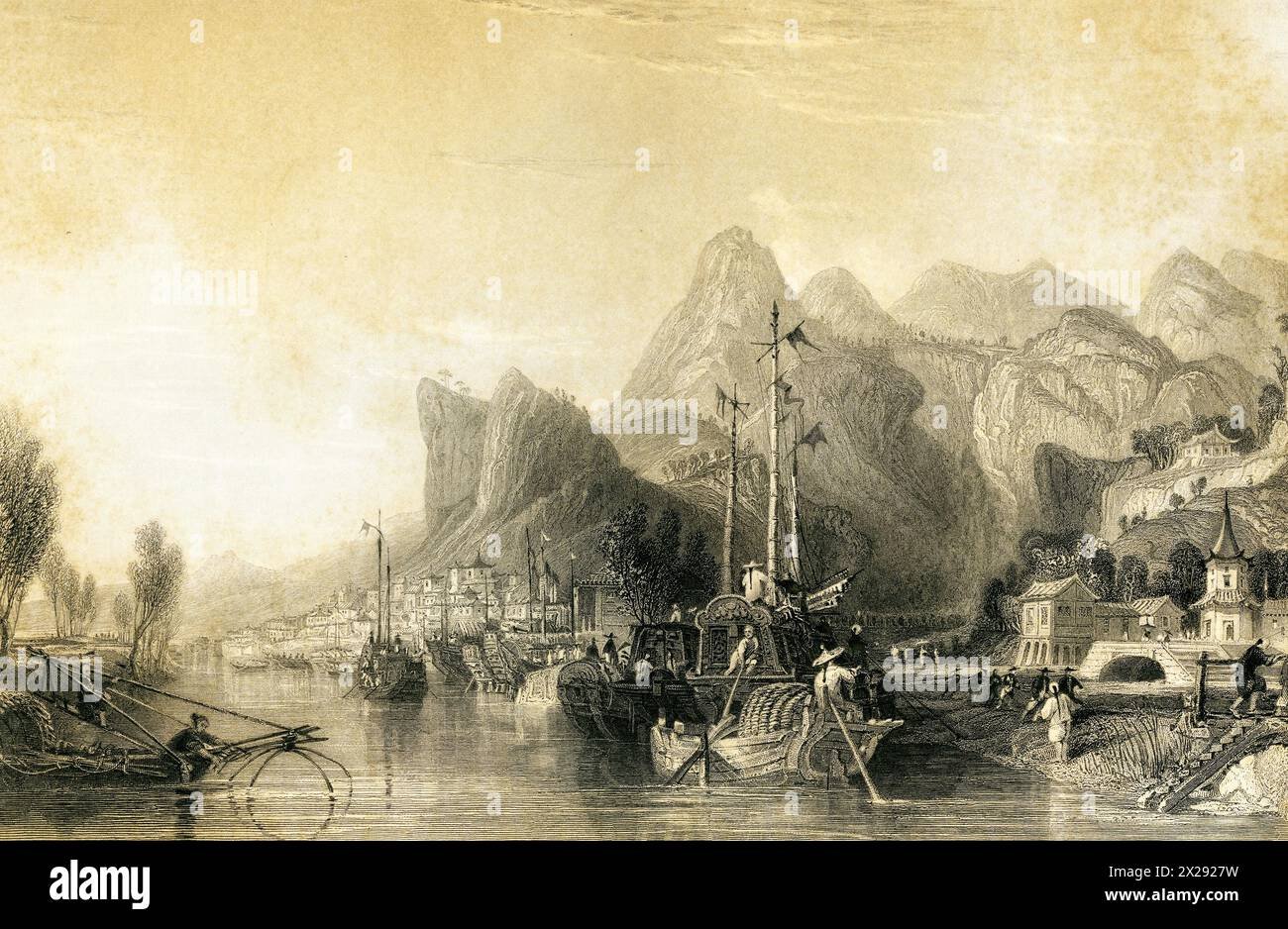
SE-TSEAOU-SHAN, OR, THE WESTERN SEARED HILLS
Cover Image: Se-Tseaou-Shan, or “The Western Seared Hills / FoShan GuangDong China / Drawn by T.Allom Engraved by J.Redaway – ALAMY Image ID:2X2927W
*This location is situated in modern-day Foshan, Guangdong, adjacent to the Shunde (GuangDong) Waterway.
Oh, for enchanter’s steed, or charmed lamp,
Or wand, or wings, to waft me thro’ the sky
To where, rock-cradled, in its drapery damp,
With chant of quiring winds for lullaby,
The little Vale of Clouds in verdure drest,
Nestles ‘mid yon Seared Summits of the West!
C. J. C.
ABOUT one hundred miles west from the city of Canton, a mountain group arises, as remarkable for the actual area which it occupies, as for the vast number of its abrupt and pointed summits. Its waters are collected from numerous torrents, and many rivers, contributing also to swell the volume of the navigable and fertilizing Se-keang. The scenery of this rocky region is celebrated by all travellers and tale-tellers; but the riches of legendary lore do not constitute the only or the greatest treasures of the locality. These are obtained by the appliances of art and industry—“gold, precious stones, silk, pearls, eaglewood, tin, quicksilver, sugar, copper, iron, steel, saltpetre, ebony, and abundance of aromatic woods.” These treasures, combined with the produce of the fertile plains that sleep around this mountain-mass, render the province of Kwang-tung, the most wealthy, commercial and civilized in the empire.
Never was mountain-scenery so illustrated by either legend or story-breathing epithet as the many-topped hills of Se-tseao; there is not a crag in all these rude, romantic, rugged regions, that has not its tradition—there is not a natural form of any magnitude unmarked by some characteristic designation.
The form of the Se-tseao is said to resemble “a floating dragon,” embracing within its sinuosities a circuit of at least forty le. Around it is drawn nature, or some preternatural power, four deep and yawning dikes, called Kéén-tsun, Sha-tow, Lung-tsin, and Kin, and from its summit start up, in broken yet conical forms, seventy-two conspicuous and lofty peaks. Like the towers of a fortress around the central keep, or the lily’s leaves around its sheltered cup, these tall peaks enclose and overhang Yan-Yüh, or “the Valley of Clouds,” a vast and fertile plain within them. The keen blasts from the east are intercepted by the peaks called Ta-ko, The Blue Cloud,( *Pih-yun.) The Purple Cloud,(† Tszé-yun.) and The Yellow, (*Hwang.) which form an impervious screen, even in this “kingdom of the winds.” On the north-west, the most remarkable elevations are those named The White Hill, († Pih-shan.) The Great Smoothing-iron, (‡ Tae-wei.) The Green Cloud, (§ Tsuy-yun.)and The Lion-peak. (|| Sze-tsze.) These rise, ridge on ridge, from “the cup of the lily,” and descend again from their culminating point, by gradual falls, to the banks of the great river, which flows smoothly past their base in its progress towards the city of Macao. Down the centre of the Valley of Clouds(¶ Yun-yuh.) flows a clear bright stream, having its springs amidst the “Heaven’s height,” and the “Heaven’s grove” summits, whence the water, falling in majestic sheets from one precipice to another, reaches at last the rocky reservoir that furnishes a copious supply to the river. The inhabitants of this happy valley have, with a natural and excellent judgment, conferred upon many of the surrounding objects, names expressive of some characteristic property. The presence of mineral treasures is indicated by the names of Gold and Silver Wells, Iron Spring, and Jasper Rock. The bolts of imperial Yohe have doubtless been often shivered on the sides and the summits of the Luytan-lun, “Thundermount,” while the “Peak of the Genii,” and the “Spirit’s Hand,” and the “Nine Dragons,” have preserved in their legendary titles the fabulous records of these alpine regions.
Underneath the “Rock Peak,” which closes the entrance of the vale, the stream that winds through it sinks suddenly from view into “The Bottomless Well,” and, after entering the broad course of the river, becomes a part of the great Pearl Canal, which opens into the channels of Western River. How closely does the Moralist’s imagined seclusion from the pursuits of men resemble these faithful details of the “Valley of Clouds !”—“The place which the wisdom or policy of antiquity had destined for the residence of the Abyssinian princes was a spacious valley in the kingdom of Amhara, surrounded on every side by mountains, of which the summits overhang the middle part. The only passage by which it could be entered was a cavern that passed under a rock, of which it had long been disputed whether it was the work of nature or of human industry.”
Amongst the numerous occupations that minister to the necessities, happiness, and wealth of the inhabitants of the Se-tseao-shan, fishing constitutes one of the most constant. Not content with the tedious process of the hook and line, the Chinaman uniformly employs the more unfailing meshes of a finely-woven net. The barge or flat-bottomed boat employed in this service, is supplied with two levers, rude long poles tied together at one end, but having a net, with its suspension-frame of crossed hoops, depending from the other. The manager of the machinery allows the lever to ascend as many feet as he desires that the net should sink in the water; and, after waiting a reasonable time for the fish to be attracted by the bait, he draws the tied ends down again, by which means the net is raised to the surface, at the stern of the boat, where an assistant is in readiness to secure the draught. This mode of fishing is essentially the same as that pursued by the fishermen on the coast of Hong Kong island, and of which a more full description has been given in the eighteenth page of this volume.
![[VOL IV] THE VALLEY OF CHUSAN](https://i0.wp.com/arclumiva.com/wp-content/uploads/2025/09/valley-of-ting-hai-chusan-dinghai-zhoushan-zhejiang-china-drawn-by-t-allom-engraved-by-s-bradshaw-2X55NJ3.jpg?resize=870%2C570&ssl=1)
![[VOL IV] ANCIENT BRIDGE, CHAPOO](https://i0.wp.com/arclumiva.com/wp-content/uploads/2025/09/ancient-bridge-chapoo-haiyan-jiaxing-zhejiang-china-drawn-by-t-allom-engraved-by-rsands-2X55NHK.jpg?resize=600%2C600&ssl=1)
![[VOL IV] HONG-KONG, FROM KOW-LOON](https://i0.wp.com/arclumiva.com/wp-content/uploads/2025/09/hong-kong-from-kow-loon-kowloon-hong-kong-china-drawn-by-t-allom-engraved-by-sfisher-2X55NGM.jpg?resize=600%2C600&ssl=1)
![[VOL IV] CHINESE BOATMAN ECONOMIZING TIME AND LABOUR, POO-KEOU](https://i0.wp.com/arclumiva.com/wp-content/uploads/2025/09/chinese-boatman-economizing-time-labour-poo-kow-nanjing-jiangsu-china-drawn-by-t-allom-engraved-by-awillmore-2X55NGD.jpg?resize=600%2C600&ssl=1)