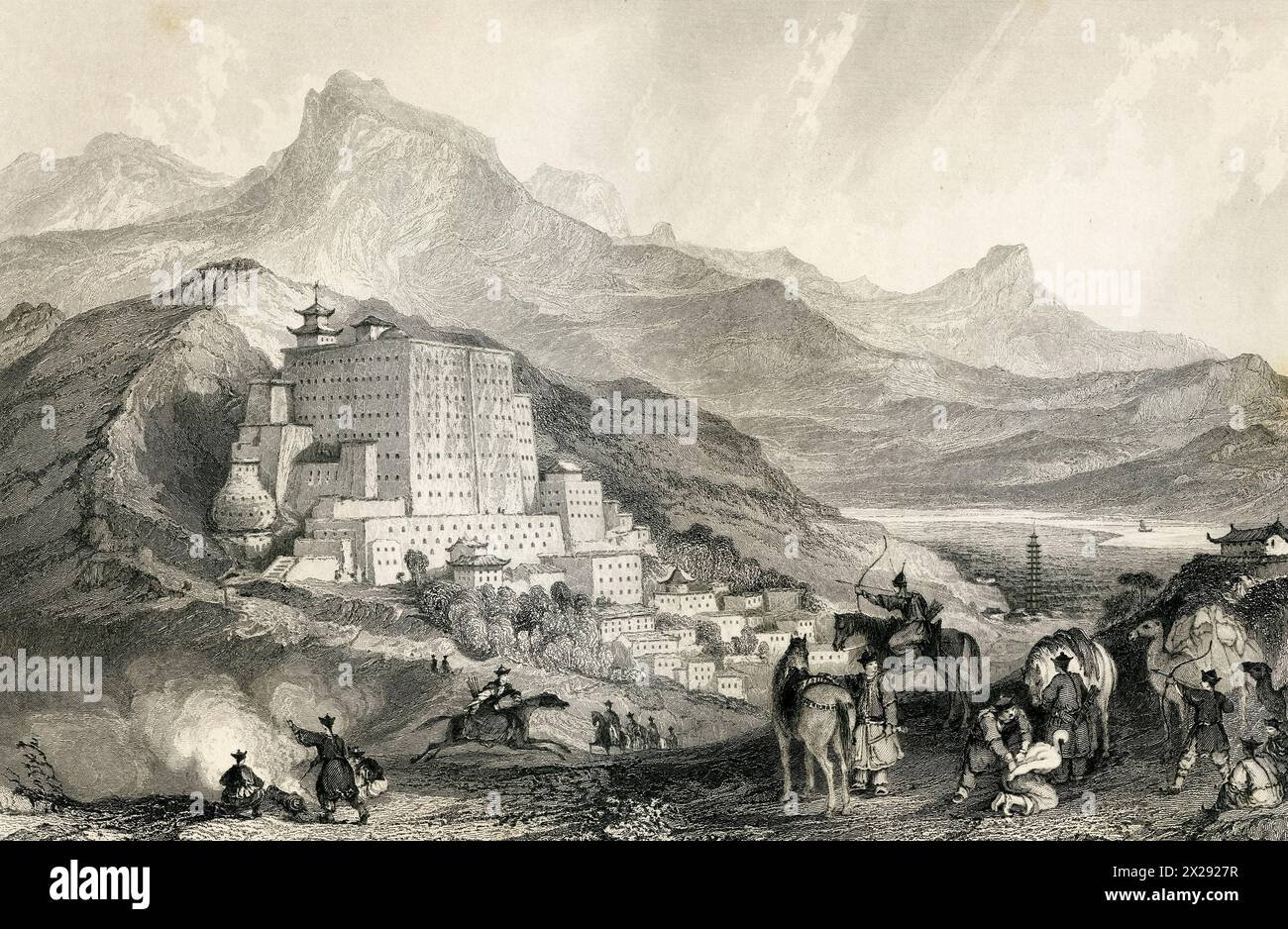
TEMPLE OF POO-TA-LA, AT ZHE-HOL, IN TARTARY
Cover Image: The Poo-Ta-La, or Great Temple near Zhehol, Tartary / ChengDe HeiBei China / UNESCO World Heritage Site / Drawn by T.Allom Engraved by J.Tingle – ALAMY Image ID:2X2927R
*The Putuo Zongcheng Temple, also known as the “Little Potala Palace,” is a Buddhist temple built in the Qing Dynasty by Emperor Qianlong to celebrate his 60th birthday and the 80th birthday of Empress Dowager Chongqing. It is located in Chengde City(Zhehol), Hebei Province, and was constructed in imitation of the Potala Palace in Tibet.
Temple of Pagan Fo! Gigantic shrine
Of giant idol and more monstrous faith!
Can prison-walls, and altars such as thine,
Train votive Emperors o’er the desert’s path?
Oh! then shall China’s ill her blessing prove,
When Christian Zhe-hol crowns our missionary love.
C. J. C.
OF Tartar descent, the emperor of China still retains his Tartarian predilections. The language of his original country is not discouraged, Mongolian Tartars find especial favour within the boundary-wall, and every returning summer witnesses the emigration of the Imperial household to his majesty’s ancestral home amidst the wild scenery of Zhe-hol. The journey thither is long, the way fatiguing, but the period at which it is made, obviates numerous inconveniences, that more severe weather and shorter days might occasion, while the imperial cortège finds suitable accommodation at the numerous travelling-palaces placed at equal intervals along the line of road reserved for royalty alone. Two objects, personal interest and public duty, demand the emperor’s annual visit to his patrimonial possessions,—inspection of his domains, and reception of the thanks to whom he entrusts the government of Tartary. These great claims upon his feelings and his justice being answered, he devotes one portion of his leisure to the pleasures of the chase, another to the offering of prayers and presents in the great temple of Fo.
The palace and gardens are seated in a valley on the banks of a majestic river, in the immediate vicinity of the little town of Zhe-hol, and overhung by lofty and rugged mountains, which, at the season of the imperial visit, present a scene of the most sublime and gratifying character. Accompanied by his Tartar life-guards, who are not required to follow the faith of their sovereign against the impulse of their consciences, his majesty enters the Poo-ta-la, while his satellites occasionally remain outside, employing themselves in showing how “swift is the arrow from the Tartar’s bow,” how incomplete his knowledge of the management of artillery, and how relentless his maxims in the punishment of minor offences. The Poo-ta-la, a corruption of Buddhulaya, the habitation of Budah, is the most spacious, celebrated, and wealthy of all the temples in Tartary. It includes one great and several smaller structures of plain exterior. The main building is a square, each side which extends 200 feet, and its general character and design are totally unlike those of any temple or building in the Celestial dominions. Eleven lofty stories are distinctly marked by as many tiers of windows in the principal front, and the inferior buildings, as viewed from the eminence in the imperial park, whence the illustration is taken, are pierced as numerously in proportion. The golden chapel occupies the central quadrangle of the principal pile, and corridors and galleries below and above surround the area in which it stands. In the centre of the chapel is a dais enclosed by golden railings, on which stand three altars richly adorned, and supporting colossal figures of Fo, his Wife, and Child. At the extreme end of the chapel, in a dark recess, is the sacred tabernacle, dimly lighted by a solitary lamp, emblematic either of immortality, if it be supposed ever-burning, or of the slight tenure of human life by the facility with which its flame may be extinguished. This point is not expounded by the priest, to whose reminiscences the occasional extinction of this vestal lamp has now been imputed; nor are strangers permitted to peep within the veil of broidered tapestry, that falls between the chapel and the shrine to exclude the curiosity of unbelievers. Ascending to the roof of the chapel, the extravagance of idolatrous enthusiasm is again exhibited in the golden plates that cover it, and in the profuseness with which every part of it is decorated. The religion to which this gorgeous but unsightly pile is consecrated, is a mere modification of the doctrines of Tao-tze or “The Sons of Immortals,” who borrowed all their notions from the priests of the Delai Lama of Thibet. Immortality being one of the pretended attributes of the Lama, the impostors carried with them into China a potion which they asserted to be the elixir vitæ; but, as such an impious fraud was easy of detection, they were soon compelled to abandon it. Celibacy, however, is retained in the reformed religion of Lao-kung.
As the visitor passes through the chapel of gold, he will have an opportunity of seeing the eight hundred lamas attached to the Poo-ta-la, some sitting cross-legged on the floor, engaged in reading or writing, and others occasionally singing, in tones solemn and subdued. It might reasonably have been concluded, from their education and learning, from their having been devoted to the altar from their childhood, like Samuel amongst the Israelites, and from the vast accumulation of treasure confided to their administration, that these lamas would possess a widely-extended influence over the followers of Fo, but such is not the case. They pay the most strict attention to the exterior rites of their religion, they contribute by pharisaitical punctuality to maintain the respect and magnificence of its ceremonies, but their private virtues, the extent and character of their information, do not entitle them to that superiority over the people which might be instrumental to the preservation of peace and subordination in society. The dress of the lamas is simple, and suitable; from their neck they wear suspended a chaplet, or roll of beads, on which they count their orisons, and in their visits to the Tartar tents they continue, as they pass, reciting prayers, telling off beads, and professing to call down hail or rain according to the value of the present offered for such intervention. In their service in the temple they pursue the ceremonies of the Tao-tzes, marching in procession round the altar, telling their beads, repeating at every count Om-e-to-fo, and bowing the head: when the entire roll is thus told off, they register the performance by a mark of chalk, and refer to it as an evidence of the number of ejaculations made to their golden god.
This singularly stupid religion is the only one to which the government in China affords any support or protection, all sects being freely permitted to exercise the privilege of unrestricted choice. The priests of the Lama are paid and maintained as part of the Imperial establishment, and the Tartar officer of state uniformly embraces this faith, if faith it can be called, disclaiming, however, all participation in the impious principle set up by “The Sons of Immortals.”
![[VOL IV] THE VALLEY OF CHUSAN](https://i0.wp.com/arclumiva.com/wp-content/uploads/2025/09/valley-of-ting-hai-chusan-dinghai-zhoushan-zhejiang-china-drawn-by-t-allom-engraved-by-s-bradshaw-2X55NJ3.jpg?resize=870%2C570&ssl=1)
![[VOL IV] ANCIENT BRIDGE, CHAPOO](https://i0.wp.com/arclumiva.com/wp-content/uploads/2025/09/ancient-bridge-chapoo-haiyan-jiaxing-zhejiang-china-drawn-by-t-allom-engraved-by-rsands-2X55NHK.jpg?resize=600%2C600&ssl=1)
![[VOL IV] HONG-KONG, FROM KOW-LOON](https://i0.wp.com/arclumiva.com/wp-content/uploads/2025/09/hong-kong-from-kow-loon-kowloon-hong-kong-china-drawn-by-t-allom-engraved-by-sfisher-2X55NGM.jpg?resize=600%2C600&ssl=1)
![[VOL IV] CHINESE BOATMAN ECONOMIZING TIME AND LABOUR, POO-KEOU](https://i0.wp.com/arclumiva.com/wp-content/uploads/2025/09/chinese-boatman-economizing-time-labour-poo-kow-nanjing-jiangsu-china-drawn-by-t-allom-engraved-by-awillmore-2X55NGD.jpg?resize=600%2C600&ssl=1)