THE OU-MA-TOO, OR FIVE HORSES’ HEADS
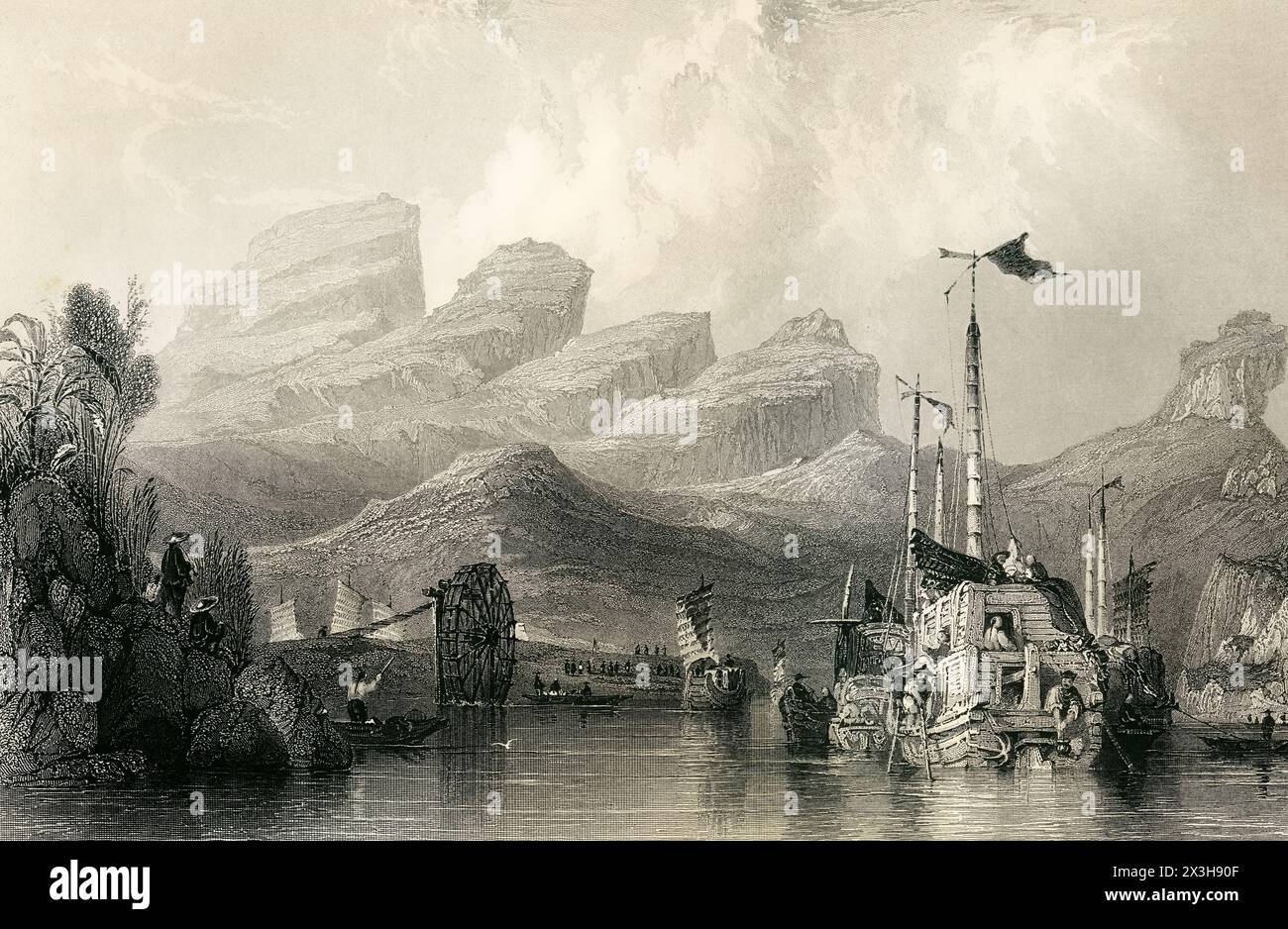
Cover Image: The Ou-Ma-Too, or “Five Horses’ Heads” / Qingyuan Guangdong China / Drawn by T.Allom Engraved by W.Floyd – ALAMY Image ID:2X3H90F
*Mount Matou is located in Qingyuan City, Guangdong Province, and is known for its Danxia landforms and beautiful scenery.
Five giant steeds to battle driven,
Men numbered, side by side;
Five mountain-tops, asunder riven,
There stand they, petrified.
Was’t fear of foeman wrought – or sorcerer’s spell?
Or is it but a poet’s miracle?
C. J. C.
THE course of the Pe-kiang river, from its fountain in the hills of Kiang-si, to its foot at Bocca Tigris, is about 350 miles in extent; and its banks present an endless variety of subjects for philosophic investigation, as well as scenery for the eye of taste. In its early efforts it pierces a passage between stupendous cliffs of sandrock on one side, and limestone on the other, which, at a little distance, seem to touch each other, forming a lofty arched cavern, through which the navigation has to pass. Nor in these dismal, deep, and dark hollows, is gloominess the only uncomfortable apprehension experienced. Restless from its natural formation, the limestone falls away, layer after year, from its lofty bed in the precipitous cliff, and in such vast debris, as to obstruct the channel, and endanger the navigation. Should a boat strike and sink in particular places, escape from these awful chasms would be impossible, even for the most expert swimmers, the cliffs on either side being perpendicular, and the length of the passes often many miles. At a place called les cinq laids diables, wrecks of luckless barges are visible above the surface and the surge, and give painful evidence of the reality of the perils that are to be encountered here. Emerging from these shadowy recesses, hills of fair and fertile fronts present themselves, whose pine-clad summits attract and decide the navigator’s attention; dense coppice-wood, interspersed with the camellia, covers the lower and nearer summits; and, in the little glens that open on the river, are innumerable huts, each surrounded by a plantation of tobacco. Such is the character of the scenery that prevails along either bank of the infant stream of Pe-kiang, and such the peculiar features that distinguish it from those of the chief northern lines of river-navigation.
Resuming its stern character, the Pe-kiang exhibits bold and sterile scenery in the vicinity of Chaou-choo-foo, a city of the second rank, to which six cities of the third order are subjected. Situated at the confluence of two navigable rivers, the Tung-ho (Eastern river) and See-ho (Western river), which here assume the name of Pe-kiang, and in a mineral district, the trade of the place is active and prosperous; and a degree of animation reigns here, that imparts the highest pleasure and interest to the prospect. Communication between different parts of the city is maintained by means of ferry-boats that ply for hire, and are managed by females solely. These hardy creatures, less interesting in appearance than the female character is elsewhere seen, are held in less respect than all others of their sex by the Chinese; for respectable females do not publicly appear in China, nor partake of that liberty to which Christian women are unsuspectingly admitted. A second town on the opposite bank of the river is connected with Chaou-choo-foo, by a bridge of boats, the central one of which is moveable, to permit navigation, and to prevent the passage of strangers.
On the opposite side of the Five Horses’ Heads, from that represented in the accompanying view, the fronts of the hills are steep, rocky, and impending; the loftiest of them is ascended by steps cut in the rock, from the foot to the highest pinnacle, on which the fragments of an ancient edifice are discoverable. These are quite too insignificant to command respect either from their extent, architectural character, or authentic history, but are still sufficient to maintain a legend. Some thousand years ago, a bonze, Lu-zu by name, took up his abode on this stylistic height; and, building a temple here, submitted himself to such austerities within it, as none of his order had ever been known to do before that period. It is of this venerable man tradition says, that he wore an iron chain around him, which so wounded and corrupted his flesh, that it became the origin and the food of worms. Whenever they fell off, and gave the least relief from pain, he immediately replaced them, saying, “that there was still something left to prey on.” Pilgrims continue to visit the scene of this extraordinary instance of hypocrisy, or folly, or both; although stories of their having been robbed and ill treated by the attendant bonzes were long current, and much better authenticated than the history of Lu-zu, whose disgusting austerities are held in such admiration by the credulous.
From the highest summit of the Ou-ma-too, an extensive, varied, and agreeable prospect is beheld. Much fertile lowland is seen adjoining the banks of the rivers, which appear like attenuated silvery lines, winding down the long-extended mountain-glens for many a mile, and falling into the Pe-kiang at Chaou-choo-foo. One mountain, San-van-hap, or the Flying Hill, more conspicuous than the rest, is believed to be the highest in China, and is said to derive its singular name from the ruined temple on its summit, which was transported by the wand of some wizard, and in a single night, from a province in the north to its present aerial position.
Less picturesque than the southern range, the aspect presented in the illustration possesses characters that confer upon it an increased interest. Sterile, uninhabited, and rugged, the surface displays a remarkable variety of colour; the disintegrated sandstone, of which the mountains are composed, strongly contrasting with the jet-black hue of the coal that here rises to the view, and is scattered over the soil in the immediate vicinity of the hills. This invaluable mineral abounds in China; in the province of Pe-tche-le is found a species of graphite: that exposed for sale in the towns along the banks of the Yang-tse-kiang resembles cannel-coal; and, in the vicinity of the Po-yang lake, a description having the character of borycoal prevails. At the base of the Five Horses’ Heads a sulphurous kind is raised, and an extensive trade is conducted here by means of it. The collieries are worked by adits driven into the sides of the mountains, not by perpendicular shafts, and the coal is conveyed in wagons to the entrance, and thrown from a stage or jetty directly into the hold of the junk. Perhaps no country in the world possesses coal in greater quantity and variety than the empire of China, and from the practised industry and extraordinary imitative powers of the people, it is more than probable, that before many years shall roll over their history, their noble rivers will be navigated, like those of the North American States, by numerous and well-equipped steam-boats.
In the coal district of Ou-ma-too, a manufacture of sulphate of iron, or green vitriol, is established. A quantity of hepatic iron pyrites, mixed with an equal amount of coal, both being broken into small similar-sized fragments, is accumulated into a pyramidal form, and coated carefully over with lime-plaster. By this process much heat is generated and extricated, and the heap remains untouched until the smoke has totally subsided. The mixture is then removed, thrown into water, and submitted to heat, when crystals of sulphate of iron are obtained by evaporation.
Irrigation is one of the most favourite practices in Chinese agriculture; and the variety of ingenious modes for raising and distributing water, reflects much credit on the industrial character of the people. On the left bank of the Pe-kiang river, and amidst the sandy grounds that are elevated above the water-level, the sugar-cane is much cultivated, and a large water-wheel, erected close to the shore, is employed for the purpose of extensive and continual irrigation. In the construction of this primitive contrivance, ingenuity and frugality are most admirably combined. Two upright posts are securely fixed in the bed of the river, and in a plane perpendicular to the trend of the bank. These uprights support the axis, about ten feet in length, of a wheel, consisting of two unequal rims, the diameter of that near the shore being eighteen inches less than that farther off: but both dip into the water, while the opposite segment of the wheel rises above the level of the bank. This double wheel is connected with the axis by eighteen spokes, obliquely inserted near each extremity of the axis, and crossing each other at two-thirds of their length. They acquire additional security by a concentric circle and bands that connect them with the rims; the spokes inserted in the interior extremity of the axis reaching the outer rim, and those proceeding from the exterior terminus reaching the inner and smaller rim. Between the rims and the crossings of the spokes, is woven a kind of close basket-work, serving as ladle-boards or floats, which meeting successively the current of the stream, by their impulse turn the wheel. To both rims are attached small tubes or spouts of wood, with an inclination of about twenty-five degrees to the horizon, or to the axis of the wheel. These tubes are closed at the outer extremity, but open at the other. By this position, the tubes which happen during a revolution to be in the stream with the open ends uppermost, fill with water. As that segment of the wheel rises, the mouths of these tubes are then relatively depressed, and pour their contents into a wide trough, whence they are conducted amongst the canes as may be required.
The only material employed in the construction of this piece of mechanism, with the exception of the nave and principal uprights, is afforded by the bamboo. The rims, spokes, floats, tubes, and even the cords, are made of entire lengths or single joints, or large pieces, or thin slices, of that wood. Neither nails, pins, screws, nor any kind of metal, enters into its construction. The cordage by which the parts are bound together is of slit bamboo cane. At a trifling cost of erection, and without further labour or any attendance, this useful machine will raise water from a considerable depth, and supply a reservoir with a quantity adequate to the wants of a spacious cultivated area.
![[VOL IV] THE VALLEY OF CHUSAN](https://i0.wp.com/arclumiva.com/wp-content/uploads/2025/09/valley-of-ting-hai-chusan-dinghai-zhoushan-zhejiang-china-drawn-by-t-allom-engraved-by-s-bradshaw-2X55NJ3.jpg?resize=870%2C570&ssl=1)
![[VOL IV] ANCIENT BRIDGE, CHAPOO](https://i0.wp.com/arclumiva.com/wp-content/uploads/2025/09/ancient-bridge-chapoo-haiyan-jiaxing-zhejiang-china-drawn-by-t-allom-engraved-by-rsands-2X55NHK.jpg?resize=600%2C600&ssl=1)
![[VOL IV] HONG-KONG, FROM KOW-LOON](https://i0.wp.com/arclumiva.com/wp-content/uploads/2025/09/hong-kong-from-kow-loon-kowloon-hong-kong-china-drawn-by-t-allom-engraved-by-sfisher-2X55NGM.jpg?resize=600%2C600&ssl=1)
![[VOL IV] CHINESE BOATMAN ECONOMIZING TIME AND LABOUR, POO-KEOU](https://i0.wp.com/arclumiva.com/wp-content/uploads/2025/09/chinese-boatman-economizing-time-labour-poo-kow-nanjing-jiangsu-china-drawn-by-t-allom-engraved-by-awillmore-2X55NGD.jpg?resize=600%2C600&ssl=1)