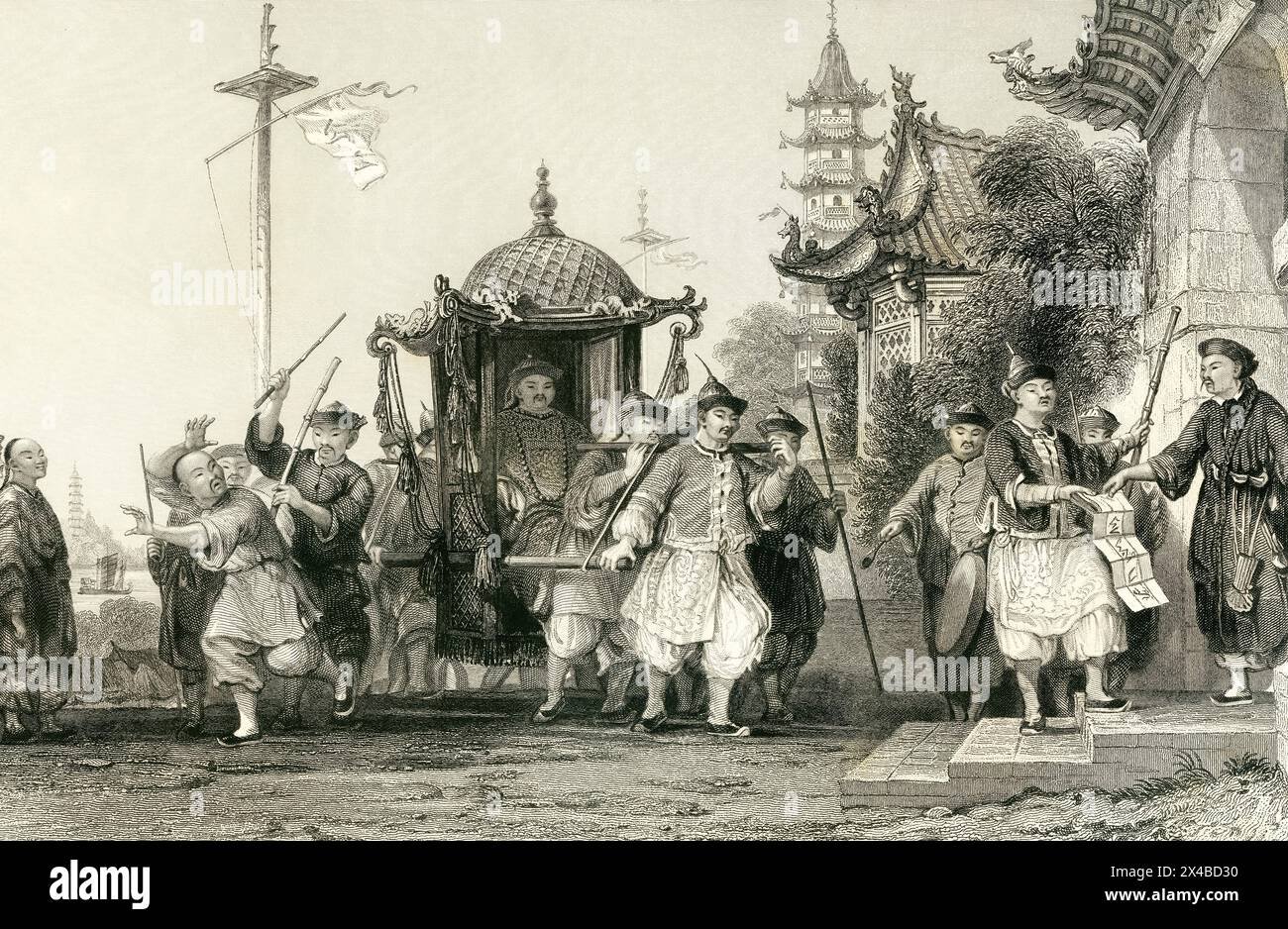
A MANDARIN PAYING A VISIT OF CEREMONY
Cover Image: A Mandarin paying a Vist of Ceremony / China / Drawn by T. Allom Engraved by A.Fox – ALAMY Image ID:2X4BD30
*The sedan chairs used by officials can be categorized into those carried by four bearers and those carried by eight bearers. According to the regulations of the Qing Dynasty, officials in Beijing with a rank of three or higher would use a four-bearer sedan chair within the city, and an eight-bearer sedan chair when traveling outside the city.
“Ceremony
Was but devised at first to set a gloss
On faint deeds, hollow welcomes,
Recanting goodness, sorry ere ’tis shown,
But where there is true friendship, there needs none.”
SHAKSPEARE.
IN most Eastern countries, palanquins, sedans, and litters, are the principal vehicles in which the wealthy and eminent are conveyed, either on private business, or public occasions. Horses are seldom used for draught, and wheel-carriages rarely adopted where convenient roads have not been constructed, nor a love of travelling yet excited amongst the people. As the distance between the man in authority, and the subject whose duty is to obey, is so jealously observed in this ancient and populous kingdom, no opportunity is left unimproved of extending the gulf of pride. While the lower classes are degraded to the rank of irrational animals, the mandarin is never seen in the condescending situation of a pedestrian, his shortest excursions being uniformly made in his silken sedan. When the most celebrated of our ambassadors, Lord Macartney, was journeying to Zhehol, in Tartary, he was overtaken, on the royal road, by the emperor of the Celestials, in a sedan chair, resembling the mandarin’s equipage in the accompanying illustration. “Various squadrons of horse, with bowmen and their quivers, preceded the emperor’s approach. Soon after, a palanquin or sedan chair appeared, covered with a bright yellow cloth, and adorned with windows of plate glass. It was carried by eight bearers, while eight others walked close to them, in readiness to relieve the former. The chair was attended by a troop of horse in yellow uniforms, also by pikemen, standard and shield bearers.”
Imitating this great original, the mandarins of China adopt the palanquin form of vehicle, and the circumstances accompanying their visits of ceremony, although they include many that are common to the aristocracy of Great Britain, are nevertheless extraordinary and characteristic. The chair is generally open, but furnished with curtains and tassels of silk; and a silken net-work, often interlaced with silver thread, covers the convex roof, which is surmounted by a ball or a button. The extremities of two long bamboo poles, which pass through staples in the sides of the sedan, are connected by cords, through the bend or curve of which a short piece of bamboo is passed, the ends resting on the shoulders of the chairmen, thus dividing the whole weight equally between the four carriers. For the sake both of speed and splendour, four others are always ready to succeed to the labour, when the first four shall exhibit the least symptoms of fatigue. It would appear that the number of chairmen is limited, either by the law of the land, or by that of opinion; for the privilege of being conveyed along by eight rational animals, is conceded universally to his imperial majesty. This selfsame respect for etiquette, in England, leaves to royalty alone the distinction of being drawn by eight horses on all occasions of public ceremony, while six are deemed sufficient for the highest members of the peerage.
Before the sedan-chair a crowd of servants advance, some beating gongs, others extolling in loud tones the virtues of their master, and calling upon the worthless rabble to make way for the approaching cortège: besides whom a number of umbrella-carriers and chain-bearers, distinguished by caps of wire with a feather in the top, often attend such processions, to terrify the ignorant and enslaved spectators, who are peremptorily desired to stand and stare; and, lastly, as no public ceremony of joy or sorrow in China, is complete without the introduction of the bamboo, a posse of fellows, in the pay of the great man, also attend his progress, armed with strong pieces of the national cane, to belabour any unhappy obstructors who endeavour to obtain a peep at the petty tyrant as he passes. The cortège having arrived, at its destination, the gate of some mandarin who is to be honoured by a visit, the conductor advances, and, presenting a long jointed tablet, coloured red, and illuminated richly—unless the family are in mourning, when the tablet is white and the letters blue—displaying the rank and title of his master, he mentions the purport of his coming. This placard, like the rent-roll of our country squires, obtains a degree of respect exactly proportioned to its contents. Should the title be eminent, the host comes to the gate, and even outside, to receive his visiter; should it be otherwise, more reserve, or less enthusiasm, is shown accordingly. This distinction cannot be said to be peculiar to China; it has been observed to prevail very generally, and very long, in countries that lay claim to a much higher degree of civilization.
The mode of recognition here amongst acquaintances is extremely courteous; joining their clenched hands—a plan which is often preferable to the application of the open palm—they raise them afterwards to the forehead, at the same time addressing the customary inquiry after the health of each other; and, amongst those who are considered the most refined and most perfect masters of politeness, genuflexions are not uncommon. Upon the termination of the visit, and return of the visiter to his sedan, the same ceremonies are repeated, some of them of course in an inverted order.
![[VOL IV] THE VALLEY OF CHUSAN](https://i0.wp.com/arclumiva.com/wp-content/uploads/2025/09/valley-of-ting-hai-chusan-dinghai-zhoushan-zhejiang-china-drawn-by-t-allom-engraved-by-s-bradshaw-2X55NJ3.jpg?resize=870%2C570&ssl=1)
![[VOL IV] ANCIENT BRIDGE, CHAPOO](https://i0.wp.com/arclumiva.com/wp-content/uploads/2025/09/ancient-bridge-chapoo-haiyan-jiaxing-zhejiang-china-drawn-by-t-allom-engraved-by-rsands-2X55NHK.jpg?resize=600%2C600&ssl=1)
![[VOL IV] HONG-KONG, FROM KOW-LOON](https://i0.wp.com/arclumiva.com/wp-content/uploads/2025/09/hong-kong-from-kow-loon-kowloon-hong-kong-china-drawn-by-t-allom-engraved-by-sfisher-2X55NGM.jpg?resize=600%2C600&ssl=1)
![[VOL IV] CHINESE BOATMAN ECONOMIZING TIME AND LABOUR, POO-KEOU](https://i0.wp.com/arclumiva.com/wp-content/uploads/2025/09/chinese-boatman-economizing-time-labour-poo-kow-nanjing-jiangsu-china-drawn-by-t-allom-engraved-by-awillmore-2X55NGD.jpg?resize=600%2C600&ssl=1)