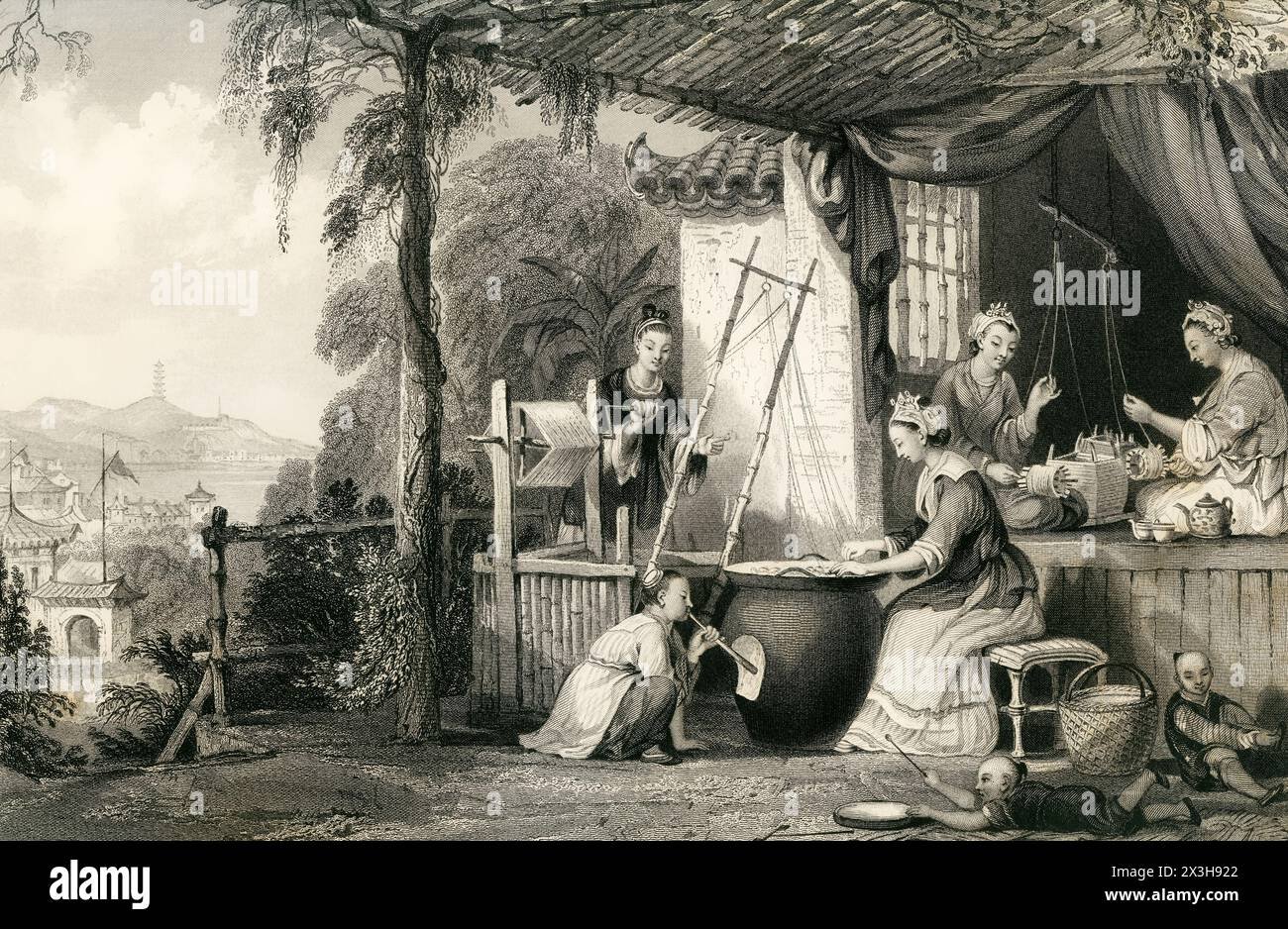
DESTROYING THE CHRYSALIDES, AND WINDING OFF THE COCOONS
Cover Image: Destroying the Chrysalides, and winding off the Cocoons Drawn Silk production China / Drawn by T. Allom Engraved by J.Davies – ALAMY Image ID:2X3H922
*Refers to the process of extracting silk threads from silkworm cocoons, typically involving soaking the cocoons in hot water and gradually unraveling the silk threads. This is an essential step in silk textile production.
The same prolific season gives
The sustenance by which he lives,
The Mulberry leaf, a simple store,
That serves him—till he needs no more!
COWPER.
IT has been shown, with a sufficient degree of certainty, that the invention of silk manufacture originated with the Chinese;(* Vide Vol. I., p. 56.) their authors assert, that from the earliest period the Son of Heaven himself (the emperor) directed the plough; the empress planted the mulberry-tree—examples which had the most happy effect upon their subjects. An Imperial treatise on “Husbandry and Weaving,” gives minute instructions for the culture of rice, from the first ploughing of the ground, to the ultimate packing of the grain; and is equally circumstantial in detailing the process to be observed from planting the mulberry to weaving the silk. The Chinese are utilitarians; laws for the promotion of any means, whereby food and clothing, the principal necessaries of life, might be obtained with more facility, of superior quality, and in greater abundance, would necessarily become popular amongst them, and the author, or inventor, have secured the lasting reverence of the nation. But, it is less than questionable, whether these principles add to their happiness here; it is perfectly certain that they cloud their prospects of an hereafter. Possessing outward placidity of manner, for the purposes of conciliation and deceit, they are known to be hard-hearted and unforgiving. As a people, they are without virtue, deep feeling, or dignity of character; toiling for food like inferior animals. Their total absence of sentiment or delicacy, as well as their disgusting cupidity, were glaringly obvious in the late Chinese war. Our fleet having destroyed the forts of Amoy, and killed hundreds of their countrymen, scarcely had the firing ceased, when the small trader-boats were alongside our men-of-war, with dealers offering fruits, fowl, rice, and other articles of fresh food, for sale to our men, so recently their mortal enemies. It is hardly possible to imagine a fact more derogatory to national, more disreputable to individual character.
In the preparation of clothing—or rather of a superior description, silk cloth—the Chinese have attained a remarkable degree of excellence. Commencing with the mulberry, the food which supports the extraordinary insect from which the original material is derived, they bestow the most tedious, yet profitable care, upon every step in the process, from its opening to its close. The provinces of Sechwen, How-quang, Kiang-si, and Che-kiang, traversed by the thirtieth parallel of latitude, are all adapted to the growth of the mulberry; but it is in the beautiful valleys and fertile plains of the latter that the worms are reared most successfully, and the finest silk obtained. Woollen clothing was generally worn until the reign of Ouenu-ti, of the Han dynasty, from which period silk has been the most esteemed, and constitutes the dress now most prevalent amongst all the opulent classes. The produce of Chekiang, and of the adjoining silk district of Kiang-nan, is the most valuable, bringing, in the Canton market, double the price of that produced elsewhere, and being preferred by the English manufacturer to the cultures of India, Turkey, or Italy.
As the end of cultivation in mulberry gardening is the production of the greatest quantity of young and tender leaves, at the total sacrifice of the fruit, the trees are never allowed to exceed a regulated height and age. The branches are pruned off, and the parent tree headed down; leaves from the young scions being found to be more tender, more delicate in their texture, and more nutritious, than the coarse leaves produced upon older branches. Although there are many species of the genus Morus, two only are distinguished in the East as supplying food for the silkworm; the black, or common, which is a native of Italy, and flourishes also in England; and the white, which is indigenous to China; the Persians, however, use both species. The red mulberry is a native of America, where it is much esteemed for the quality of its timber, and employed for knees in shipbuilding. The Morus Alba is propagated from seed, by layers, or from cuttings; plants from seeds, in this, as in most other species, will be found to be more healthy, and therefore preferable, although more disposed to be fruitful.
Suitable soil is prepared by trenching, mixing it with ashes and river-mud, and making the compound moist and loamy; it is thrown up into beds or ridges, about a foot in height, and in these the plants are set, generally in the quincunx form, and at convenient distances. The intervals between the rows serve as conduits for water, occasionally; but are uniformly occupied with rice, millet, or pulse of some kind, so that not a square foot of land is lost to either landlord or tenant. Various stratagems are employed for the destruction or prevention of insects; and, in applying essential oils, as well as in gathering the leaves, double ladders are always used, the trees being too slender to sustain any great weight or pressure. Gathering of the leaves, the lungs of a tree, necessarily superinduces disease, which the cultivator endeavours most artfully to relieve, or to remedy, by pruning, lopping, and cutting out old wood. When these appliances all fail, and the inveteracy of the canker baffles the skill of the physician—when the tree shows a greater tendency to the production of fruit, and a less to that of delicate leaves, it is removed altogether, and its place supplied by a healthy young plant from the nursery.
The silk-worm (Bombyx) of the genus Phalæna(Phalaena), and by entomologists called Phalæna bombyx mori, is originally a native of China. From the egg (about the size of a pin’s head) when fostered by a genial warmth, proceeds a minute dark-coloured worm, that casts its skin three or four times, according to the variety of the species, in its progress to full-grown existence and to a caterpillar form. It now acquires a whitish colour, speckled with blue or yellow, ceases to feed, and commences those labours, which have rendered it so famous in natural and in commercial history. On the first day of its caterpillar-life, that is, about the thirtieth day of its entire existence, the insect puts forth, through two apertures in its nose, a viscid secretion, by which it becomes attached to the surface on which nature or art may have placed it; on the second, it forms, by means of duplicate filaments, proceeding through these nasal foramina, a ball of an ovoid shape around itself, as a shield against hostile insects, and against a frigid atmosphere; and, on the third day, this cocoon completely conceals the little labourer from view.
At the expiration of about ten days, its insect toils being completed, and the sustenance previously laid up exhausted, the caterpillar changes into the chrysalis or nymph state, and remains for some days longer, awaiting another transformation. In the natural state, when the time has been fulfilled, and the pupa completely metamorphosed, the prisoner, guided by instinct, cuts through the silken barrier of the cocoon, and comes forth a new creature, the destined inhabitant of a new sphere, and, being furnished with limbs, antennæ, and wings, takes flight towards the regions of Him that made him so wonderfully. In a state of culture, none of course are permitted to destroy their cocoons, save those that are to be preserved for the continuation of the species; and these aurelias, or moths, are carefully brought together, and placed on soft cloth or other proper surface, to deposit their eggs. There is a viscous liquid around the eggs, which causes an adherence to the paper, or cloth, or leaf, on which they are laid; but they are easily released from this encumbrance by dipping them in water and wiping them dry.
Nothing is more necessary to be guarded against in the rearing of silk-worms than the effects of noise and cold; a sudden shout, the bark of a dog, even a loud burst of laughter, has been known to have destroyed whole trays of worms; and entire broods perish in thunder-storms. The utmost vigilance, therefore, is practised in keeping off visitors or intruders from the sheds, which are always constructed in a remote situation. It is this necessity for the formation of an artificial temperature that creates the great difficulty of rearing silk-worms in Europe. About 55° of Fahrenheit is the most suitable for the preservation of the ovum; but there is considerable risk attending any increase, lest the process of incubation may be accelerated so rapidly as to precede the moment when the mulberry leaf shall have reached its edible age. In the silk-nursing provinces of China, the mean temperature, according to the same description of thermometer, from the first of October to the first of November, is about 55° at sun-rise, and 65° at noon, with an atmosphere uniformly clear and tranquil; and seldom, at any season, exceeding 85°, the highest temperature to which the worm may with safety be exposed. Here then, evidently, is the native country of this extraordinary insect, where the process of incubation proceeds simultaneously with the growth of the only species of food on which it can subsist.
Much attention is given by the Americans of the United States to the culture of the silk-worm and the establishment of silk manufactories, and this branch of industry is rapidly spreading amongst them. The morus multicaulis, on the leaves of which they feed the worms, appears to thrive luxuriantly in most of the States; and the government seem so intent upon at least supplying the home consumption of this valuable article of commerce, that twelve of the States pay a handsome bounty for the production of cocoons, or of the raw silk. In the year 1842, upwards of 30,000 pounds of silk were obtained from the States of Massachusetts, Connecticut, New York, Pennsylvania, Tennessee, and Ohio alone; but it is fully ascertained, that from the Southern border of the Union, up to the 44th degree of latitude, the climate is admirably suited to the culture of silk. Success in rearing the silkworm has naturally encouraged the application of machinery in the preparation and manufacture of the filaments; and the inventions for reeling, spinning, and weaving silk into ribands, vestings, damasks, &c., deposited in the National Gallery and Patent Office of the Republic, are equal in ingenuity to any that can be shown in China or in Europe. The annual value of silk stuffs imported into the United States exceeds 20,000,000 of dollars; the silk annually manufactured in France is valued at 25,000,000, and of Prussia at 4,500,000. It has been calculated that if one person in one hundred of the States’ population were to produce annually one hundred pounds of raw silk, the yearly value of such product would be double that of the cotton now exported, and nine times the worth of the exported tobacco. This estimate is not unreasonable as regards the quantity of silk that might be obtained by the industry of the people, for ,the Lombardo-Venetians, only four millions of souls, have raised and shipped, in a single year, six million pounds of silk: the American conclusion,as to throw Venetian produce on the general market, the price would fall in proportion.
Hindoostan is the native country of several species of moths, resembling in habits the common silk-worm; most of them, however, live wild, and in this state have hitherto proved so productive, that the Hindoos have not thought it necessary to nurse them. The Joree worm, of Assam, feeds on the pipul tree; the Saturnia, including several species, lives on the hair-tree leaf; this is the largest moth known, measuring ten inches between the tips of its wings; and its cocoons, the size of a hen’s egg, are brought in quantities to Bhageolpoor and Calcutta. One species, the Eria, which lives on the palma-christi leaves, is domesticated in India; while another, of the Saturnia tribe, is wholly neglected by the Assamese. Silk has been obtained from the spider’s web, and gloves, made of this strong, glossy, and beautiful material, were presented both to the Royal Society of London, and the Academy at Paris, by Monsieur Bon. It was soon perceived, however, that great difficulty must attend any attempts to appease the voracity, or calm the inquietude, of the spider. It was almost impossible to rear them in any considerable quantities; and when a number, at the expenditure of much time, trouble, and anxiety, were brought together, unless they had an ample supply of flies to prey on, they quickly destroyed each other.
![[VOL IV] THE VALLEY OF CHUSAN](https://i0.wp.com/arclumiva.com/wp-content/uploads/2025/09/valley-of-ting-hai-chusan-dinghai-zhoushan-zhejiang-china-drawn-by-t-allom-engraved-by-s-bradshaw-2X55NJ3.jpg?resize=870%2C570&ssl=1)
![[VOL IV] ANCIENT BRIDGE, CHAPOO](https://i0.wp.com/arclumiva.com/wp-content/uploads/2025/09/ancient-bridge-chapoo-haiyan-jiaxing-zhejiang-china-drawn-by-t-allom-engraved-by-rsands-2X55NHK.jpg?resize=600%2C600&ssl=1)
![[VOL IV] HONG-KONG, FROM KOW-LOON](https://i0.wp.com/arclumiva.com/wp-content/uploads/2025/09/hong-kong-from-kow-loon-kowloon-hong-kong-china-drawn-by-t-allom-engraved-by-sfisher-2X55NGM.jpg?resize=600%2C600&ssl=1)
![[VOL IV] CHINESE BOATMAN ECONOMIZING TIME AND LABOUR, POO-KEOU](https://i0.wp.com/arclumiva.com/wp-content/uploads/2025/09/chinese-boatman-economizing-time-labour-poo-kow-nanjing-jiangsu-china-drawn-by-t-allom-engraved-by-awillmore-2X55NGD.jpg?resize=600%2C600&ssl=1)