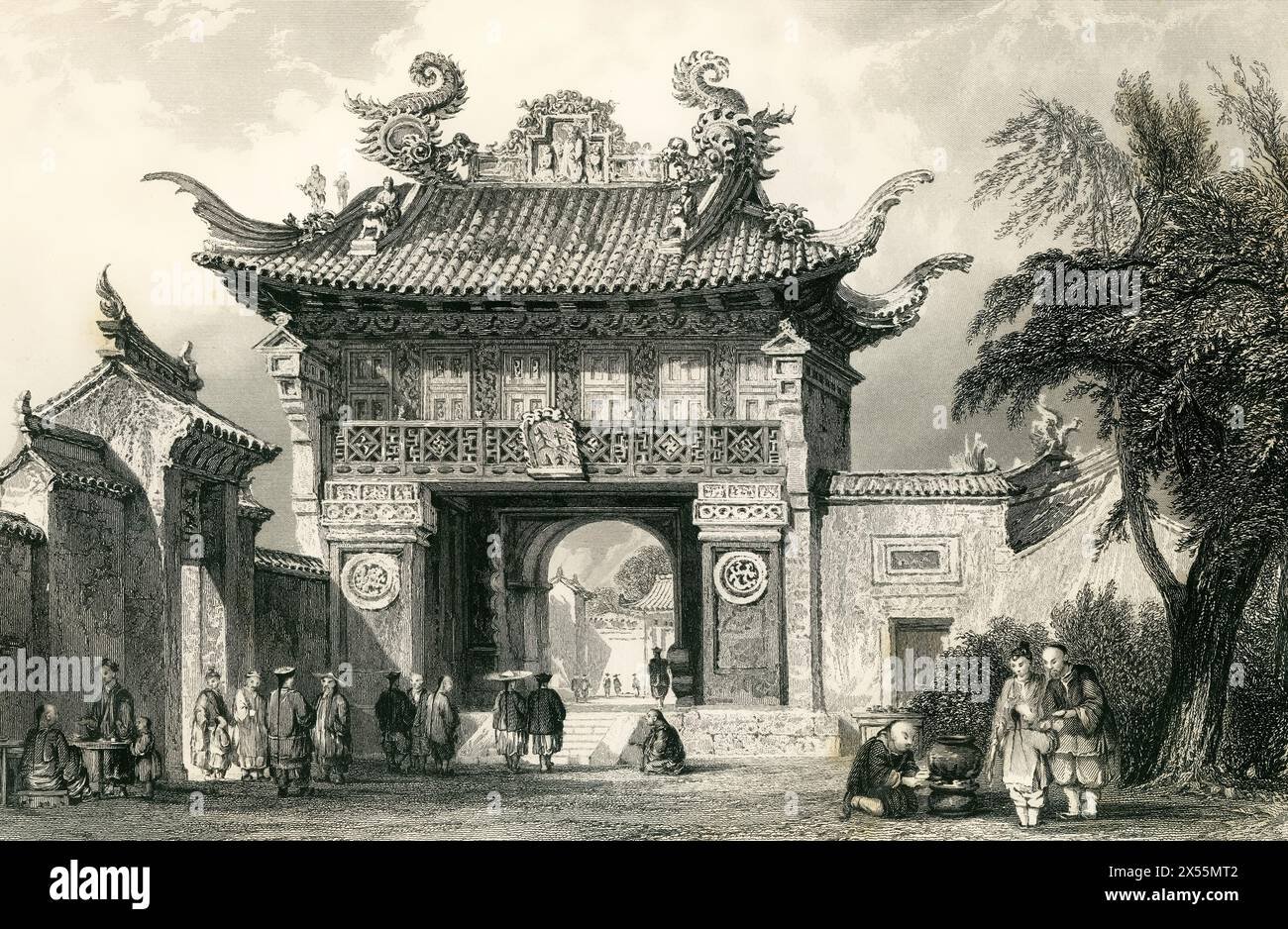
FIRST ENTRANCE TO THE TEMPLE OF CONFUCIUS, CHING-HAI
Cover Image: First Entrance to the Temple of Confucius, Ching-hai / NingBo ZheJiang China / Drawn by T. Allom Engraved by J.Tingle – ALAMY Image ID:2X55MT2
*Temple of Confucius(The Zhenhai Confucian Temple), also known as Zhenhai Academy, is located in the northeast of Ningbo, Zhejiang Province, China. It served as the highest institution of learning and a place of worship for Confucius in the former Zhenhai County. The temple was originally built in the second year of the Northern Song Dynasty’s Yongxi era (985 AD) and was destroyed in the fourth year of the Southern Song Dynasty’s Jianyan era (1130 AD). It was rebuilt in the sixth year of the Qingyuan era (1195 AD) at the same location and renamed “Da Cheng Dian.” However, it suffered further destruction in the twenty-fifth year of the Ming Dynasty’s Wanli era (1597 AD) and was subsequently rebuilt once more.
“See a siege,
Behold the ordnance on their carriages,
With fatal mouths gaping on girded city.”
SHAKSPEARE.
CHING-HAI is situated on the embouchure of the Tahea river, and is the capital of a heen, or district, in the province of Che-kiang. The site is singularly strong by nature, overhanging an elevated peninsula, the base of which is washed by the sea on one side, and by the rapid current of the Tahea on the other, against the attrition of which it is protected by a noble stone embankment. This grand sea-wall extends along the outer coast for a distance of six miles or upwards, and defends a vast tract of level land which lies considerably below the high-water mark; the extreme point of Ching-hai peninsula is crowned by a fort of great capacity, but which lay dismantled and ungarrisoned for many years, until the terror of British arms in the recent wars, alarmed the citizens for their safety.
It may assist our readers in forming an estimate of the true quality of our enemies, in the late unequal contest with China, to present them with a brief extract from a report of the Lord Amherst’s voyage, detailing the opposition that ship surmounted in ascending the Tahea and passing Ching-hai. “In passing this town, numerous boats came and spoke us; among others, several filled with low mandarins, who endeavoured to induce us to stop, both by entreaties and finally by threats; these boats not being able to keep up with us, some of them landed, and running along the banks of the river, tried to induce some large vessels full of passengers to stop our progress; but these declined all interference. They then set a troop of boys to pelt us with stones, as we were sailing close inshore to avoid the tide; on which I hailed them, threatening to inform the Chee-foo of their insolence; and they then checked the boys from throwing any more stones. The breeze fortunately freshening, we stood to the other side of the river, and met with no further impediment.” (* Report of the Lord Amherst’s Voyage to the North-east Coast of China, by Mr. Lindsay, p. 43. 26th May.)
Such was the military character of these over-civilized people in 1833; but a visit from an English armament to the neighbouring island of Chusan has so completely awakened them to the folly of their presumption and confidence, that when our fleet appeared before the walls of Ching-hai in 1841, every man in the district held his lantern in his hand, supplied with oil, and “with trimmed wick.” When our ships cast anchor before this once unprotected district, Sir Henry Pottinger writes, that “the city was so strongly covered by its citadel (a fort built on a lofty headland jutting into the sea) and a number of heavy batteries and outworks on each bank of the estuary, that the Imperial commissioner, Yukeen, who had come specially to defend it, and other civil and military Chinese authorities, appeared, from their proclamations, to have flattered themselves, even after their past and recent experience of the power of the British arms, that the place could not be taken.”
Long familiarity with peace had rendered the Celestial government less capable of calculating on the chances of war: this the poet could have taught them without a trial—
“Thou know’st, great son,
The end of war’s uncertain.”
To render fate, however, as stable as possible, Sir William Parker laid down such a plan of operations as reduced the capture of Ching-hai to a moral certainty. The Wellesley man-of-war was ordered to place herself due north of the citadel, or Joss-house hill, as close in as she could be carried without risk of taking the ground at low-water; the Blenheim to the east, and the Blonde to the south-west of the Wellesley; while the Modeste was to anchor south-west of the Blonde; all as near to the Chinese positions as their respective drafts of water would admit, care being taken not to obstruct each other’s fire. The object of this arrangement was to drive the enemy from the citadel with shot and shell, and prevent reinforcements being sent up to it from the city. The fire of these ships would also cover a landing-place for a body of marines at the western base of the hill: while the Chinese would inevitably be expelled from the east quarter of the city by the fire of the Blonde and Modeste. Orders equally decisive and distinct were delivered to the transports and cruisers, as well as to the Sesostris, which was to anchor off the north side of Passage island, to shell the citadel on the east, and flank the batteries on the right bank of the river. The Queen was ordered to advance as far as would render it practicable to burst shells in the Chinese encampment, to clear the south-west part of the citadel-hill, should the enemy be driven thither by the fire of the ships to the northward, and to shell the batteries on the town-side, which defended the entrance to the harbour.
These instructions being implicitly obeyed, the whole squadron settled in the mud as the tide ebbed; and, by this chance of war, became as steady as land-forts, so that their fire was more tremendous than the admiral had even anticipated. For some time, almost an hour, the Chinese stood to their guns; but, their ramparts being ruined, and the citadel breached, they began to desert their posts with rapidity. This was the signal for our troops to land: notwithstanding the obstruction of a rocky shore, Captain Herbert succeeded in effecting his object, and before noon he was seen gallantly heading his columns as they ascended the hill to assault the citadel. While yet they were a few yards from the gate, a Tartar stood above it, waving the Imperial flag triumphantly in defiance; the next moment, a shell from the Wellesley, pointed with the most fatal precision, fell on the spot, and the brave soldier disappeared in the ruins which its explosion scattered around. This catastrophe struck terror into the few Tartars that remained in the citadel; and without offering further resistance, they all escaped from one gate, while the British entered at another.
The infinite superiority of British military skill became now sufficiently obvious to the enemy, and, when Captain Herbert directed his march upon the city, on the walls of which a few resolute and loyal men were collected, a general abandonment commenced within. Several volleys were poured upon the defenders of the ramparts, with all that steadiness and perfect discipline which only exists in the English army; after which, the walls, though twenty-six feet in height, were escaladed. Here the conflict ended; the English took possession of the city, as they had just before done of the citadel, and the Dragon, a false and senseless emblem, made way for the Lion, whose quality is noble and generous.
It must not be concluded, that the Chinese are ignorant of some of the arts of war; they are ingenious in plotting, and expert in executing; and, had one of their projects for the interruption of our operations against Ching-hai, taken effect, this siege would indeed have been memorable in the history of the war. At the battery that stood near the foot of the hill, a mine had been prepared, and scarcely had the English column passed the spot, when it was sprung, without any injury, save the loss of one poor drummer. The Chinese Guy, who undertook to fire the train, was perceived as he attempted to escape, and soon paid the forfeit of his fortitude, being slain by a shower of bullets from a party of marines.
Our gallant regular troops, who had been landed at an early hour, proceeded to attack the Chinese force, 5,000 strong, that were encamped on the south side of the river. Under cover of a rising ground, two columns of the little army marched round unimpeded, and fell upon the enemy’s flank, while the centre column engaged them in front. The effect of this manœuvre, so ably designed and so promptly executed, was decisive—panic-struck and confounded, they gazed awhile upon this influx of enemies, and only collected presence of mind to perceive, that one way, the sea, was still open for retreat. In the pursuit that followed, many personal conflicts occurred, in all of which the Briton proved himself physically superior to the Chinaman. The fugitives maintained their rapid retreat from the encampment, until they reached the water, and, plunging into the current, were there exposed to a murderous fire from our marines. At length they accepted quarter, and the dreadful carnage ended.
This was probably the most sanguinary of all the battles fought in this war; it is known that fifteen hundred fell on the side of the enemy; that the Tartar general who promised to catch the Barbarians in a net, terminated his own existence; and that many brave officers in the Imperial service refused to survive the disgrace of that day. These, however, are the ills of war; and those that dedicate themselves to that insatiate demon, must be prepared to meet their destiny.
There are others that more command our sympathy, who become the victims of this earthly pestilence—the widows, and the orphans, and the parents that are bereft of unfriended children. A scene of this heart-rending character was witnessed by our soldiers as they entered the ruined city. “At one spot were four children struck down by a shot, while their father was occasionally embracing their bodies, or making attempts to drown himself in a neighbouring pond, from doing which he was forcibly restrained by his friends. Numerous similar scenes were witnessed—the unavoidable miseries of war.”(*Bingham’s Narrative of the Expedition to China, &c., vol. ii.) While our troops remained in possession of the city, those opportunities of examining the architecture and institutions of the empire—to which foreigners had hitherto been either jealously admitted, or from which they were totally excluded—were now fully enjoyed. Elsewhere in these pages, the philosophy of Confucius has been described; it will here, therefore, be sufficient to notice the sumptuous college, dedicated in his name, at Ching-hai. Three noble gates span the area which leads to the college-hall; the outermost, represented in the accompanying illustration, being the most gorgeous and beautiful. With that inexplicable caution only exemplified in China, the grand gate of the temple is protected by enclosing walls, in one of which, at right angles with the façade, is a minor entrance, opening directly upon the street. The porch itself is enriched by devices, and figures, and emblems, of endless variety, and perhaps meanings also. A balustrade of precious wood, pierced after a regular and chaste pattern, protects the balcony of the upper story, upon which open six doors, of hard wood, exquisitely carved. The roof consists of yellow glazed tiles; and, when the sun’s rays strike upon them, they present the appearance of the brightest burnished gold. This dazzling spectacle is seen at mid-day from a considerable distance, owing to the commanding height of the structure itself. Figures, carved in alto-relievo, a common description of ornament here, decorate the ridge of the roof. Dragons of huge dimensions, bearing on their scaly backs different grotesque figures, guard the projections at each angle.
![[VOL IV] THE VALLEY OF CHUSAN](https://i0.wp.com/arclumiva.com/wp-content/uploads/2025/09/valley-of-ting-hai-chusan-dinghai-zhoushan-zhejiang-china-drawn-by-t-allom-engraved-by-s-bradshaw-2X55NJ3.jpg?resize=870%2C570&ssl=1)
![[VOL IV] ANCIENT BRIDGE, CHAPOO](https://i0.wp.com/arclumiva.com/wp-content/uploads/2025/09/ancient-bridge-chapoo-haiyan-jiaxing-zhejiang-china-drawn-by-t-allom-engraved-by-rsands-2X55NHK.jpg?resize=600%2C600&ssl=1)
![[VOL IV] HONG-KONG, FROM KOW-LOON](https://i0.wp.com/arclumiva.com/wp-content/uploads/2025/09/hong-kong-from-kow-loon-kowloon-hong-kong-china-drawn-by-t-allom-engraved-by-sfisher-2X55NGM.jpg?resize=600%2C600&ssl=1)
![[VOL IV] CHINESE BOATMAN ECONOMIZING TIME AND LABOUR, POO-KEOU](https://i0.wp.com/arclumiva.com/wp-content/uploads/2025/09/chinese-boatman-economizing-time-labour-poo-kow-nanjing-jiangsu-china-drawn-by-t-allom-engraved-by-awillmore-2X55NGD.jpg?resize=600%2C600&ssl=1)