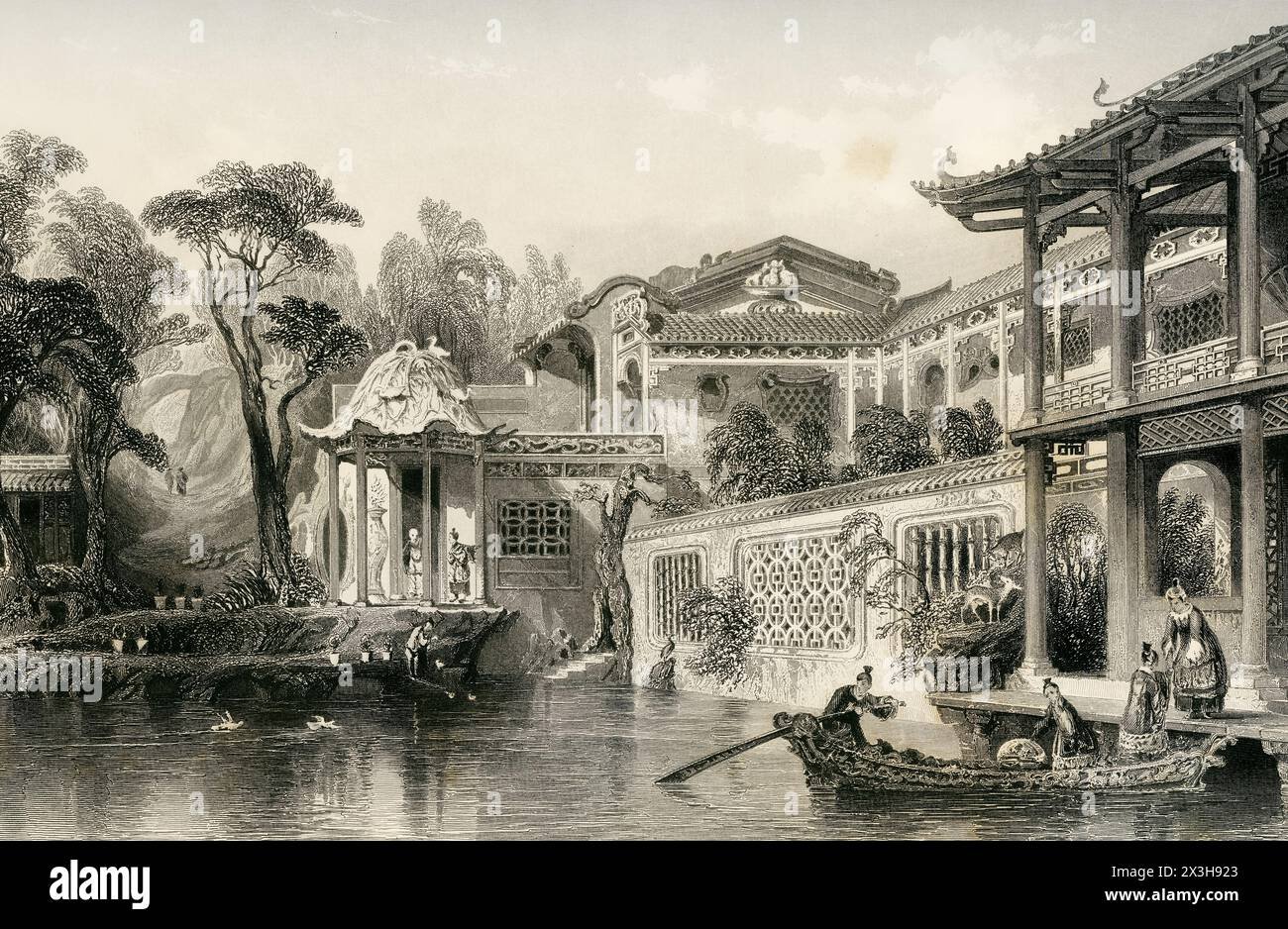
HOUSE OF CONSEEQUA, A CHINESE MERCHANT, IN THE SUBURBS OF CANTON
Cover Image: House of Conseequa, a Chinese merchant, near Canton / Guangzhou GuangDong China / Drawn by T.Allom Engraved by W.H.Capone – ALAMY Image ID:2X3H923
*Canseequa was a businessman from Hunan. After his death, this luxurious mansion was sold to pay off debts. / From a Drawing in the possession of Sir Geo. Staunton, Bart.
There one might dream the hours away,
As if the world had not
Or grief, or care, or disarray,
To darken human lot.L. E. L.
THE interior of Conseequa’s villa, however gorgeous or fantastic, is not to be viewed as a mere fiction of art, illustrative of domestic architecture, but, as a real, existing specimen of that beautiful villa-style so prevalent amongst the Chinese. When hospitality is associated with the character of a Chinese gentleman, and it is one of his genuine characteristic qualities, it is not to be concluded that its practice resembles that of Europeans. A mandarin’s house, being built according to prescribed laws, and subject to the surveillance of the police, necessarily includes regular divisions; one allotted to the reception and entertainment of visitors, another exclusively devoted to the females of his family. In the decorations of the latter, to which none but the gentler sex have access, fancy would almost appear to be exhausted, and treasures, to a great extent, are uniformly expended. The accompanying view represents but one of the many courts that are shaded by weeping foliage, grateful by the cool air that passes over the water, and surrounded by porticos, and bowers, and casements, where the warmest moments of mid-day may be enjoyed with as little inconvenience as the cooler and darker of the setting sun.
Education is not extended to females in China; Confucius has disgraced his philosophy by representing one sex as “of this earth, earthy,” and therefore inferior to the other, which he considers intellectual, heavenly, and destined to immortality. Formed on the barbarous philosophy,
“Which saith, that woman is but dust,
A soul-less toy for tyrants’ lust,”
Chinese laws prohibit the literary education of females. Chinese customs even pretend to despise every filial accession of the stigmatized sex, and Chinese insensibility has left this palpable violation of nature’s laws uncorrected and unavenged.
To compensate for the injuries inflicted on their race, by depriving them totally of intellectual enjoyment, pleasure-grounds, ponds, flowers, grottos, aviaries, and amusements suited to the supposed weakness of their faculties, are furnished abundantly by the rich man to his wife and daughters; and few mandarins, or merchants, have exceeded Consequa in the liberality, or taste, which he has displayed in his villa near Canton. His courts, halls, galleries, porticos, corridors, verandas, and other fantastic forms of architecture, are multiplied beyond the extent to which luxury usually reaches; and the liberty which the members of his family enjoy, seems almost to exceed the best ability to exercise, of which their crippled feet can possibly admit.
An octagonal portico, beneath which two figures are represented, one pointing to the pleasure boat, the other looking in the same direction, is roofed with a representation of the lotus, or nelumbium inverted. This beautiful flower, held sacred, as far as that term can be understood by the followers of Fo, amongst the Chinese, seems to have been the origin of the Tee, or umbrella, which forms the finial in Chinese architecture. In its original, inviolate shape, it corresponds precisely with the inverted cup that covers the pagoda; elongated, it is adapted to buildings of any length, but of limited breadth, the character of the flower being still preserved; and, that architects should have felt a strong inclination to introduce an ornament, or member, into the national style, borrowed from the sacred emblem of the land, is perfectly natural. Here, however, in Consequa’s house, the inverted lotus is undisguisedly employed as the ornamental canopy of a porch or a portico. The Greeks borrowed their columns from the stem of the tree—the ornaments of their capitals, from the acanthus and other flowers; we, of the farther west, have taken our clustered columns and intersecting arches from the Druid’s grove; and another style of nature’s architecture, with its stalagmitic decorations, has unquestionably suggested the ornamental manner in which the Moors have finished their most gorgeous palaces.
![[VOL IV] THE VALLEY OF CHUSAN](https://i0.wp.com/arclumiva.com/wp-content/uploads/2025/09/valley-of-ting-hai-chusan-dinghai-zhoushan-zhejiang-china-drawn-by-t-allom-engraved-by-s-bradshaw-2X55NJ3.jpg?resize=870%2C570&ssl=1)
![[VOL IV] ANCIENT BRIDGE, CHAPOO](https://i0.wp.com/arclumiva.com/wp-content/uploads/2025/09/ancient-bridge-chapoo-haiyan-jiaxing-zhejiang-china-drawn-by-t-allom-engraved-by-rsands-2X55NHK.jpg?resize=600%2C600&ssl=1)
![[VOL IV] HONG-KONG, FROM KOW-LOON](https://i0.wp.com/arclumiva.com/wp-content/uploads/2025/09/hong-kong-from-kow-loon-kowloon-hong-kong-china-drawn-by-t-allom-engraved-by-sfisher-2X55NGM.jpg?resize=600%2C600&ssl=1)
![[VOL IV] CHINESE BOATMAN ECONOMIZING TIME AND LABOUR, POO-KEOU](https://i0.wp.com/arclumiva.com/wp-content/uploads/2025/09/chinese-boatman-economizing-time-labour-poo-kow-nanjing-jiangsu-china-drawn-by-t-allom-engraved-by-awillmore-2X55NGD.jpg?resize=600%2C600&ssl=1)