THE PASS OF YANG-CHOW
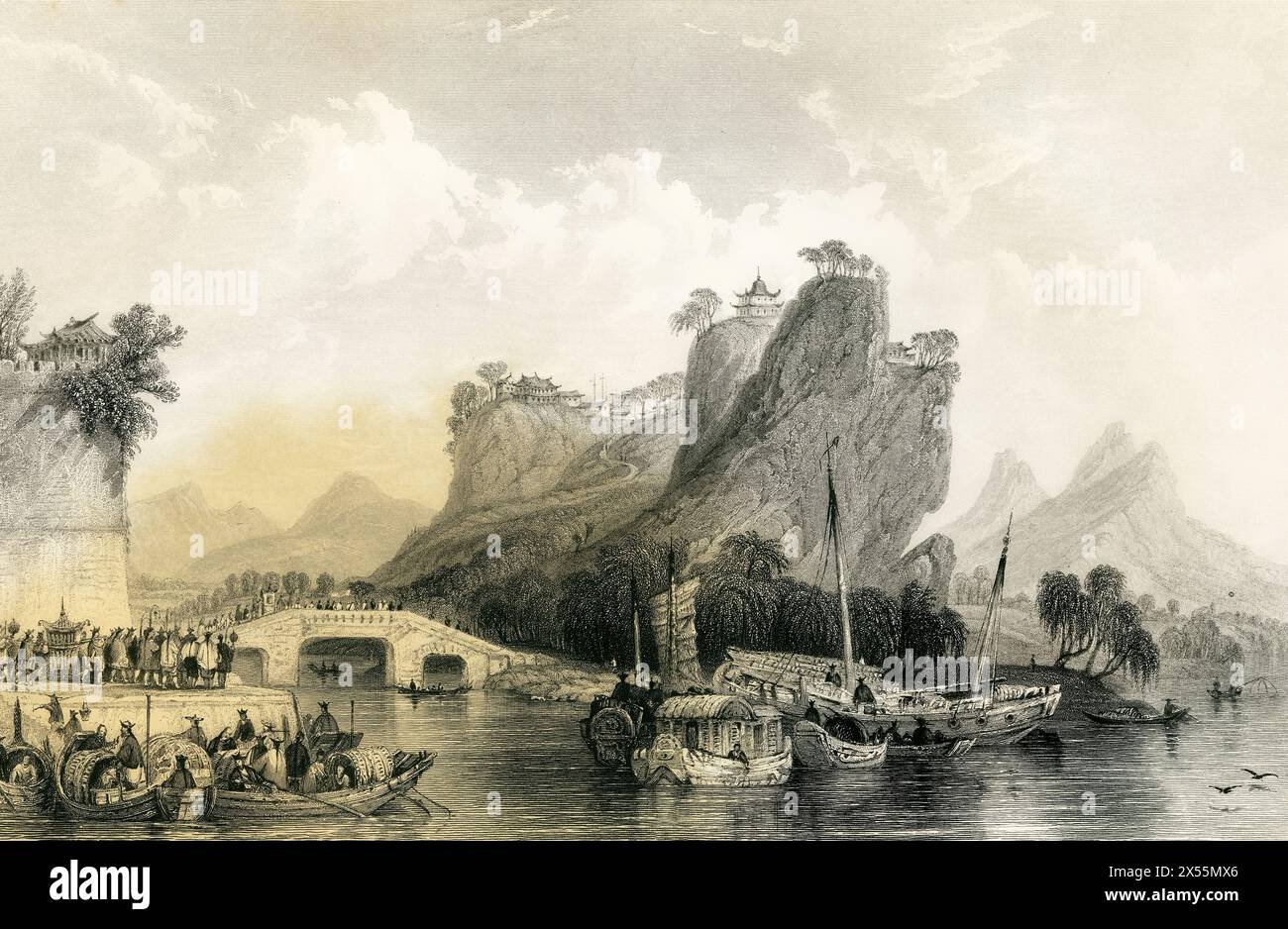
Cover Image: The Pass of Yang Chow / YangZhou JiangSu China / Drawn by T. Allom Engraved by A.Willmore – ALAMY Image ID:2X55MX6
*Yangzhou, originating from the Yangzhou Governor’s Office, was one of the nine provinces in ancient China. It was one of the most important commercial cities in ancient China, strategically located at the confluence of the Grand Canal and the Yangtze River, serving as the maritime gateway for feudal dynasties for nearly a millennium.
“Oh! far away ye are, ye lovely hills,
Yet can I feel the air
Grow sweet while gazing where
The valley with the distant sunshine fills.”
L.E.L.
THERE is some little falsehood, or error, or exaggeration, mixed with a much larger proportion, however, of truth, in the narratives which the learned Jesuits have left of China and the Chinese. Whatever may have been the cause, they have grievously misrepresented the circumstances of Yang-chow-fou in their own time, as indeed in every other. This charge refers more particularly to their statement, “that the inhabitants educate with great pains, many young girls, and teach them to sing, play on instruments, paint, and acquire everything requisite for an accomplished education, and then sell them as morgantic wives to great mandarins.” This is a total misconception of fact: females are not thus reduced to slavery, or made commodities of public barter; how could the inhabitants, themselves all slaves of an emperor, enslave their peers? These girls are apprenticed to professions by their parents, and afterwards appear as public performers for the gratification of a luxurious community. Had the Jesuits said “that music, painting, poetry, and general literature were here very highly cultivated,” it would have been a genuine character of the city and its vicinity.
The climate of this district is exhilarating, like that of south Italy, and Sicily, in the Mediterranean; the country all around picturesque, romantic, varied by scenes both tame and wild, familiar and desolate; and the commerce of the place so active, that multitudes are drawn hither by utility, and detained by pleasure.
Beneath a fanciful flat-arched bridge, a canal falls into the Yang-tse-kiang, and on a rocky height above it are pleasure-gardens, and public pavilions, and rustic theatres, from which the view over the delightful province of Keang-nan is so gratifying and celebrated, that the Pass of Yang-chow is also called “The Rock of Views.” To these rocky retreats from the cares of commerce, the mandarins and the millions withdraw each evening; and, at these periods the crowds that seek a transit of the bridge is too great to be accommodated within a reasonable time, so that a number of small boats are put in requisition to ferry the fashionable across the canal, a distance of a few yards only. Much of the interruption which the poor sustain, who are almost driven into the water, arises from the multitude of attendants upon the seats of the mandarins: rank, greatness, superiority above his fellow-men, being uniformly estimated by the splendour and number of a mandarin’s retainers.
At the embouchure of the canal that traverses the Pass of Yang-chow, is a little bay in the river, where the salt-junks lie at anchor, and where they transfer their valuable freights to boats that navigate the canals and minor rivers of the province.
Modern writers, who have collected diligently every published passage relating to Yang-chow, imitate the bad example of the Jesuits in ascribing to its citizens the double guilt of slave-dealing and immorality. They mistranslate the imputation, and speak of the especial beauty of the females here, while their accomplishments alone were the object to which the monks alluded. They pretend to tell many a tale of adventure that occurred at the “Cactus-bridge,”—on the “Rock of Views,” and beneath the fleecy clouds of Yang-chow; but all are pure creations of the fancy.
Yang-chow-fou is a city of ancient foundation, and said to contain two millions of inhabitants! At the period of Chinese chronology called “Spring and Autumn,” about the year 600 B.C., it formed part of the state of Woo; it passed afterwards to the government of Tsoo, and thence to that of Tsin, the first of the line of universal monarchs. It was subsequently annexed to the district of Kei-keang, or “The Nine Rivers.” At later periods, it is designated in native works by the name, Keang-too, “the River Court,” or Court of Leang-nan, Kwang-ling, and Pang-chow; but the Sung dynasty restored its original name. At the commencement of the Ming, or last Chinese dynasty, it was known as Wei-haë-foo, which it exchanged for its present designation of Yang-chow. The district includes three cities of the second rank, and several towns of third. One of the most remarkable objects in this locality is the Ta-tung-shang, or “Great Brass Hill,” so called from a monarch of Woo having coined money there. Other eminences adorn and distinguish this admired region; amongst them are the famous Kwan-leen-leang, the most remarkable for outline and elevation in the empire; and the Tuh-kang, to the north-west of the city, impending over the waters of the Yang-tse-keang, on which it is seated.
Amongst these lofty, sunny, yet agreeable hills, some natural productions are gathered, which are valued and admired. A medicinal plant called the cho-yo, well known in China, and of which there are thirty species, or sorts, is held in the highest esteem; the ho, or star-tree, is also indigenous here, as well as the hevan-heya, or circular-flower. They tell a story of this last rare production, which seems to be the original of our own fancy about the platanus—that the whole family of the species now naturalized in the British Isles, originated from one implanted Oriental tree; and that whenever the parent sickens, all its offspring become sensibly affected. An inclement season is said to have cut off all the circular-flower trees in China, save one only, and even this showed indications of disease; upon which the emperor Che-ching, of the Mongol dynasty, caused it to be engraved on the Pa-seën-heva, and partially preserved the kind. “The twenty-four city-bridges” have been admired for their solidity, not for their science. Visitors will doubtless feel a desire to see the tomb of Pwan-koo, the first man who sprung forth out of chaos, as well as the mausoleum of the emperor Yang-te, at Lung-tang. In the vicinity are the ruined walls of the ancient city of Kwang-ling, the gardens of Suy, or Shang-lin, and the supreme forest. Close by the pass of Yang-chow is the Hevan-heva terrace, on which were formerly several costly pavilions, besides Halls of Ancestors, and of Confucius.
![[VOL IV] THE VALLEY OF CHUSAN](https://i0.wp.com/arclumiva.com/wp-content/uploads/2025/09/valley-of-ting-hai-chusan-dinghai-zhoushan-zhejiang-china-drawn-by-t-allom-engraved-by-s-bradshaw-2X55NJ3.jpg?resize=870%2C570&ssl=1)
![[VOL IV] ANCIENT BRIDGE, CHAPOO](https://i0.wp.com/arclumiva.com/wp-content/uploads/2025/09/ancient-bridge-chapoo-haiyan-jiaxing-zhejiang-china-drawn-by-t-allom-engraved-by-rsands-2X55NHK.jpg?resize=600%2C600&ssl=1)
![[VOL IV] HONG-KONG, FROM KOW-LOON](https://i0.wp.com/arclumiva.com/wp-content/uploads/2025/09/hong-kong-from-kow-loon-kowloon-hong-kong-china-drawn-by-t-allom-engraved-by-sfisher-2X55NGM.jpg?resize=600%2C600&ssl=1)
![[VOL IV] CHINESE BOATMAN ECONOMIZING TIME AND LABOUR, POO-KEOU](https://i0.wp.com/arclumiva.com/wp-content/uploads/2025/09/chinese-boatman-economizing-time-labour-poo-kow-nanjing-jiangsu-china-drawn-by-t-allom-engraved-by-awillmore-2X55NGD.jpg?resize=600%2C600&ssl=1)