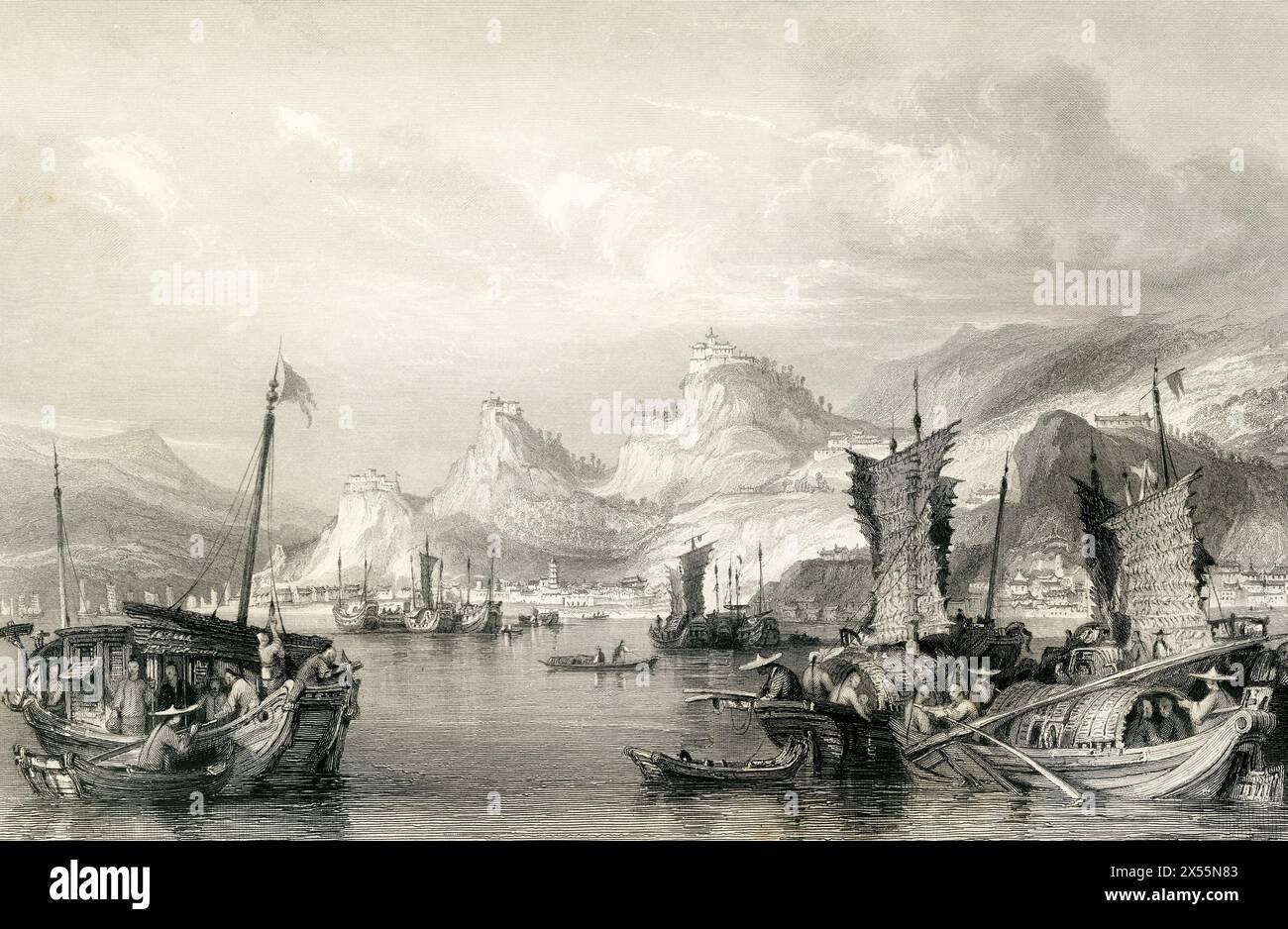
AMOY, FROM THE OUTER HARBOUR
Cover Image: Amoy, from the Outer Harbour / XiaMen FuJian China / Drawn by T. Allom Engraved by A.Le.Petit – ALAMY Image ID:2X55N83
*During the Qing Dynasty, Xiamen experienced unique developments in its economy, commerce, and culture. It also played a crucial role in maritime defense and trade.
“Again their own shore rises on the view,
No more polluted with a hostile hue:
No sullen ship lies bristling o’er the foam,
A floating dungeon—all is hope and home.” († Vide Vol. II., p. 69.)
BYRON.
WHEN Du Halde dwelt amongst the Chinese, Amoy was much valued as a commercial position, and, had the empire enjoyed free institutions, the trade of Eastern China would unquestionably have centered in this picturesque locality. “Amoy is a famous port, hemmed in on one side by the islands, which are high, and shelter it from every wind; it is also so spacious, that it can contain many thousands of vessels; and the sea there is so deep, that the largest ships may come up close to the shore, and ride there in perfect safety. You see there, at all times, a great number of Chinese junks, and about twenty years ago, you might see there many European vessels; now they come hither but seldom, and all the trade is removed to Canton. The emperor keeps six or seven thousand men there in garrison, under the command of a Chinese general.
In entering the haven, you double a cape, or rock, which thus divides itself into two, almost as the Mingaret does in the port of Brest. The rock is visible, and rises several feet above the water. Three leagues thence, stands a little island, having a hole through which you see from one side to the other, and called, on this account, “the Bored Island.” Between this port and Formosa, the islands of Pong-hou form a small archipelago, which are occupied by a Chinese garrison, and the mandarin who resides there has a constant eye upon vessels that trade between China and Formosa.” When Mr. Gutzlaff visited this “famous port,” so many years after, he found its natural features unaltered, and the prejudices of the people, or rather of the government, equally unchanged. The city, however, had outgrown the Jesuit’s accurate description, having a circuit of sixteen miles, and containing upwards of 200,000 inhabitants. Numerous temples arose amidst the houses, and pagodas towered over the narrow ways. Wealth has accumulated in the hands of a few, leaving poverty to sit at the lot of many, and the opening of the ports to foreign trade will necessarily add new avenues of prosperity to the inhabitants of the city and suburbs. Already, a fleet of 200 junks is actively engaged in the Formosa and Japan trade, and the province of Fokien derives its chief revenues from the duties collected in the port of Amoy.
It was to this sheltered, secure, and favourite harbour, that the British merchants directed their principal expeditions for the revival of trade with China; here the Delight ship anchored in 1685, the Hardwicke in 1744, the Lord Amherst in 1832; but all their efforts were frustrated by the jealousy and inhospitality of the Tartar rulers.
Besides one large island, Ko-long-soo, that interrupts the winds and waves, and leaves a passage on either side into the retiring bay, several rocky islets grace the approach from sea towards the river; of these, Chea-soo, Sio-ta, and Toa-ta, are fortified. The granite heights that command the channel and the suburbs, are also dignified with military structures on their lofty pinnacles, but, so elevated above sea-level, and so insignificant in capacity and strength, that they are wholly useless as protective positions. These heights are much admired, even by those to whom they are long familiar; and, in the deep ravines that separate them, are seen magnificent temples to Fo, sumptuous private villas, and lofty and many-storied pagodas. When the British took possession of Amoy, and silenced all its batteries, the scenery of these hills excited the curiosity of our brave soldiers and sailors, and, in their wanderings among the crags, they discovered a number of stone jars, coated with a tenacious lute. On opening these vessels, they were found to contain perfect human skeletons, dislocated, each bone carefully packed, and numbered or marked with red paint. The discoverers have not guaranteed any solution of this singular problem,—nor does any probable one present itself, even after reflection.
![[VOL IV] THE VALLEY OF CHUSAN](https://i0.wp.com/arclumiva.com/wp-content/uploads/2025/09/valley-of-ting-hai-chusan-dinghai-zhoushan-zhejiang-china-drawn-by-t-allom-engraved-by-s-bradshaw-2X55NJ3.jpg?resize=870%2C570&ssl=1)
![[VOL IV] ANCIENT BRIDGE, CHAPOO](https://i0.wp.com/arclumiva.com/wp-content/uploads/2025/09/ancient-bridge-chapoo-haiyan-jiaxing-zhejiang-china-drawn-by-t-allom-engraved-by-rsands-2X55NHK.jpg?resize=600%2C600&ssl=1)
![[VOL IV] HONG-KONG, FROM KOW-LOON](https://i0.wp.com/arclumiva.com/wp-content/uploads/2025/09/hong-kong-from-kow-loon-kowloon-hong-kong-china-drawn-by-t-allom-engraved-by-sfisher-2X55NGM.jpg?resize=600%2C600&ssl=1)
![[VOL IV] CHINESE BOATMAN ECONOMIZING TIME AND LABOUR, POO-KEOU](https://i0.wp.com/arclumiva.com/wp-content/uploads/2025/09/chinese-boatman-economizing-time-labour-poo-kow-nanjing-jiangsu-china-drawn-by-t-allom-engraved-by-awillmore-2X55NGD.jpg?resize=600%2C600&ssl=1)