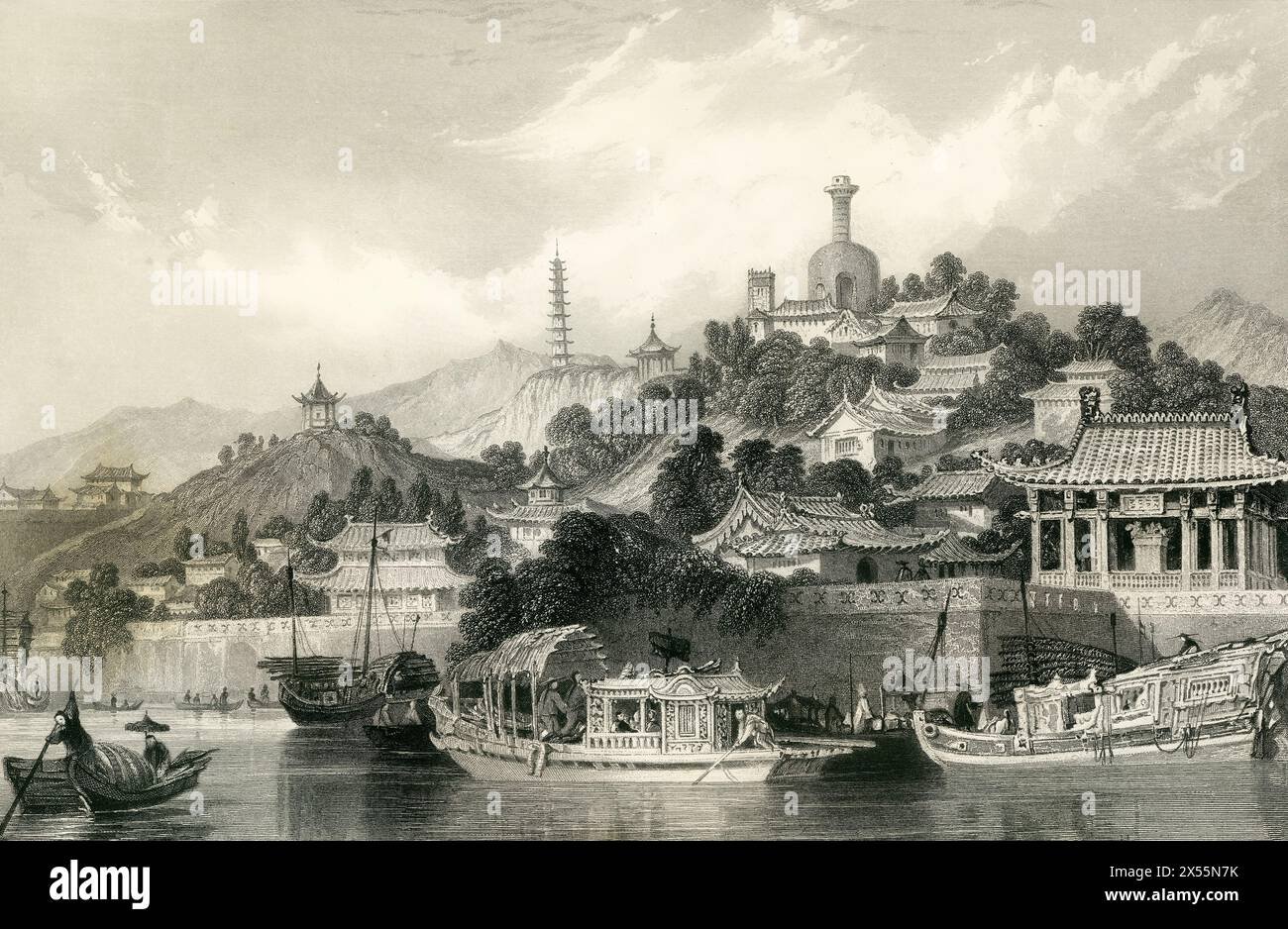
GARDENS OF THE IMPERIAL PALACE, PEKING
Cover Image: Gardens of the Imperial Palace, The Summer Palace, Peking / BeiJing China / Drawn by T. Allom Engraved by J.B.Allen – ALAMY Image ID:2X55N7K
*The Summer Palace, located in the northwest of Beijing, is a royal garden built during the Qing Dynasty, commissioned by Emperor Qianlong. Covering an area of about 290 hectares, it includes beautiful lakes, grand palaces, exquisite temples, and various gardens. This garden is an outstanding representation of classical Chinese gardening and is recognized as a UNESCO World Heritage site. / Property owner: artport, digitalization: artport.
The architecture and landscapes of the Summer Palace cleverly combine elements of landscape painting, architectural art, and garden design, providing the royal family with an ideal place to escape the summer heat. Prominent features include Kunming Lake, the Grand Canal, the Long Corridor, the Tower of Buddhist Incense, the Hall of Happiness and Longevity, the Marble Boat, and many other famous attractions.
The Summer Palace has also witnessed the historical changes in China and has suffered damage from invasions and wars. However, its cultural and historical value has led to its restoration and preservation, making it one of China’s significant tourist destinations.
Fatigued with form’s oppressive laws,
When Taou-Kwang avoids the great;
When cloy’d with merited applause,
He seeks the rural calm retreat:
Does he not praise each mossy cell,
And feel the truth these numbers tell?RURAL ELEGANCE.
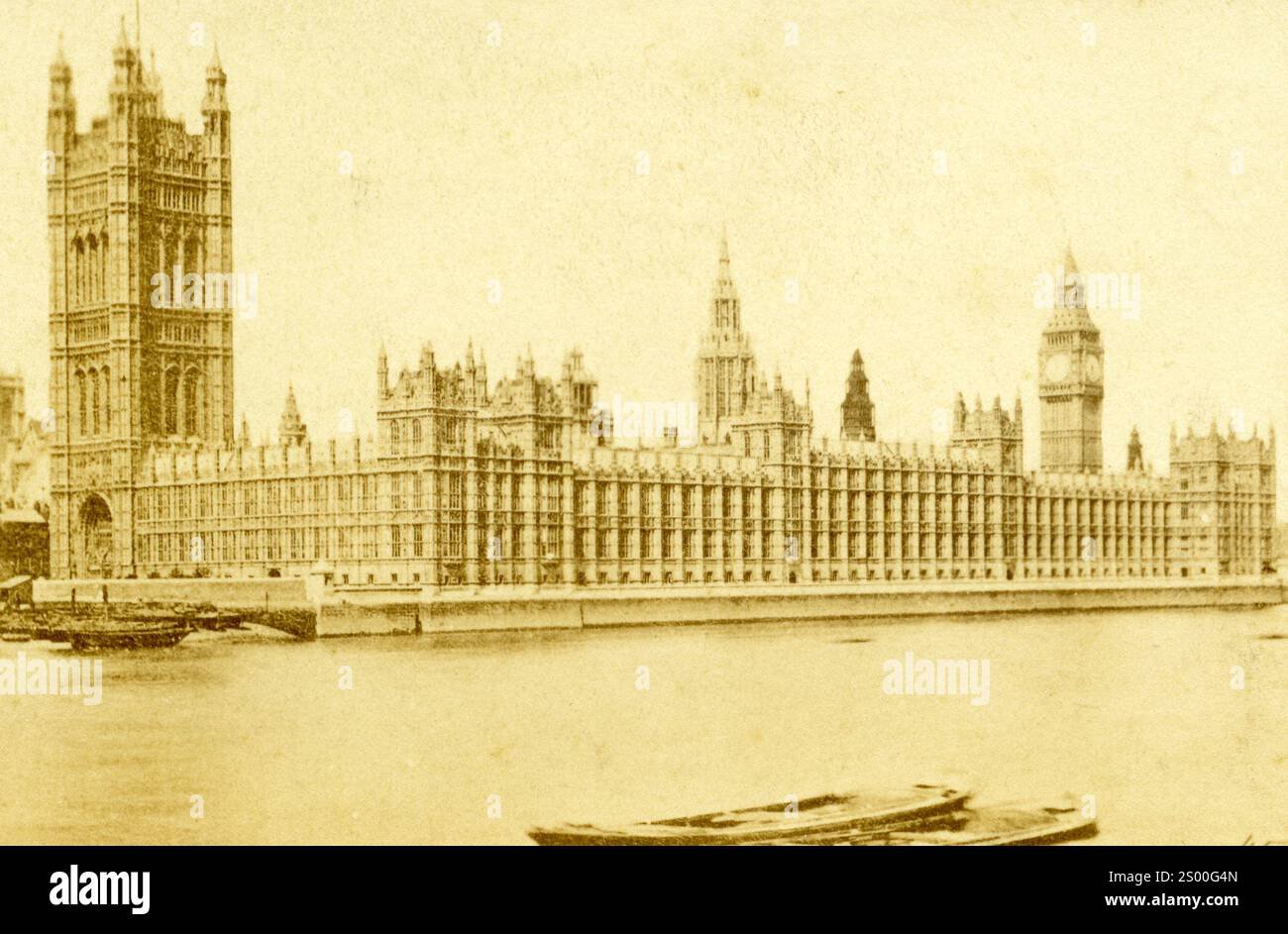
THERE are two distinct cities within the walls of Peking, one occupied by Chinese, the other by Tartars exclusively. In the latter of these are the chief public offices, several sacred institutes, colleges, halls, and, lastly, in the very centre of this labyrinth, the imperial palace and gardens. Three spacious gates pierce the imperial wall, opening communication with the external or Chinese city, which is also fenced and fortified; and an inner enclosure, called “the prohibited wall,” surrounds an area of about two square miles, devoted entirely to the imperial household, and only entered by his majesty’s retinue or his visitors. The mural defences of the palace are built of bright red varnished bricks, covered with shining yellow tiles, whence they are also styled “The Yellow Wall,” and are upwards of twenty feet in height.
The inner surface of the enclosure is varied by the construction of artificial mountains, the excavation of lakes with little islands floating on their tranquil bosoms, and running rivulets, interrupted occasionally by picturesque cataracts; summer-houses and pavilions adorn the margin of the waters, and impart an interest to the numerous islands; and the grouping of fanciful edifices, with clusters of trees, and masses of rock-work, necessarily produce a most agreeable illusion with respect to both distance and magnitude. One great reservoir, or lake, supplies the minor basins within the gardens, and its surface is constantly animated by the arrival and departure of pleasure-junks and barges belonging to the attendants and retainers of the palace.
Pleasure appears to reign supremely in these fairy lands, and were judgment to be given by the eye alone, that siren would be successful. But inquiry will soon correct the hasty conclusion, by discovering the melancholy admixture of sorrow that is infused into all human histories. The double walls, that prohibit surprise, are not unnecessary, nor has the imperial throne been always “a bed of roses.” There is a perilous uncertainty attendant upon making rice the national food; and so frequently is this consequence experienced, that the emperor’s palace would not be safe from the violence of the hungry, in those days of famine that periodically visit his dominions. The markets of Peking are frequently plundered in the most daring manner, and all the courage of the emperor’s tiger-hearted myrmidons is requisite to protect the Tartarian city from assault. Nor are these the only dangers to which the imperial person is exposed. Though the succession to the throne depends on the arbitrary nomination of the reigning prince, this arrangement does not always prevent usurpations. An instance of this occurred in the succession of Yoong-ching to his father Kang-he. The son nominated by the dying emperor was his fourth, but that prince being in Tartary at the period of the emperor’s somewhat sudden demise, Yoong-ching, who was a privileged wang, entered the palace, and seized the billet of his brother’s nomination. Before the number four, which he there found, he boldly set down the sign of ten, and in that way made it appear that he, the fourteenth son, was the prince actually nominated. Seizing the sceptre, he ordered his brother to be arrested and imprisoned, in a building which is yet standing, about four miles north of Peking, and there he detained him till death closed his melancholy story,
In the year 1813, and on the 18th of October, a formidable body of conspirators attacked the palace, during the emperor’s absence at the thermal springs of Je-ho, but being gallantly resisted by the present emperor, second son of the reigning monarch, the revolt was crushed without further injury; and it is to this act of bravery, most probably, Taou-kwang’s nomination to the throne of his royal parent is to be attributed. On the summit of the loftiest eminence in the accompanying illustration, stands a monument of singular structure, but of still more singular history; it was the last scene of the existence of that race of emperors who had beautified the whole of these enchanting grounds, and raised so many gorgeous buildings amidst their scenery. A man whom fortune seemed to favour, as if destined to become the head of a new dynasty in China, availed himself of the weakness and the luxury of the court; and of that indolence which, more than even luxury, had brought the former dynasties to ruin; with an army of Chinese, first collected under the hope of bringing about better times, and kept together afterwards by the tempting bait of plunder, he marched to the gates of Peking. The ill-fated monarch, too slightly supported, and possessed of too little energy to repel, but with sentiments too elevated to endure submission to an enemy who had been his subject, yet determined to save his offspring from the danger of dishonour, stabbed his only daughter, and then terminated his own life with a fatal noose. Here were two iniquitous murders committed, by a man, who had not the bravery to die in battle, nor the moral courage to survive adversity.
![[VOL IV] THE VALLEY OF CHUSAN](https://i0.wp.com/arclumiva.com/wp-content/uploads/2025/09/valley-of-ting-hai-chusan-dinghai-zhoushan-zhejiang-china-drawn-by-t-allom-engraved-by-s-bradshaw-2X55NJ3.jpg?resize=870%2C570&ssl=1)
![[VOL IV] ANCIENT BRIDGE, CHAPOO](https://i0.wp.com/arclumiva.com/wp-content/uploads/2025/09/ancient-bridge-chapoo-haiyan-jiaxing-zhejiang-china-drawn-by-t-allom-engraved-by-rsands-2X55NHK.jpg?resize=600%2C600&ssl=1)
![[VOL IV] HONG-KONG, FROM KOW-LOON](https://i0.wp.com/arclumiva.com/wp-content/uploads/2025/09/hong-kong-from-kow-loon-kowloon-hong-kong-china-drawn-by-t-allom-engraved-by-sfisher-2X55NGM.jpg?resize=600%2C600&ssl=1)
![[VOL IV] CHINESE BOATMAN ECONOMIZING TIME AND LABOUR, POO-KEOU](https://i0.wp.com/arclumiva.com/wp-content/uploads/2025/09/chinese-boatman-economizing-time-labour-poo-kow-nanjing-jiangsu-china-drawn-by-t-allom-engraved-by-awillmore-2X55NGD.jpg?resize=600%2C600&ssl=1)