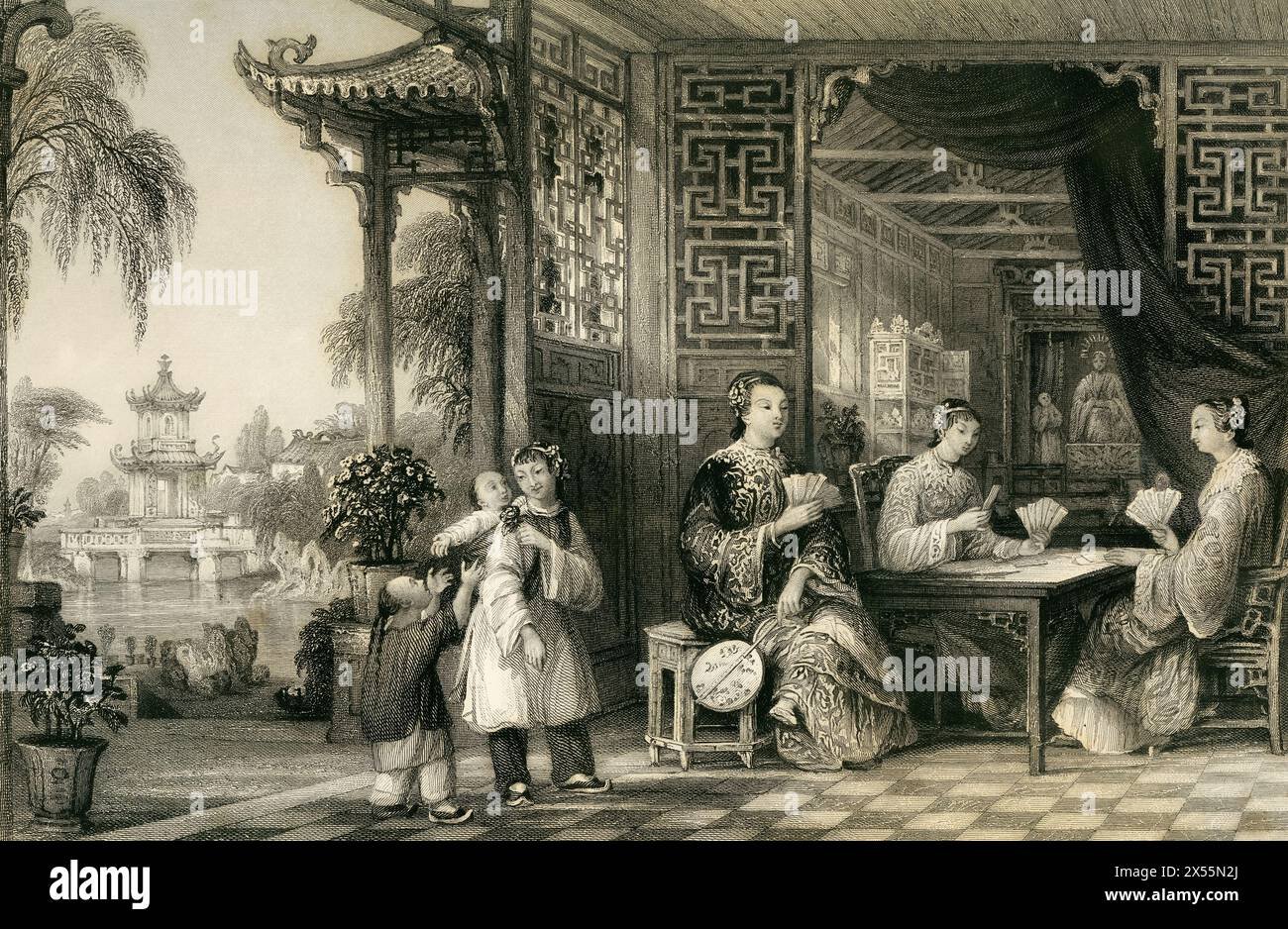
LADIES OF A MANDARIN’S FAMILY AT CARDS
Cover Image: Ladies of Mandarin’s Family at Cards / China / Drawn by T. Allom Engraved by A.Willmore – ALAMY Image ID:2X55N2J
*The exact time when playing cards were first introduced to China is not very clear, but they were likely introduced in the modern history of China. Playing cards are generally believed to originate from Europe and can be traced back to the 14th century or earlier. In China, playing cards were probably introduced through trade or diplomatic channels. This process may have occurred during different historical periods, such as the Ming or Qing dynasties or later. Playing cards gradually gained popularity in China and became a popular form of entertainment and gambling. However, the specific timeline and mode of introduction may vary by region, making it difficult to determine the exact time of their introduction.
Cards were superfluous here, with all the tricks
That idleness has ever yet contrived,
To fill the void of an unfurnished brain,
To palliate dullness, and give time a shove.
COWPER.
THE position which females occupy in society may be very fairly taken as a test of civilization, in each respective nation: wherever the moral and intellectual powers of the gentler sex are held in estimation, that country will be found to enjoy such laws as promote the happiness of the people; wherever personal charms constitute the only ground of love or admiration, as in many Asiatic governments, there tyranny and slavery prevail extensively. Neither do the lavish gifts of nature secure a happy home to their possessor, or subdue the fierce spirit of her absolute lord; on the contrary, surpassing beauty, in unchristian climes, rivets the chains of slavery more firmly, elevates the harem walls to a more hopeless height, excludes the society of friends or companions, and shuts in the luckless victim from the world for ever. And while submission to the caprice of a tyrant is the captive’s wisest policy, her sole remaining lot, even this great sacrifice does not mitigate the ferocity of his nature, or the rudeness of his habits, for often are these helpless inhabitants of the Oriental harem immolated, to allay a groundless jealousy, or make room for a more favoured rival; and oftener still are the most dreadful assassinations perpetrated by tyrants, whose uncontrollable passions are inflamed by the bare suspicion of infidelity. Hence it follows, that where the softer sex are retained in a state of bondage, and denied participation in social duties and social intercourse, there the habits of the people are necessarily rude—there civilization is inevitably checked in its humanizing progress.
It has been remarked, that in England, science, arts, and civilization have advanced more rapidly since the reign of Elizabeth, than in the period between her government and the Conquest—realities which are without doubt attributed to the altered estimation of female character that a custom existed in Wales of selling wives, or rather brides, to husbands; in Scotland, women were prohibited by its uncouth laws from appearing as evidences in a court of justice; and, in our eighth Henry’s reign, women and apprentices were prevented from reading the New Testament in English. Since these rude restrictions have been removed, and female intellect emancipated, see to what a rank among the nations the earth Great Britain has attained! It was while a woman filled the throne that the invincible armada was scattered and destroyed—while a woman reigned, that English literature acquired that character conveyed in the epithet of Augustan—and, it was during a woman’s reign, that China, the oldest of nations, was vanquished by the arms of Britain. It should not be forgotten, that a civilized, a christian, and a chaste community, is more likely to be governed ably and honestly under the softer than the sterner sex, for, in one case, the most distinguished statesmen, in the other, the most intriguing females of the aristocracy, influence the patronage of the court.
A species of middle state, between rudeness and civilization, is the portion of a Chinese lady of quality. Inhumanly deprived of the use of her limbs, whenever she desires to go abroad she is subject to a species of concealment in a close sedan, similar to the arrhuba of Mohammedan odaliques; and so strictly is this incognito observed, that less wealthy persons keep covered wheelbarrows for their captive wives—not to prevent the winds of heaven from visiting them too roughly, but to deprive them of the homage of earthly eyes. Notwithstanding all this jealous care, it is remarkable that females in the humbler ranks are treated with little respect: one class are the flowers of the garden, the other of the forest; one are fed, and lodged, and cherished, with all the care and cost and jealousy that belong to the conservatory—the other left to waste their sweetness on the desert air, or else spurned soon after by the rude hand that plucked them. Often do we see the poor man’s wife labouring in the fields of rice, the farm of cotton, the nurseries of silk, her infant being safely tied upon her back, while her husband is engaged in the excitements of smoking or of gambling.
There is but one supreme mistress of a mandarin’s palace, and to her authority all others of her sex, within the limits of the pavilion, must acknowledge entire submission. To the disgrace of this ancient empire, however, polygamy does exist here, although in a form more mitigated than in the Turkish dominions. Amongst the graceful cabinets counted along with the ladies’ apartments, there is usually one arranged as a chapel of worship, or a hall of ancestors. In general, a figure of Tien-sing, the Queen of Heaven, is placed in a niche at the end, various decorations being introduced all around; and a splendid curtain of embroidered silk falling in front, secures retirement and perfect seclusion for the votaries who may be disposed to enter and to worship. Having no sanctuary in these domestic chapels, where they pour forth the real sentiments of their souls, before that God whose existence their innate ideas prove, but of whose nature and properties they still are ignorant. With the inconsistency that seems to characterize all Chinese customs, and distinguish them from those of other nations, it is in front of this very capella, and in the very presence of their little golden protectress, that the ladies of every family uniformly seat themselves, to indulge in the amusement of card-playing. Defined so many other species of social enjoyment, none but the most rigid and fastidious could object to their indulgence in this ancient game—but who can be unconscious of the glaring contradiction which the choice of a playing-room discloses?
The variety of games known in China is endless; and many of them require considerable dexterity. In shape, the cards are longer and narrower than those in use amongst Europeans, and a pack includes a much larger number. When cards have lost their power of pleasing, the time is beguiled by the introduction of tobacco. Females, from the tender age of eight years, are initiated in this disgusting habit; and a little silken reticule is generally attached to every lady’s dress, to hold a pipe and a supply of tobacco. But these, and even less graceful employments, are pardonable, when the monotonous nature of their life of seclusion is remembered. Although less suspected, less enslaved, less degraded than Turkish females, yet the formality to which Chinese ladies are doomed is eminently tedious. Children, chief solace of a mother’s retired and useful life, are in China placed under laws that outrage the best feelings of human nature. Female infants may be destroyed at the pleasure of the father—over children of the other sex, the law gives the parent absolute power; hence, at the age of ten years, the boy is removed finally from the mother’s surveillance, nor is he permitted after to visit the pavilion in which he was born—the scene in which his helplessness first found that care which a mother only knows how to bestow. Cut off, by a hateful code of regulations, from the opportunity of fulfilling her legitimate trust, the Chinese wife and mother is necessitated to have recourse to those means of filling up the great void in life which these privations have created. Painting, embroidery, the care of an aviary, the recreations of the garden and the pleasure grounds, occasional appeals to the little image that presides over the domestic altar, fond attentions to her children while they are permitted to remain with her, the game of chess when the number of fair captives is limited to two, but, when increased beyond that amount, the more popular amusement of cards, are called to the relief of those pangs which disappointments produce—those sorrows by which separation from the world is so often accompanied.
![[VOL IV] THE VALLEY OF CHUSAN](https://i0.wp.com/arclumiva.com/wp-content/uploads/2025/09/valley-of-ting-hai-chusan-dinghai-zhoushan-zhejiang-china-drawn-by-t-allom-engraved-by-s-bradshaw-2X55NJ3.jpg?resize=870%2C570&ssl=1)
![[VOL IV] ANCIENT BRIDGE, CHAPOO](https://i0.wp.com/arclumiva.com/wp-content/uploads/2025/09/ancient-bridge-chapoo-haiyan-jiaxing-zhejiang-china-drawn-by-t-allom-engraved-by-rsands-2X55NHK.jpg?resize=600%2C600&ssl=1)
![[VOL IV] HONG-KONG, FROM KOW-LOON](https://i0.wp.com/arclumiva.com/wp-content/uploads/2025/09/hong-kong-from-kow-loon-kowloon-hong-kong-china-drawn-by-t-allom-engraved-by-sfisher-2X55NGM.jpg?resize=600%2C600&ssl=1)
![[VOL IV] CHINESE BOATMAN ECONOMIZING TIME AND LABOUR, POO-KEOU](https://i0.wp.com/arclumiva.com/wp-content/uploads/2025/09/chinese-boatman-economizing-time-labour-poo-kow-nanjing-jiangsu-china-drawn-by-t-allom-engraved-by-awillmore-2X55NGD.jpg?resize=600%2C600&ssl=1)