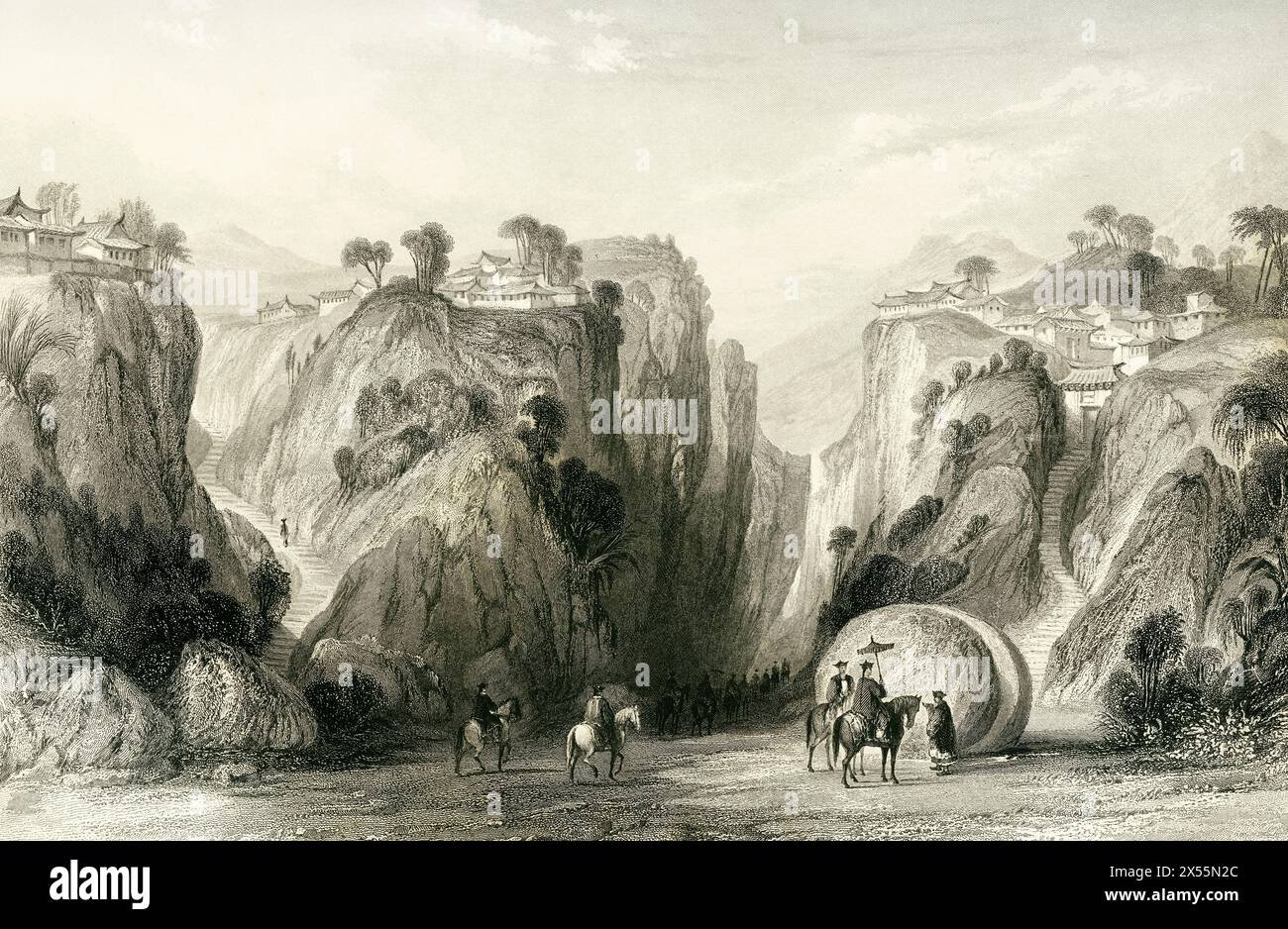
THE PROOF-SWORD ROCK, HOO-KEW-SHAN
Cover Image: The Proof-sword Rock, Hoo-kew-shan / SuZhou JiangSu China / Drawn by T. Allom Engraved by J.Sands – ALAMY Image ID:2X55N2C
*On the east side Road near Tiger Hill(Hoo-kew-shan) in Suzhou, there is a massive rock that’s split like a sword cut, and on the stone, you can find the characters “Proof-sword Rock” (Shijianshi), which means “Sword Testing Stone.” Legend has it that this stone was used by King Helu of Wu and Qin Shi Huang to test their swords. / From a Drawing in the possession of Sir Geo. Staunton, Bart.
And, as the brand he poised and sway’d,
“I never knew but one,” he said,
“Whose stalwart arm might brook to wield
A sword like this in battle-field.”
SCOTT.
IN the mythological or romantic ages of every country, personal strength commanded a respect which is now confined to the few remaining nations that have evaded civilization. The victory is no longer to the strong; intellect, civilization, science have obtained a signal triumph over the brute or animal force; and the prowess of Ajax, or of Cœur de Leon, the unfading theme of the troubadour, will soon be neglected by the writer of history. However, conspicuous excellence in some one respect, whether it arise from a pure unmixed boon of nature, or from the meritorious labours of the individual, cannot fail in attracting the attention of a chronicler worthy of the subject.
Physical ability seems to have been employed as a test of royal origin, of fitness to rule, of military elevation, from the earliest period; but, the criterion in individual cases was different. When Ulysses returned to his sea-girt isle, his halls were filled with suitors for the hand of his faithful queen. Remonstrance would naturally have been vain; his altered appearance, and the protracted period of his wanderings, forming so strong a presumption against personal identity; but when, seizing the bow, which none else could bend, and with –
– one hand aloft display’d
The bending horns, and one the string essay’d,
he shot the arrow through the mystic rings, his claims to royal ancestry were no longer disputed, even by those who offered violence to his resumption of the throne.
The respect in which muscular strength was held by our Norman lords, may be estimated from their long adherence to the practice of single combat, an ordeal still known as “the wager of battle.” A remarkable instance of this kind occurred in the reign of our King John. Some doubt existing as to the English title to a town in Normandy, Philip of France proposed that it should be decided by wager of battle, and his challenge was readily accepted. In all England there was none so famous for courage, and swordsmanship, and gigantic strength, as John de Courcey; but through the artifices of his rival, de Lacey, he had been falsely accused and imprisoned in the Tower of London. Called from his dungeon by a mean and merciless monarch, he answered, “My country, but not my king, shall have my services.”
The field and the lists were now appointed, galleries were erected, and the princes and nobility of both kingdoms seated as spectators, when the French champion sallied forth, took one turn, and then rested himself in his tent. De Courcey next appeared, and went through a similar ceremony. And now the trumpets sounded the grand charge, and the champions issuing from their rests, advanced gallantly to the combat; but, according to the custom of the joust, they first reined in and viewed each other searchingly. The stern aspect of De Courcey, his giant form, his steady seat, his perfect command of horse and weapon, struck terror to the Frenchman’s heart, who calmly essayed as if to take another turn, and display his prowess; but, when the next trumpet sounded, and De Courcey drew his trusty sword, the French champion broke the barrier, and fled the field. The trumpets proclaimed the victory of the English king; but Philip proved, untested against such claim, unless De Courcey gave some indisputable evidence of his surpassing strength. Accordingly, a stake being set up, and a shirt of mail and helmet of steel placed thereon, the champion was directed to prove his sword upon this new adversary. Casting a stern glance at both monarchs as they stood beside him, he raised his shivery arm, and with a single blow, struck the heavy steel so forcibly, that none but himself was able to pull out the weapon. King John, astonished at this extraordinary proof of De Courcey’s chivalrous qualifications, restored him to his title and rank and possessions; adding, that he was prepared also to grant him whatever favour he might prefer. “Your generosity,” replied the victor, “has placed me beyond any desire of further riches: I shall only ask, therefore, that it may be permitted to myself and my successors to remain covered in the presence of royalty.” His request was granted, and, to this day, his descendants, the Earls of Kinsale, enjoy exclusively the privilege of wearing their hats in the presence of the sovereigns of Great Britain.
Another Irish giant and chieftain, but of more genuine Hibernian origin than de Courcy, exhibited his military qualifications by a proof still more unequivocal—this was Fingal, or Fin-mac-cumhal, general of the Irish militia. When this puissant soldier was setting out upon an expedition against the enemies of his country, a mysterious-looking person joined the cavalcade, and entered into familiar converse with the chief. They very naturally discoursed of the profession of arms, and the man of mystery, in the vehemence of argument, exclaimed, “Unless your sword can cleave that mountain, it shall not subdue the multitude of your enemies.” Fingal immediately smote the rugged cliff, and cleft it to the very base.(* Vide Wright’s Guide to Wicklow – Glendalough.)
A tradition, preserved in the San-tsae-to-hwey, gives the following version of the Proof-rock legend of Hoo-kew-shan.( † Hoo-kew-shan, a travelling palace of the emperor, is in the province of Keang-nan. Vide vol. i. p. 14, et seq.) “Heuen-tih, prince of Shuh, one of the three rival kingdoms, was invited by Sun-kwan, the designing monarch of Eastern-woo, to visit his territories, and espouse his sister; but the real object of this flattering invitation was to obtain possession of the prince’s person. Heuen-tih, an honourable and unsuspecting man, adopting the advice of Kung-ming, called also in history, Choo-ho-leang, a sort of Chinese Machiavelli, cheerfully passed the frontiers, and proceeded to the palace of the treacherous Sun-kwan; where his manly appearance was highly pleasing to the queen-dowager, although at first indignant that she had not been consulted in the choice of a husband for her royal daughter. A grand banquet was prepared in honour of the princely guest; but the wicked host caused the pavilion in which it was spread to be closely surrounded by a body of armed men, intending to seize the prince, and throw him into a dungeon. This iniquitous attempt, however, was completely frustrated by the personal bravery of a single man, the gallant aide-de-camp of Heuen-tih, who, perceiving that treachery was intended, suddenly entered the royal salon with his sword drawn, and, placing himself before his master, declared that they should not be made prisoners alive. This resolute conduct arrested the project, and the queen-dowager being made acquainted with the circumstance, did not hesitate to upbraid her son with having dishonoured his royal race, violated the rights of hospitality, and blighted the fair prospects of a sister’s happiness.
He who had been guilty of such baseness felt little reluctance in employing falsehood in his defence; and, having given a secret order for the prince’s escape, declared that the plot was only intended for the purpose of protecting his sister, and his minister, Chia-lai, were ready to complete their promise in the most entire manner, by conferring the hand of the princess Sun-foo-jun upon their valued guest. This, however, was but the first movement of a second plot for the prince’s destruction, for they now calculated upon his becoming so much intoxicated by the pleasures of a luxurious court, that opportunity would not long be wanted for effecting their base objects.
It was immediately after his escape from the dagger of the assassin, that Heuen-tih, having laid aside his robes of ceremony, was walking in front of the palace, when he observed a large rock lying beside the broad pathway. His extraordinary fortunes occupied his thoughts at the moment, and, drawing his sword, and looking up to heaven, he said, “If I, Lew-pei, am destined to revisit my capital, King-choo, and acquire entire possession of the empire, may I cleave this rock in two with a single blow!” While he yet spoke, he smote the rock, from which a perfect blaze of light flashed forth, and cut it in two. Sun-kwan, who stood behind him unperceived, and closely watched his movements, now advanced, and inquired what cause of anger he could possibly entertain towards the stone. “My years,” replied he, “are now the four lustre, yet I am unable to defend my country from the invader: this reflection has filled my heart with pain and sorrow. The honourable alliance which I have just formed with your illustrious family has again, however, awakened my ambition, and I resolved on asking heaven to give me, as a sign or prognostic that I should only defeat my enemy Tsao, power to split this rock at a single blow of my trusty sword; and heaven has granted my request.” The false-hearted Sun-kwan, believing the story to be a mere invention, resolved to test its authenticity; declaring, that he too had asked heaven for a similar sign, as to whether he should partake of the glory of subduing the grand usurper, and of retaking King-choo; and that he also would prove his sword upon the rock of fate. He spoke, and, letting fall his shining blade, the rock was completely rent from top to bottom. Ten characters, graven in the stone, commemorate the extraordinary event, and an elaborate native poem celebrates the praises of the princes, whose fate was so mysteriously connected with the Proof-sword rock.
![[VOL IV] THE VALLEY OF CHUSAN](https://i0.wp.com/arclumiva.com/wp-content/uploads/2025/09/valley-of-ting-hai-chusan-dinghai-zhoushan-zhejiang-china-drawn-by-t-allom-engraved-by-s-bradshaw-2X55NJ3.jpg?resize=870%2C570&ssl=1)
![[VOL IV] ANCIENT BRIDGE, CHAPOO](https://i0.wp.com/arclumiva.com/wp-content/uploads/2025/09/ancient-bridge-chapoo-haiyan-jiaxing-zhejiang-china-drawn-by-t-allom-engraved-by-rsands-2X55NHK.jpg?resize=600%2C600&ssl=1)
![[VOL IV] HONG-KONG, FROM KOW-LOON](https://i0.wp.com/arclumiva.com/wp-content/uploads/2025/09/hong-kong-from-kow-loon-kowloon-hong-kong-china-drawn-by-t-allom-engraved-by-sfisher-2X55NGM.jpg?resize=600%2C600&ssl=1)
![[VOL IV] CHINESE BOATMAN ECONOMIZING TIME AND LABOUR, POO-KEOU](https://i0.wp.com/arclumiva.com/wp-content/uploads/2025/09/chinese-boatman-economizing-time-labour-poo-kow-nanjing-jiangsu-china-drawn-by-t-allom-engraved-by-awillmore-2X55NGD.jpg?resize=600%2C600&ssl=1)