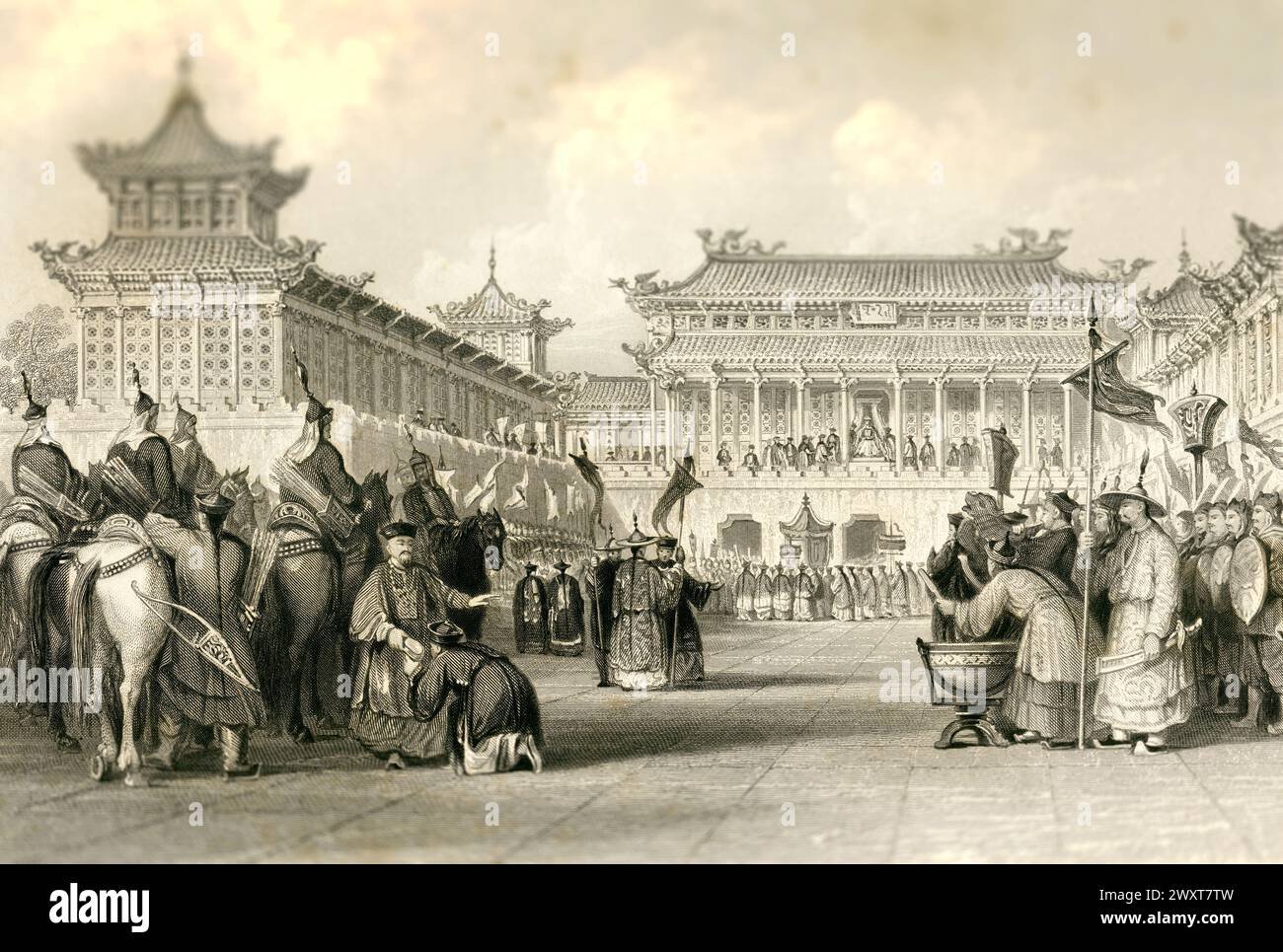
THE EMPEROR TAOU-KWANG REVIEWING HIS GUARDS, PALACE OF PEKING
Cover Image: The Emperor Taou-kwang reviewing his Guards, Palace of Peking ( Emperor Daoguang Reviewing Imperial Guards, Forbidden City Beijing ) / BeiJing China / Drawn by T. Allom Engraved by J.B.Allen – ALAMY Image ID:2WXT7TW/3CGJHCF
*Emperor Daoguang of the Qing Dynasty held a parade at the Noon Gate in the Forbidden City.
The Daoguang Emperor, also known by his temple name Emperor Xuanzong of Qing, personal name Mianning, was the seventh emperor of the Qing dynasty, and the sixth Qing emperor to rule over China proper, reigning from 1820 to 1850. His reign was marked by “external disaster and internal rebellion.” These included the First Opium War and the beginning of the Taiping Rebellion which nearly brought down the dynasty. The historian Jonathan Spence characterizes the Daoguang Emperor as a “well meaning but ineffective man” who promoted officials who “presented a purist view even if they had nothing to say about the domestic and foreign problems surrounding the dynasty.”
The groves of polish’d spears, the targets bound
With circling gold, the shining helms around
Against the sun with full reflection play,
Rival his light, and shed a second day.
THE HENRIADE.
POLITICAL feeling, unavoidable discontent amongst a certain portion of the governed, and a growing desire for extended freedom, combine in exposing the imperial throne to daily danger. A Tartar corps, like the Swiss guard of Paris in times gone by, forms the chiefest protection against treachery or surprise; and these military men are treated with a marked distinction by their royal master. Although their fidelity has never been impeached, and the rays of imperial favour shine brightly on them, the least abuse of power on their part would endanger their existence. Of this fact, the fate of the Janissaries at Constantinople, and of the Mamelukes at Cairo, presents an appalling argument, derived from the analogy of despotic governments.
In the court of the Three Halls, in the palace at Peking, an annual review of the Tartar guards is held, by the emperor in person, as the new year opens. Along the embattled terrace in front of the extended colonnades, the great officers of the palace are ranged; while Taou-kwang, seated on the throne, and surrounded by his ministers, looks complacently down upon the brave defenders of the yellow standard.
These Tartar lifeguards might possibly display the most courageous bearing, if called to defend their monarch’s crown; but, their mode of life, and imperfect discipline, do not afford much favourable promise. Although it is a practice of the Ping-poo, a military tribunal, to institute comparisons between their great officers, and the most ferocious kinds of animals; recommending that they should be “tigers in their fierce deportment;” although they deck their troops with skins of the lion and the tiger, and paint their shields with the most hideous devices; yet is their uniform but a mere meretricious costume, and their discipline a most entire mockery of the military art.
The full uniform of a Tartar officer on a field-day, or occasion of review, is complicated and costly, but not compact. A polished helmet, resembling an inverted cone, and ending in a crest about eight inches above the head, is adorned with gold and with coloured hair; a robe of blue or purple silk, and studded with gilt buttons, envelopes the person, and descends to the boots, which are of black satin; while the handles of their swords and horns of their bows, and stocks of their match-locks glitter with precious gems. The dress of the privates is less gorgeous, but equally fantastic; their robes are of stuff striped in imitation of tiger-skin, their cap or helmet lofty, and shaped as a tiger’s head; and, on their round shields of bamboo cane are raised devices, either a dragon’s figure, or a tiger’s head. No duty, however, seems to be imposed on the imperial guard, beyond the watchful care of their august master; they are permitted to pursue commercial avocations, relieving each other in their duty at the palace; but they reside always within the Tartar city, which is distinct, and separated by a lofty wall from the Chinese section of Peking. The ceremony of a review within the Imperial palace is necessarily imposing; the costume, if not suited to European taste, is still rich and brilliant; the banners are always numerous and of the most gaudy colours, while palanquins, lanterns, dragons, and other devices, carried by the standard-bearers, confer a character of sumptuousness, in which the Chinese falsely imagine that true nobility consists. None but the imperial band is allowed to perform: it includes kettle-drums and gongs of large diameter, wind instruments shaped like dragons, serpents, and fish, besides an unlimited number of clarionets and lutes.
END OF VOL. III.
![[VOL IV] THE VALLEY OF CHUSAN](https://i0.wp.com/arclumiva.com/wp-content/uploads/2025/09/valley-of-ting-hai-chusan-dinghai-zhoushan-zhejiang-china-drawn-by-t-allom-engraved-by-s-bradshaw-2X55NJ3.jpg?resize=870%2C570&ssl=1)
![[VOL IV] ANCIENT BRIDGE, CHAPOO](https://i0.wp.com/arclumiva.com/wp-content/uploads/2025/09/ancient-bridge-chapoo-haiyan-jiaxing-zhejiang-china-drawn-by-t-allom-engraved-by-rsands-2X55NHK.jpg?resize=600%2C600&ssl=1)
![[VOL IV] HONG-KONG, FROM KOW-LOON](https://i0.wp.com/arclumiva.com/wp-content/uploads/2025/09/hong-kong-from-kow-loon-kowloon-hong-kong-china-drawn-by-t-allom-engraved-by-sfisher-2X55NGM.jpg?resize=600%2C600&ssl=1)
![[VOL IV] CHINESE BOATMAN ECONOMIZING TIME AND LABOUR, POO-KEOU](https://i0.wp.com/arclumiva.com/wp-content/uploads/2025/09/chinese-boatman-economizing-time-labour-poo-kow-nanjing-jiangsu-china-drawn-by-t-allom-engraved-by-awillmore-2X55NGD.jpg?resize=600%2C600&ssl=1)