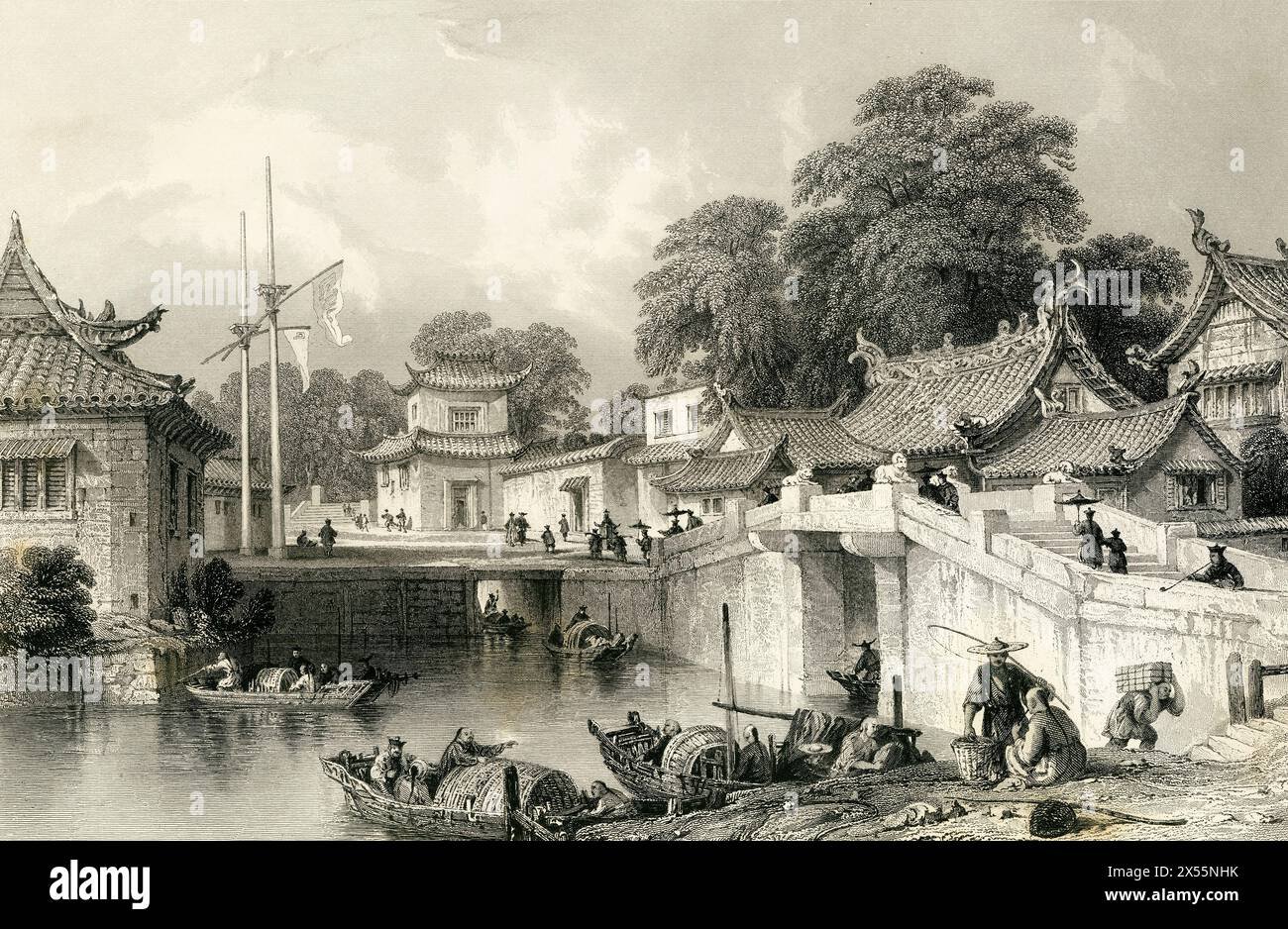
ANCIENT BRIDGE, CHAPOO
Cover Image: Ancient Bridge, Chapoo / HaiYan JiaXing ZheJiang China / Drawn by T. Allom Engraved by R.Sands – ALAMY Image ID:2X55NHK
*This painting depicts a scene on Chapoo(Zhapu) Street. Zhapu is located in the water towns of Jiangnan, with a dense network of rivers and, as a result, the construction of numerous bridges. According to records, during the Qing Dynasty, there were a total of 24 bridges in Zhapu Town. These bridges included four magnificent drawbridges that surrounded the city, as well as picturesque small bridges constructed along the waterways typical of the Jiangnan region. / Sketched on the Spot by Capt Stoddart R.N..
Bridges, and palaces, and towers,
Now rise by such strange quick’ning powers,
That we, who come of ancient race,
Must travel with a slower pace.
H.
IN primitive forests, where time and tempest struggle for dominion, huge trees are prostrated by these giant powers, and thrown into singular positions. Sometimes they fall and lean against each other, in a Gothic arch; sometimes they lie in heaps, like basaltic columns; and at others they stretch across the ravine or the torrent, as securely as if science had lent her aid in their disposition. It was such accident, if there be chance in the operations of nature, that first suggested the idea of the horizontal bridge, consisting of a single plank; hence it may with some probability be concluded, that the flat arch is the most ancient in use, not only amongst the Chinese but other nations also. At later periods, when industry and civilization had grown old together, these people executed works of the greatest engineering difficulties; amongst such are bridges of some hundred arches, resting on piers of solid masonry, triumphal monuments of the richest design, arches, and aqueducts. Even the art of tunnelling was early practised, and it is several centuries since Colao, a native of Quang-tong, caused the high mountain that hangs over Nanking to be pierced through from north to south, by a high road for travellers.
The flat bridge of a single opening on the river of Chapoo is obviously of the most early style. Strong abutments being constructed, large flags are laid, lapping one over the other like stairs, to the edge, or nearly, of the pier, from which flag-stones of requisite dimensions are laid across the interval. In the next era of bridge-building the Egyptian arch was adopted; in the third, the segment of a perfect circle. On the balustrade of Chapoo bridge, lions couchant, rather rudely executed, are placed, emblematic of the magnificence of the structure, or the great ability of the architect. In no country is learning held in higher esteem, art pursued with greater zeal, or genius more uniformly rewarded. The captain of a Tartar band, who succeeds in annihilating or dispersing a banditti, is honoured with a triumphal arch, on which his exploits are blazoned in letters of gold; temples are raised to the shade of the philosopher; and the fame of the great tunnel at Nanking is ever before the eyes and the minds of his countrymen, a monument to his honour being placed on the highest pinnacle of the mountain which the tunnel pierces. The memory of their princes is also preserved by architectural testimonials, inferior, however, in most instances, to the monuments of those whom science or virtue has rendered illustrious. Although women are secluded from mingling in the duties of society, it is with the utmost deference and respect, pretending, that it is solely with a view to spare their feelings, that they do not require them to participate in the active duties of society. Whether this be a specimen of Chinese duplicity, or a true and genuine sentiment, it is certain that the highest honours are frequently paid to female virtue, and the praises of the softer sex are not only celebrated in the stanzas of the poet, but obelisks and arches, and monuments of the most costly character, are also raised, to mark a nation’s admiration of the high qualities that distinguish mother, wife, and daughter.
![[VOL IV] THE VALLEY OF CHUSAN](https://i0.wp.com/arclumiva.com/wp-content/uploads/2025/09/valley-of-ting-hai-chusan-dinghai-zhoushan-zhejiang-china-drawn-by-t-allom-engraved-by-s-bradshaw-2X55NJ3.jpg?resize=870%2C570&ssl=1)
![[VOL IV] HONG-KONG, FROM KOW-LOON](https://i0.wp.com/arclumiva.com/wp-content/uploads/2025/09/hong-kong-from-kow-loon-kowloon-hong-kong-china-drawn-by-t-allom-engraved-by-sfisher-2X55NGM.jpg?resize=600%2C600&ssl=1)
![[VOL IV] CHINESE BOATMAN ECONOMIZING TIME AND LABOUR, POO-KEOU](https://i0.wp.com/arclumiva.com/wp-content/uploads/2025/09/chinese-boatman-economizing-time-labour-poo-kow-nanjing-jiangsu-china-drawn-by-t-allom-engraved-by-awillmore-2X55NGD.jpg?resize=600%2C600&ssl=1)
![[VOL IV] ENTRANCE TO THE CHIN-CHEW RIVER, FOKIEN](https://i0.wp.com/arclumiva.com/wp-content/uploads/2025/09/entrance-to-the-chin-chew-river-fokien-jinjiang-quanzhou-fujian-china-drawn-by-t-allom-engraved-by-ctdixon-2X55NG7.jpg?resize=600%2C600&ssl=1)