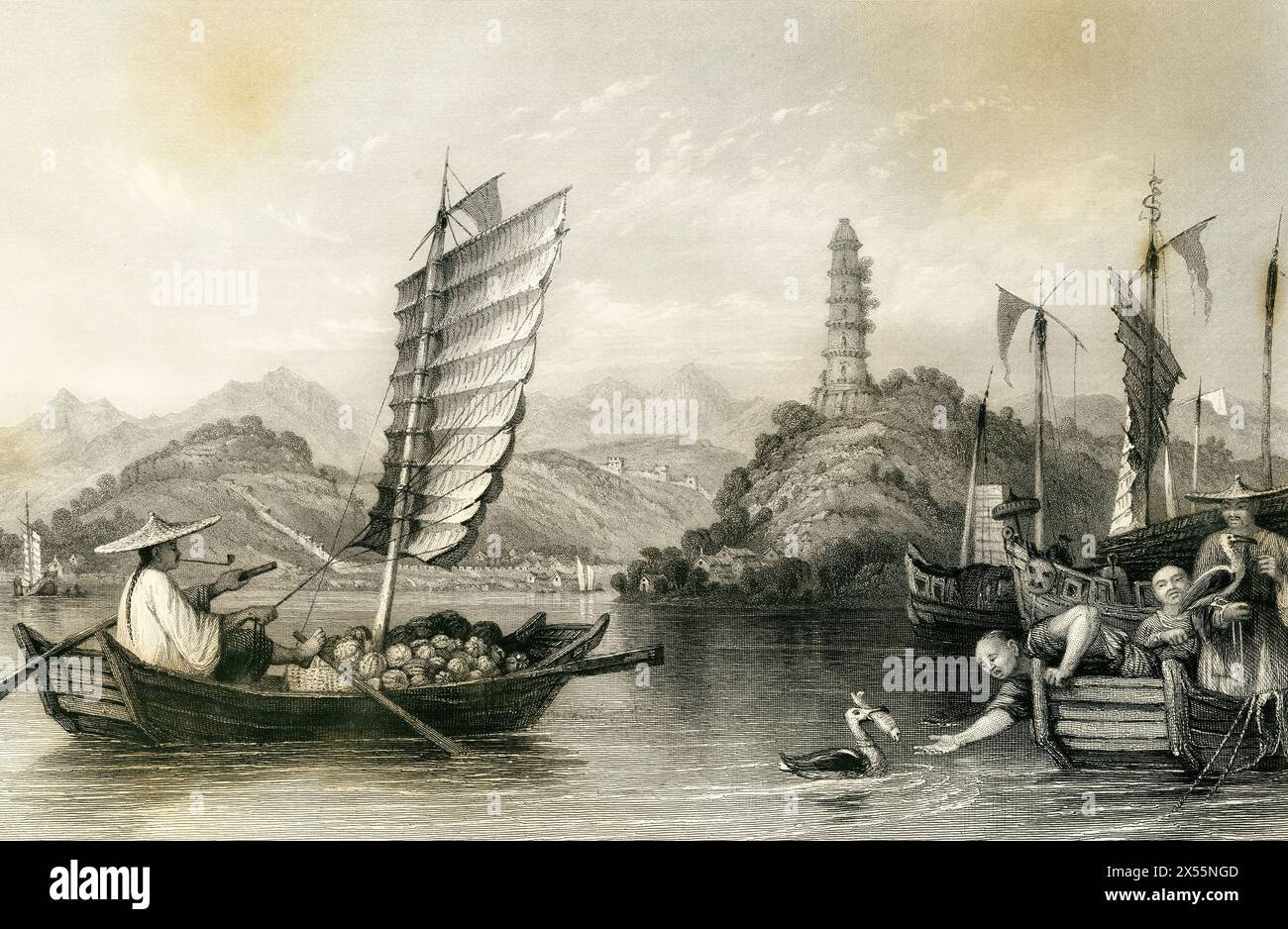
CHINESE BOATMAN ECONOMIZING TIME AND LABOUR, POO-KEOU.
Cover Image: Chinese boatman economizing Time & Labour, Poo-kow / NanJing JiangSu China / Drawn by T. Allom Engraved by A.Willmore – ALAMY Image ID:2X55NGD
*This illustration depicts a boatman rowing with both his hands and feet. PuKou, NanJing (JiangSu). / Sketched on the Spot by Capt Stoddart R.N..
“Now he weighs time even to the utmost grain.” – Henry V.
ON the north bank of the Yang-tse-keang, and opposite to the canal that extends from that river to the walls of Nanking, may still be seen the mouldering battlements of Poo-keou-hien. These primitive defences were never of considerable height or strength, and their preservation is less to be ascribed to original solidity, than to the mildness of climate and conservative disposition of the native population. The enceinte of the deserted city is now grown over with shrubs and wild flowers; and such is Chinese veneration for ancient places—so great the superstition that protects all records of days long numbered – that not the slightest trespass is ever committed upon this solitary site. Nature has resumed her empire within the walls which the industry of man had raised for her exclusion. The forsaken pagoda that crowns the summit of a rocky eminence, rising rather rapidly above the river, consists of five stories, resting on a substructure, that would appear, from the solid quality of the natural foundation, to have been altogether unnecessary. From its plain decorations, and very inferior style, it may probably have been dedicated to the winds, or the waves, rather than to Buddha, whose priests would not readily have abandoned a position so agreeably and felicitously placed for the visits of votaries. In several places of China, known to Europeans, temples of the winds have been found, without either priests or protectors, and resigned, like the forsaken pagoda of Poo-keou, to the mercy of their tutelar deities.
Its proximity to Nanking gives ample employment to the rural population of this district, and facility of water-conveyance is amongst the chief advantages which they enjoy. ’Tis true, labour is cheap where hands are numerous, and the Chinese are more lavish of manual workmanship than any other people that we are acquainted with; yet in some few instances they seem to practise an economy in time and trouble, totally at variance with their habitual extravagance of both, in all others. A market-gardener of Poo-keou, having loaded his boat heavily with fruit and vegetables, erects a bamboo mast, unfurls a sail of bamboo-fibres, and, drawing together the bamboo cords that constitute his reefing-tackle, makes fast their common extremity to a pin beside him. Placing his pipe securely in his mouth, and his broad bamboo hat as firmly on his head, he proceeds upon his voyage: – should the wind be suitable to fill his sail, then with one hand he tightens or relaxes his tackle, and with the other holds the helm. One oar is allowed to lie idle, but the other is worked advantageously, both for guidance and propulsion, with the foot. This illustration of customs forms a striking contrast to another, which the same scenic representation exhibits. While the economist of labour is passing in his laden boat, fishermen are actively engaged with their trained diving-birds, procuring a supply for the market of Nanking. In this most tedious process, a process which has been previously described in the pages of these volumes, the sagacity of the cormorant is alone entitled to our admiration; the indefatigable patience, that caused its development, deserving little more than our compassion.
![[VOL IV] THE VALLEY OF CHUSAN](https://i0.wp.com/arclumiva.com/wp-content/uploads/2025/09/valley-of-ting-hai-chusan-dinghai-zhoushan-zhejiang-china-drawn-by-t-allom-engraved-by-s-bradshaw-2X55NJ3.jpg?resize=870%2C570&ssl=1)
![[VOL IV] ANCIENT BRIDGE, CHAPOO](https://i0.wp.com/arclumiva.com/wp-content/uploads/2025/09/ancient-bridge-chapoo-haiyan-jiaxing-zhejiang-china-drawn-by-t-allom-engraved-by-rsands-2X55NHK.jpg?resize=600%2C600&ssl=1)
![[VOL IV] HONG-KONG, FROM KOW-LOON](https://i0.wp.com/arclumiva.com/wp-content/uploads/2025/09/hong-kong-from-kow-loon-kowloon-hong-kong-china-drawn-by-t-allom-engraved-by-sfisher-2X55NGM.jpg?resize=600%2C600&ssl=1)
![[VOL IV] ENTRANCE TO THE CHIN-CHEW RIVER, FOKIEN](https://i0.wp.com/arclumiva.com/wp-content/uploads/2025/09/entrance-to-the-chin-chew-river-fokien-jinjiang-quanzhou-fujian-china-drawn-by-t-allom-engraved-by-ctdixon-2X55NG7.jpg?resize=600%2C600&ssl=1)