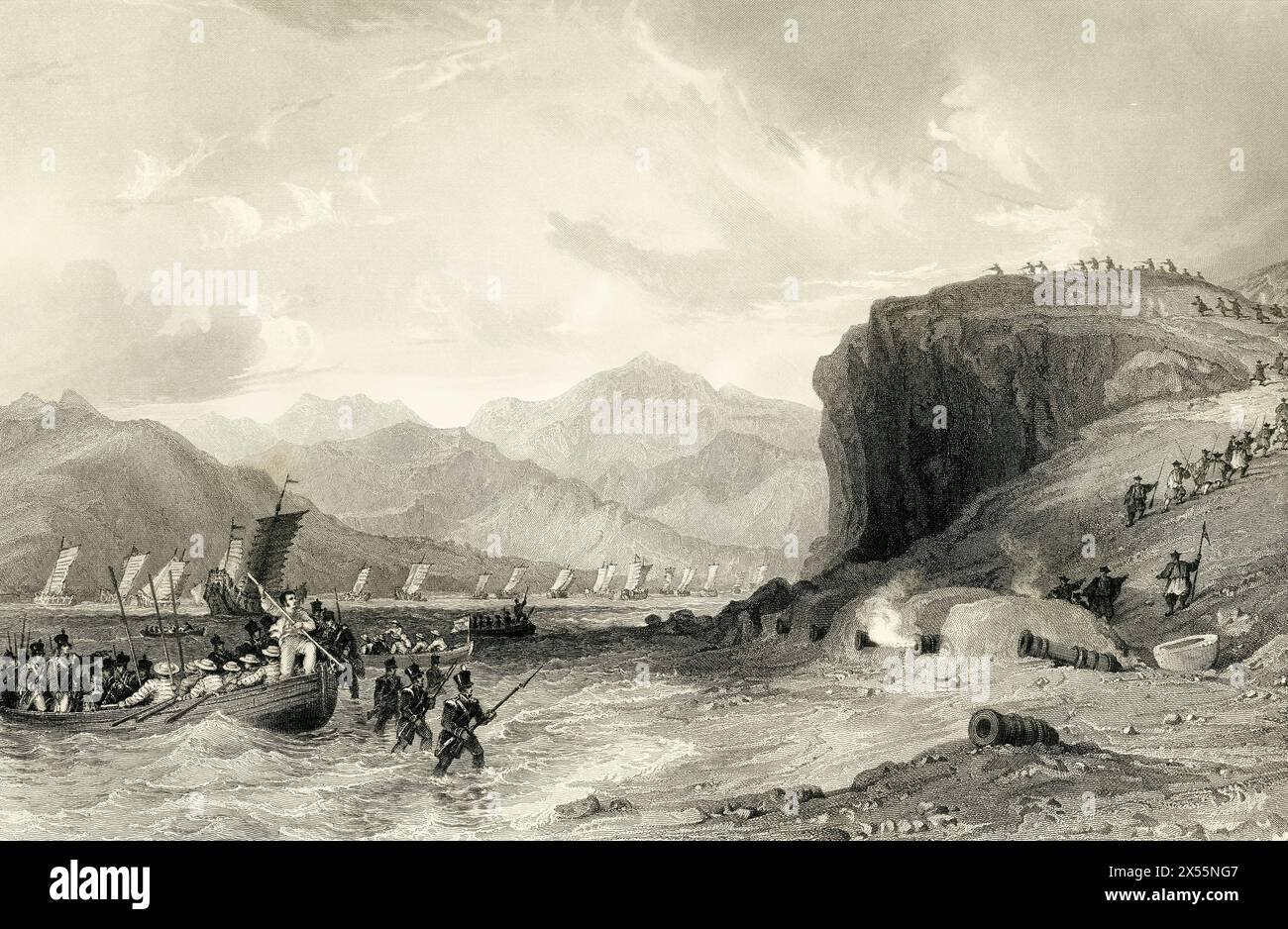
ENTRANCE TO THE CHIN-CHEW RIVER, FOKIEN
Cover Image: Entrance to the Chin-chew River, Fokien / JinJiang QuanZhou FuJian China / Drawn by T. Allom Engraved by C.T.Dixon – ALAMY Image ID:2X55NG7
*The battles that occurred in Jinjiang (Quanzhou) during the Opium War period. / Sketched on the Spot by Capt Stoddart R.N..
Though the grave were in his way,
Forward, would the Briton say;
And upon his latest breath,
Would be “Victory or Death.”
IN its progress northward, after Amoy had been captured, the British fleet entered the estuary of the Chin-chew river, on the south bank of which, but some miles inland, the city of Tscuen-theou-foo is situated. As this port was the very focus of the contraband traffic in opium, some rude preparations had been made to resist the approach of a hostile expedition. Description of those puerile operations is superseded by the intelligent, and very clever drawings of the scene, which the portfolio of Captain Stoddart, a sharer of the expedition, placed under Mr. Allom’s control. The Chinese junks kept at a respectful distance, from the boats of the detachment that was ordered to effect a landing at the foot of a bluff on the north side of the river, and, as to the brave Tartars, who were placed there to serve the guns on shore, after a few discharges only, they fled in the wildest dismay, abandoning their copper ordinance and all their ammunition nition to the enemy. The material of which they were made, rendered the captured cannon something more than trophies of glory: the value of those taken at Chin-hea alone, exceeded £10,000 sterling; and the spoils of Woo-sung were still more important.
The commercial city, to which the Chin-chew river is the highway, holds a distinguished place amongst those of the first class; inferior to few in geographical position, and in healthful trade, it is eminently adorned with triumphal arches, temples, and other public edifices, its streets being remarkable for their extent and width. Seven cities of the third rank are placed under the protection of this ancient and populous fou. It is in the immediate vicinity of Tsuen-theou, that the extraordinary bridge is to be seen, which Martini has described in the following terms: – “I saw it twice, and each time with astonishment. It is built entirely of a blackish stone, and has no arches, but upwards of three hundred large stone pillars, which terminate on each side in an acute angle, to break the violence of the current with great facility. Five stones of equal size, laid transversely from one pillar to another, form the breadth of the bridge, each of which, according to the measurement I made in walking, was eighteen of my ordinary steps in length; there are one thousand of them, all of the same size and figure: a wonderful work, when one considers the great number of these heavy stones, and the manner in which they are supported between the pillars. On each side there are buttresses or props, constructed of the same kind of stone, on the tops of which are placed lions on pedestals, and other ornaments of a similar description.” Many lives having been lost while ferry-boats were the only means of crossing these troubled waters, a certain humane governor of the city constructed this splendid monument to his fame, at his sole expense. That expense, if reliance may be placed on the accounts of the learned Du Halde, amounted to half a million sterling.
![[VOL IV] THE VALLEY OF CHUSAN](https://i0.wp.com/arclumiva.com/wp-content/uploads/2025/09/valley-of-ting-hai-chusan-dinghai-zhoushan-zhejiang-china-drawn-by-t-allom-engraved-by-s-bradshaw-2X55NJ3.jpg?resize=870%2C570&ssl=1)
![[VOL IV] ANCIENT BRIDGE, CHAPOO](https://i0.wp.com/arclumiva.com/wp-content/uploads/2025/09/ancient-bridge-chapoo-haiyan-jiaxing-zhejiang-china-drawn-by-t-allom-engraved-by-rsands-2X55NHK.jpg?resize=600%2C600&ssl=1)
![[VOL IV] HONG-KONG, FROM KOW-LOON](https://i0.wp.com/arclumiva.com/wp-content/uploads/2025/09/hong-kong-from-kow-loon-kowloon-hong-kong-china-drawn-by-t-allom-engraved-by-sfisher-2X55NGM.jpg?resize=600%2C600&ssl=1)
![[VOL IV] CHINESE BOATMAN ECONOMIZING TIME AND LABOUR, POO-KEOU](https://i0.wp.com/arclumiva.com/wp-content/uploads/2025/09/chinese-boatman-economizing-time-labour-poo-kow-nanjing-jiangsu-china-drawn-by-t-allom-engraved-by-awillmore-2X55NGD.jpg?resize=600%2C600&ssl=1)