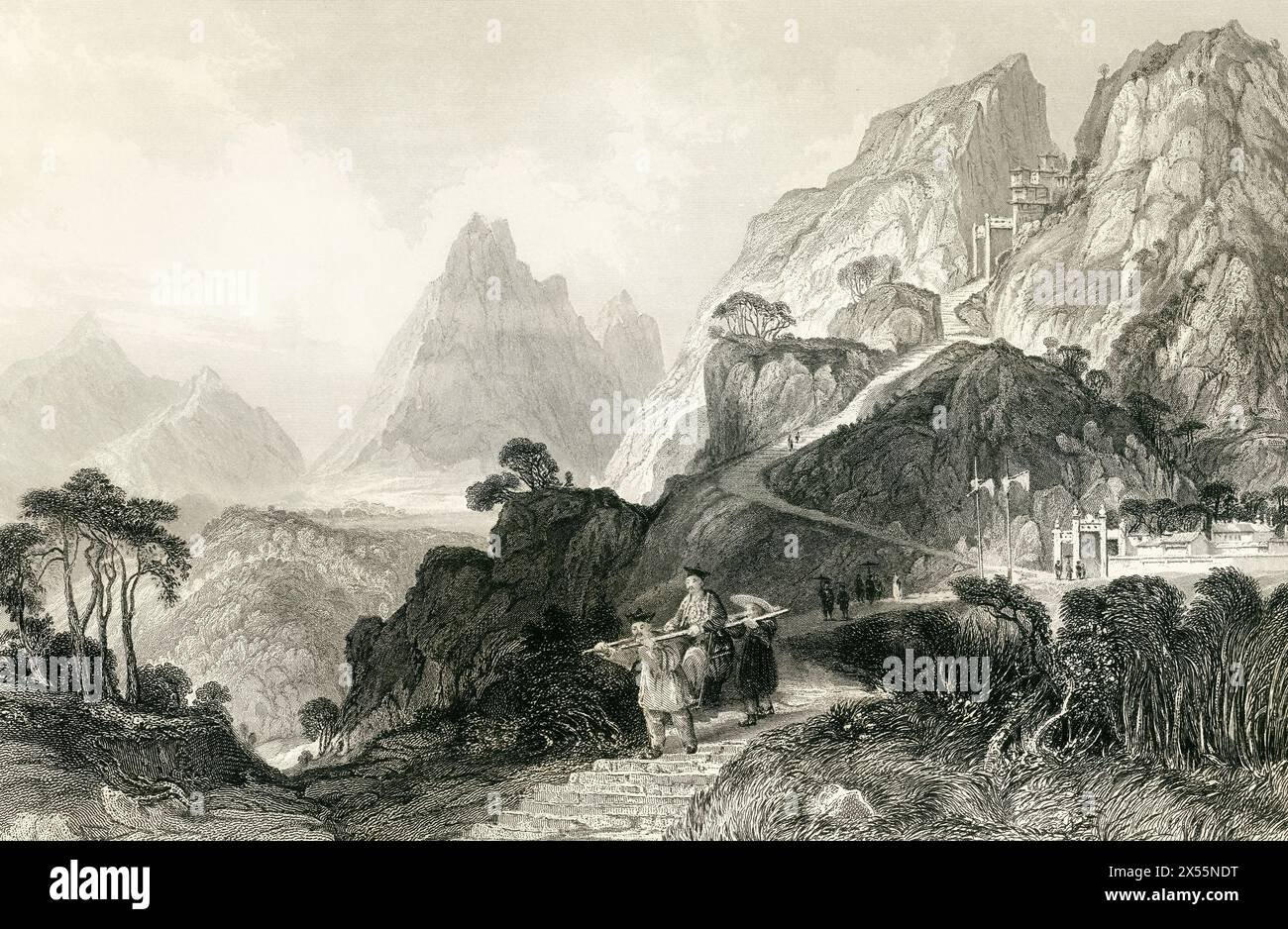
FOOT OF THE TOO-HING, OR TWO PEAKS, LE NAI. PROVINCE OF CHEN-SI
Cover Image: Foot of the Too-hing, or Two Peaks, at Le Nai ( Province of Shen-si ) / China / Drawn by T.Allom Engraved by R.Sands – ALAMY Image ID:2X55NDT
*The location depicted in this illustration is marked as being in Shanxi, but the real Shuangfeng Mountain is located in Xiaogan, Hubei Province.
Tis good to climb the mountain high
And trace the valley deep,
To gaze upon a brilliant sky
Where clouds of silver sleep.
ARGYRO CASTRO.
FEW scenes in the whole empire of the Chinese, more fully illustrate the jealous policy of its government than the picturesque locality of the “Two Peaks.” Not deeming this rocky barrier sufficient protection against the untamed animals, rational and irrational, of the desert, the Great Wall has been continued on the other side of the mountains of Chen-si, without sufficient reflection, by its royal founder, upon the ridicule so superfluous a defence might probably excite. Against all such apprehensions, however, the legislators of China appear to have been completely proof—remaining eternally wrapped up in ideas of the antiquity, majesty, populousness, and power of their country. Nor is this more than useless wall, raised to defend the Too-hing, the only act of conspicuous folly and bigoted policy which the vicinity discloses. Valuable mines of gold lie buried in the rocky treasury of these mountains, easily accessible to such skilful miners as the Chinese; but they are prohibited from being worked, on pain of death. So resolute on this point is the imperial decision, that a guard of tiger-hearted Tartars is stationed at “Two Peaks,” to prevent the least attempt at seeking for this source of human weal and woe.
A high road, from the Orloous country to Sin-gan-foo, through the Too-hing mountains, was formed, it is said, some thousand years since, and by upwards of one hundred thousand labourers. High hills were levelled, deep valleys filled up, and bridges thrown across chasms, and ravines, and defiles, from mountain to mountain. In some places roads were conveyed on pillars, like our grand modern aqueducts of Europe, across low districts of miles in length; in others, as at “Two Peaks,” a passage was cut through the solid rock, and, with an expenditure of manual labour never known but in China, steps hewn in a lofty mountain from its base to its summit. At the commencement of this zig-zag avenue a guard is stationed, under the command of officers at the upper gate is of singular construction. The passage hewn in the rock being only wide enough to admit a sedan, with a foot-passage at a side doorway,—the guards are lodged in a series of apartments elevated on poles some twenty feet above the road. Besides transit duties, a very considerable amount of revenue is derived from the productions of the district itself.
The climate is suited to the cultivation of rhubarb, honey, cinnabar, musk, wax, and odoriferous woods of the sandal kind. Although the inhabitants are not allowed to touch the gold, they raise coal in great quantities, besides several species of minerals employed by native physicians as remedies for fever, and as antidotes against poison. Stags, fallow-deer, wild oxen, and fierce animals of the feline species, range these rocky regions; their capture affording constant employment to the natives, and their skins constituting a source of wealth. In the low districts, where the river periodically inundates the land, wheat and millet are raised in abundance, but little or no rice. This perhaps is too commercial, too utilitarian a picture, of this remote but romantic locality, nor is it in all respects a full and fair one; for, in addition to the varied forms of the Too-hing summits, the luxuriant vegetation of intermediate valleys, and salubrious quality of the climate, no province of China is more richly adorned with instructive examples of natural history. This is the country of that beautiful spotted animal resembling the leopard, for which a name is yet wanting in English; of the Chinese chamois, from which musk is obtained; of The Golden Hen, the pride of the feathered tribe, in Asia; and, here also, amidst a myriad of blushing companions, The Queen of Flowers has established her superiority. More delicately coloured than the rose, its leaves are larger, its perfume sweeter, and its blossoms endure much longer.
![[VOL IV] THE VALLEY OF CHUSAN](https://i0.wp.com/arclumiva.com/wp-content/uploads/2025/09/valley-of-ting-hai-chusan-dinghai-zhoushan-zhejiang-china-drawn-by-t-allom-engraved-by-s-bradshaw-2X55NJ3.jpg?resize=870%2C570&ssl=1)
![[VOL IV] ANCIENT BRIDGE, CHAPOO](https://i0.wp.com/arclumiva.com/wp-content/uploads/2025/09/ancient-bridge-chapoo-haiyan-jiaxing-zhejiang-china-drawn-by-t-allom-engraved-by-rsands-2X55NHK.jpg?resize=600%2C600&ssl=1)
![[VOL IV] HONG-KONG, FROM KOW-LOON](https://i0.wp.com/arclumiva.com/wp-content/uploads/2025/09/hong-kong-from-kow-loon-kowloon-hong-kong-china-drawn-by-t-allom-engraved-by-sfisher-2X55NGM.jpg?resize=600%2C600&ssl=1)
![[VOL IV] CHINESE BOATMAN ECONOMIZING TIME AND LABOUR, POO-KEOU](https://i0.wp.com/arclumiva.com/wp-content/uploads/2025/09/chinese-boatman-economizing-time-labour-poo-kow-nanjing-jiangsu-china-drawn-by-t-allom-engraved-by-awillmore-2X55NGD.jpg?resize=600%2C600&ssl=1)