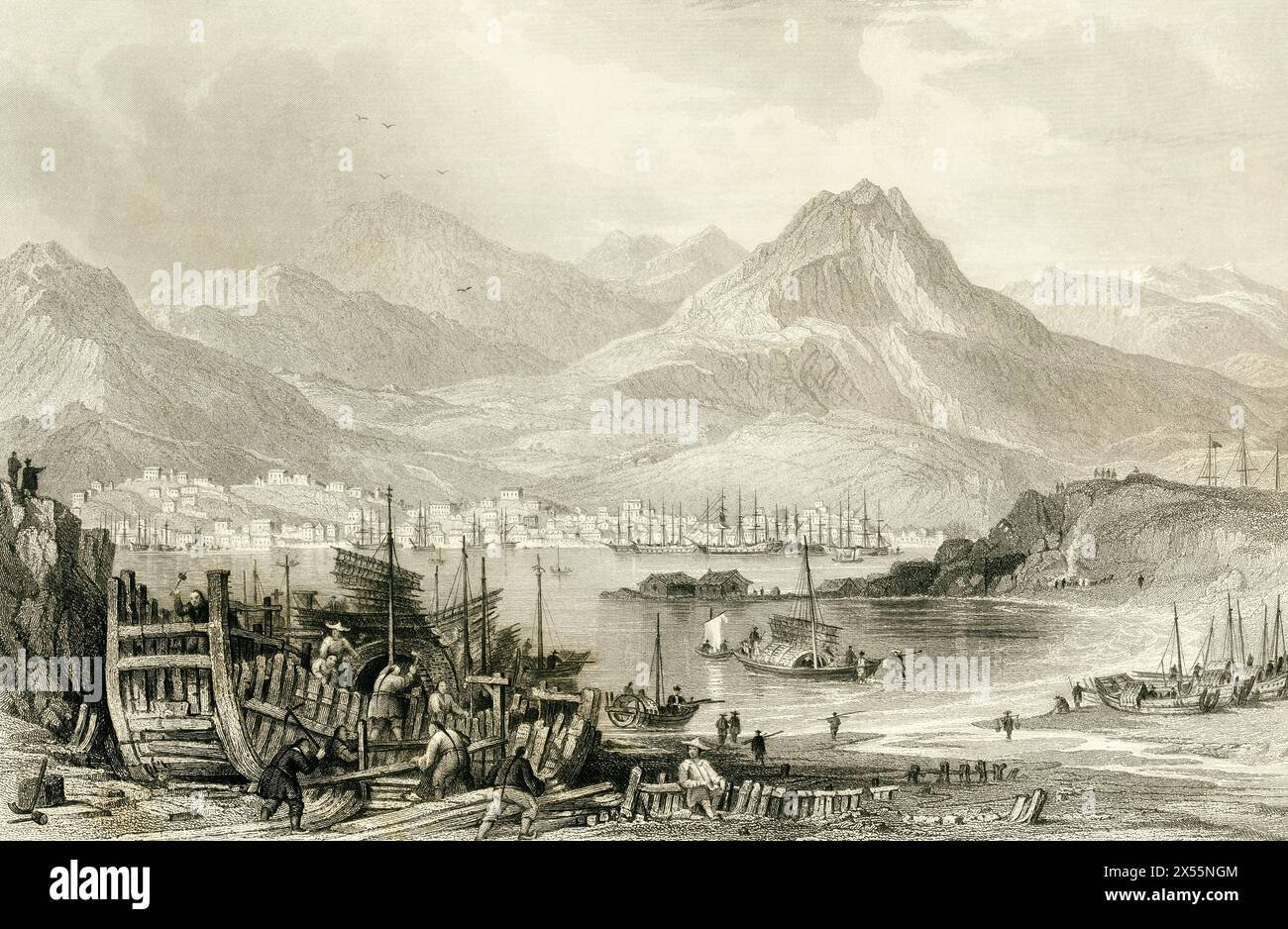
HONG-KONG, FROM KOW-LOON (*The principal facts in this account of Victoria, and the island of Hong-kong generally, are taken from a paper in the Journal of the Geographical Society, by A. R. Johnston, Esq., Deputy – Superintendent of Trade at Canton. Indeed, it is to the zeal and decision of this able and active officer, that the unexampled success of this important depot of commerce is to be attributed.)
Cover Image: Hong-kong, From Kow-loon / Kowloon Hong Kong China / Drawn by T. Allom Engraved by S.Fisher – ALAMY Image ID:2X55NGM
*In 1842, following the British victory in the First Opium War, China was required to open multiple ports, including Hong Kong, according to the Treaty of Nanking. This marked the beginning of Hong Kong as an international trading port, attracting businessmen and immigrants from around the world, and profoundly impacting the economic and social development of the region. After its opening, Hong Kong gradually developed into a significant commercial and financial center, becoming an international gateway city in southern China. / Sketched on the Spot by Capt Stoddart R.N..
“Oh! who shall say
That man is nothing? when his mind can make
Conquest of stubborn earth, and sea, and air,
And all that is therein!”
HONG-KONG, or Heong-keong, land of crystal streams, at a distance appears, like all others of “the thousand islands” that stud the estuary of the Tigris—precipitous and uninviting. Its high hills often terminate in sharp peaks, and are thickly strew with masses of rock, of primitive formation, frequently piled upon one another in a remarkable and sometimes fantastic manner, with here and there a lower hill, covered with gravel and sand. From the summit to the water’s edge there are few or no trees; and, except in the months of May, June, July, and August, when these islands look green, they might be supposed to be quite barren.
“On landing and examining the island, the north and north-east sides are found to be separated from the south and south-west by a continued range of hills, in no place less than 500, in most parts upwards of 1,000, and in more than one instance reaching 1,744 feet above the level of the sea. When this is added, that the utmost breadth of the island does not exceed four or five miles, it may easily be imagined that the descent to the sea on either side is very abrupt.
“The eastern end of the island is divided from the centre by two deep ravines, both running from the same eminence; the one in a south-east direction, which terminates in Tie-tam bay; and the other, in a northerly direction, terminating in the small valley of Wang-nie-chong. The western part of the island is likewise divided from the centre by two ravines, both running from the same eminence; the one to the south, terminating in a small undulating piece of country, on which the village of Pok-foo-lum is situated; and the other to the north, where it spreads out and forms Government hill and the small flat beneath. Small streams descend all these ravines, and they quickly swell into torrents when rain falls; but, it is somewhat remarkable, that they never fail to furnish water in the driest season of the year. There are also other smaller rivulets which furnish a good supply of water at all seasons.
“A coarse kind of grass is found on all the hills: on those having a northerly and north-easterly aspect, it is choked by ferns and brushwood; but, where it is southerly, its growth is unchecked, except when burnt by the natives.
“Victoria is the only town on the island; this was founded by the English, in 1841, and formally ceded to the British crown under the Nanking treaty. In the short term of two years from Sir H. Pottinger’s arrival, when a tent was pitched for the government-residence, a large town has sprung up, a dense population has accumulated. Here now are to be seen extensive stores, forts, wide streets, bazaars, and markets. A noble military road, sixteen yards broad, has been constructed, and continued entirely round the island. Branch roads to Tie-tam and Chuck-py-wan, traverse the hills, exhibiting in their formation the most scientific modes of civil engineering practised in Europe. The list of public buildings includes a government-house, jail, court-house, church, Baptist chapel, a Catholic establishment, Morrison’s Education Society, medical, missionaries’, and mariners’ hospitals. Including the Chinese quarter, situated east of the governor’s house, the total population amounts to 14,000 souls.
“The village of Chek-choo, the largest and most important on the island, contains 800 inhabitants. There are 180 dwellings and shops at this place, and the average value of each house is 400 dollars. The people are employed in trading, in farming, and in curing fish. About sixty, mows(*Sir George Staunton roughly estimates the Chinese mow at 1,000 square yards of our measure.) of land are under cultivation here, which the owners value at forty dollars a mow of rice-ground, and fifteen dollars a mow of land for the cultivation of vegetables. The natives cure about 150 pekuls (*A pekul is equal to 133^1/3 lbs. of our measure.) of fish a month, consuming in the process from thirty to forty pekuls of salt, paying one Spanish dollar for five pekuls: 350 boats, large and small, traffic with the place, but not more than thirty are owned by the natives; most of their boats are used for fishing in the vicinity, and the fish, when cured, is exchanged at Canton, and other nearer places, for the necessities of life.
“The houses at Chek-choo, although inferior to those in an ordinary Chinese town on the mainland, are yet superior to those found in the other villages of Hong-kong; but the quality of land under cultivation, as well as the quantity, is not equal to that at Heong-kong, Wang-nie-chong, Soo-kun-poo, and Pok-foo-lum, places that may be strictly denominated agricultural villages.
“The other villages on the island, besides Chek-choo, are—Heong-kong, from which the island derives its name, prettily embowered in trees, surrounded by cultivated land, and having about 200 inhabitants. Tie-tam is situated at the head of a deep bay, where a good deal of flat land may be reclaimed, and a good boat-harbour formed. A few ships may find protection from the weather in particular parts of the bay of Tie-tam; but the other parts are exposed in both monsoons. Some fifty poor people dwell here. Wang-nie-chong and Soo-kun-poo are picturesquely placed in the midst of fruit-trees, and surrounded by cultivated land. In their vicinity, as at Tie-tam, a considerable extent of land might be reclaimed from the sea, and it shortly will be much required for building-purposes. The united population of the two villages amounts to about 350. Pok-foo-lum is situated about 500 feet above the level of the sea, and commands an extensive view of all the islands to the south and west, as far as Macao. There are, besides the villages enumerated, many hamlets on the east coast of the island, where the magnificent granite of Hong-kong is principally quarried.”
The climate is not essentially different from that of Macao, although, of course, particular sheltered localities are more hot, while, on the other hand, those that are exposed to the monsoons are cooler. Indeed, the description of the climate of Macao by the late Dr. Pearson, who was for many years the medical attendant of the Company’s establishment there, applies with equal propriety to that of Hong-kong. The most prevalent diseases are intermittent and remittent fevers, and dysentery; intermittent fever is very common about the equinoxes, and in the cold weather; remittent fevers prevail during the hot season, especially; dysentery is common during the whole year, but particularly after sudden changes of weather. The natives appear to suffer from these complaints as well as Europeans, but they have no remedies of their own except counter-irritation, produced by pinching and rubbing with the fingers, and with copper cash, in fevers. Vaccination has been introduced by Europeans since the occupation of the island.
The only animals found here are a species of deer, the armadillo, and the land tortoise; several sorts of snakes have been observed.
Among the fruits and vegetables produced on the island are the mango, lychee, longan, orange, pear, rice, sweet potatoes, and yams; a small quantity of flax is grown, and prepared for household uses by the villagers. Since the occupation of the island by the English, the potato of Europe, and the fruits of Canton and Macao, have been introduced; and many European seeds have been brought out by the agent of the Horticultural Society of London.
“The prevailing rock of Hong-kong and of the surrounding islands is granite, in all its species; one having the quartz, mica, and felspar well mixed, and suited for the best sorts of building-purposes; and another, wherein these three ingredients vary in proportion, are not so closely mixed, and consequently only adapted for foundations, dikes, and the other rougher sorts of masonry. “In some places close to the sea, veins of trap are found, varying from six inches to a foot in thickness. On the south and west sides of the island the rock differs from the generality of the species on the opposite side, and assumes the appearance of thick flag-stone, breaking into large crystallized pieces, which it likewise does on the pinnacle of the highest hills, and from time to time falls down and spreads over the surface at their bases. These large stones are very numerous in particular localities, but, owing to their excessive hardness, the Chinese have not yet got into the way of cutting them for use. Occasionally, something like sandstone is found in some parts, but of sufficient size to be used for building.”
![[VOL IV] THE VALLEY OF CHUSAN](https://i0.wp.com/arclumiva.com/wp-content/uploads/2025/09/valley-of-ting-hai-chusan-dinghai-zhoushan-zhejiang-china-drawn-by-t-allom-engraved-by-s-bradshaw-2X55NJ3.jpg?resize=870%2C570&ssl=1)
![[VOL IV] ANCIENT BRIDGE, CHAPOO](https://i0.wp.com/arclumiva.com/wp-content/uploads/2025/09/ancient-bridge-chapoo-haiyan-jiaxing-zhejiang-china-drawn-by-t-allom-engraved-by-rsands-2X55NHK.jpg?resize=600%2C600&ssl=1)
![[VOL IV] CHINESE BOATMAN ECONOMIZING TIME AND LABOUR, POO-KEOU](https://i0.wp.com/arclumiva.com/wp-content/uploads/2025/09/chinese-boatman-economizing-time-labour-poo-kow-nanjing-jiangsu-china-drawn-by-t-allom-engraved-by-awillmore-2X55NGD.jpg?resize=600%2C600&ssl=1)
![[VOL IV] ENTRANCE TO THE CHIN-CHEW RIVER, FOKIEN](https://i0.wp.com/arclumiva.com/wp-content/uploads/2025/09/entrance-to-the-chin-chew-river-fokien-jinjiang-quanzhou-fujian-china-drawn-by-t-allom-engraved-by-ctdixon-2X55NG7.jpg?resize=600%2C600&ssl=1)