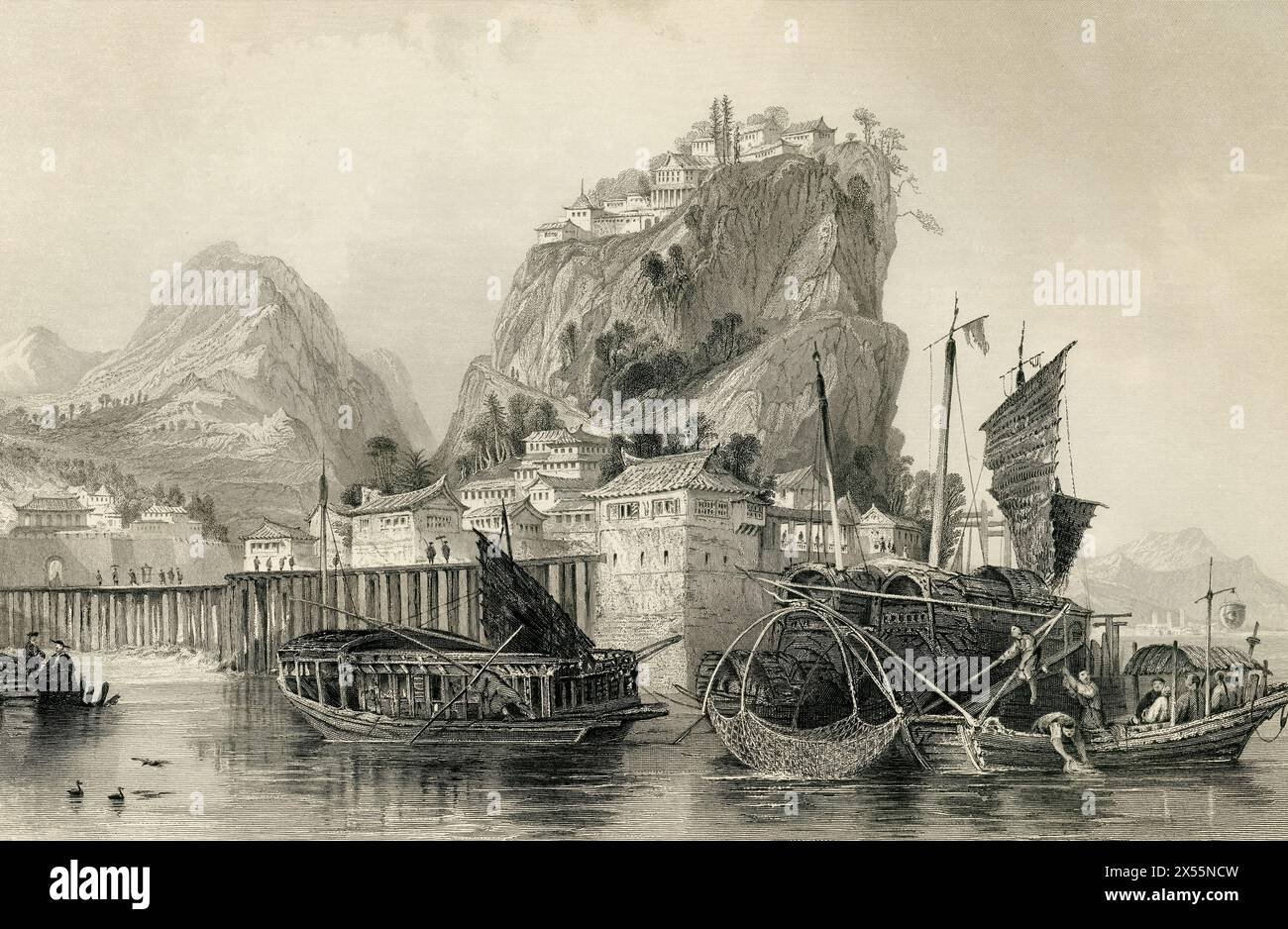
MOUTH OF THE RIVER CHIN-KEANG
Cover Image: JMouth of the River Chin-keang and The Yangtze River / ZhenJian JiangSu China / Drawn by T. Allom Engraved by J.Sands – ALAMY Image ID:2X55NCW
*Zhenjiang Port is a renowned port on the Yangtze River. During the Ming and Qing dynasties, Zhenjiang Port became a crucial hub for transporting goods from the Jiangnan region to the north. Additionally, it played a significant role in military defense and fortifications. / From a Drawing in the possession of Sir Geo. Staunton, Bart.
Does the bright heaven make of thy tide its glass?
Do the dark clouds above thy mirror pass?
Do thy banks echo to the shepherd’s song?
Do human feet pass restlessly along?
SEVERAL tributaries discharge their waters into the Yang-tse-kiang in the vicinity of the Golden Island, and, by their combined effects, have there given to the channel of that noble river all the characters of a vast land-locked bay.
This advantage is fully appreciated by native navigators, who not only make this expansion a regular halting-place, but in many instances the terminus of their voyage, by transhipping their freights for distant places, and returning for others. Independently, however, of the beauty of river scenery, which is here so conspicuous that the Golden Island was once the favourite retreat of royalty, exclusive of the concurrent advantages which the locality affords as a commercial entrepôt, the embouchure of the Chin-keang is a place of the utmost consequence to the internal security of the empire. It is the spot where the advance of a hostile fleet should be resisted: it is the key of the Imperial canal, for a few powerful war-steamers anchored here, could effectually blockade the approach to Peking by the canal—to Nanking, by the Yang-tse-kiang. The peaceful and passive policy of China has not hitherto felt it necessary to fortify this passage of the river, but possibly the experience of recent events may humble their pride, or correct their prejudices, in whichever of those evil qualities the error may have its source. A pier or jetty raised on piles, and extending for several hundred yards from the great river, serves as a loading and a landing place for junks of burden; and stores for the deposit of merchandise, either for reshipment or immediate sale, stand in the very waters that wash the base of the steep cliffs.
A lofty rock, that rises like the frustum of a cone, and shelters the official residences of the little port, is broken into picturesque forms, beautifully tinted by the masses of lichens that shade its deep fissures, and by the bright foliage of the pine that waves over it. An assemblage of glowing white houses on the summit, secure apparently of surprise, constitutes a sort of Tartar capitol, in which a garrison is stationed for the defence of the large cities in the surrounding district, and for the conservation of the river. A pathway, cut in the rock, encircles it like the spiral staircase of a campanile, but the actual length of the ascent is so considerable, that few others than the residents of the citadel encounter it. The surface of the rock is both spacious, and fertile enough, to afford fruits and vegetables to its occupants; and pines, and cypress trees, flourish here in numbers large enough to form a perfect shelter against the winds. From the highest point of the cliff that faces the north, a magnificent panorama is presented to the view. Immediately beneath is seen the city of Chin-keang with its quay and shipping, and fishing-boats arriving and departing; a little further, the great river having extended to a width of two miles, is descried winding majestically through the land for many a li; in the centre, and where it is richest, the Golden Island, clothed with the most luxuriant foliage, through which pagodas and temples occasionally peep, rises gracefully from the silvery surface, and immediately opposite is observed the opening of the Imperial canal into the bay of Chin-keang. A mountain-chain, composed of massive granite, extends along the north bank of the river, as far as the ken can reach, and closes, in that direction, this amazing picture.
There is no passage on the river more conspicuous by the presence and concentration of great and striking features—none more eminently beautiful and animated by trade—none of so much importance to the empire when threatened with invasion by any Christian power.
![[VOL IV] THE VALLEY OF CHUSAN](https://i0.wp.com/arclumiva.com/wp-content/uploads/2025/09/valley-of-ting-hai-chusan-dinghai-zhoushan-zhejiang-china-drawn-by-t-allom-engraved-by-s-bradshaw-2X55NJ3.jpg?resize=870%2C570&ssl=1)
![[VOL IV] ANCIENT BRIDGE, CHAPOO](https://i0.wp.com/arclumiva.com/wp-content/uploads/2025/09/ancient-bridge-chapoo-haiyan-jiaxing-zhejiang-china-drawn-by-t-allom-engraved-by-rsands-2X55NHK.jpg?resize=600%2C600&ssl=1)
![[VOL IV] HONG-KONG, FROM KOW-LOON](https://i0.wp.com/arclumiva.com/wp-content/uploads/2025/09/hong-kong-from-kow-loon-kowloon-hong-kong-china-drawn-by-t-allom-engraved-by-sfisher-2X55NGM.jpg?resize=600%2C600&ssl=1)
![[VOL IV] CHINESE BOATMAN ECONOMIZING TIME AND LABOUR, POO-KEOU](https://i0.wp.com/arclumiva.com/wp-content/uploads/2025/09/chinese-boatman-economizing-time-labour-poo-kow-nanjing-jiangsu-china-drawn-by-t-allom-engraved-by-awillmore-2X55NGD.jpg?resize=600%2C600&ssl=1)