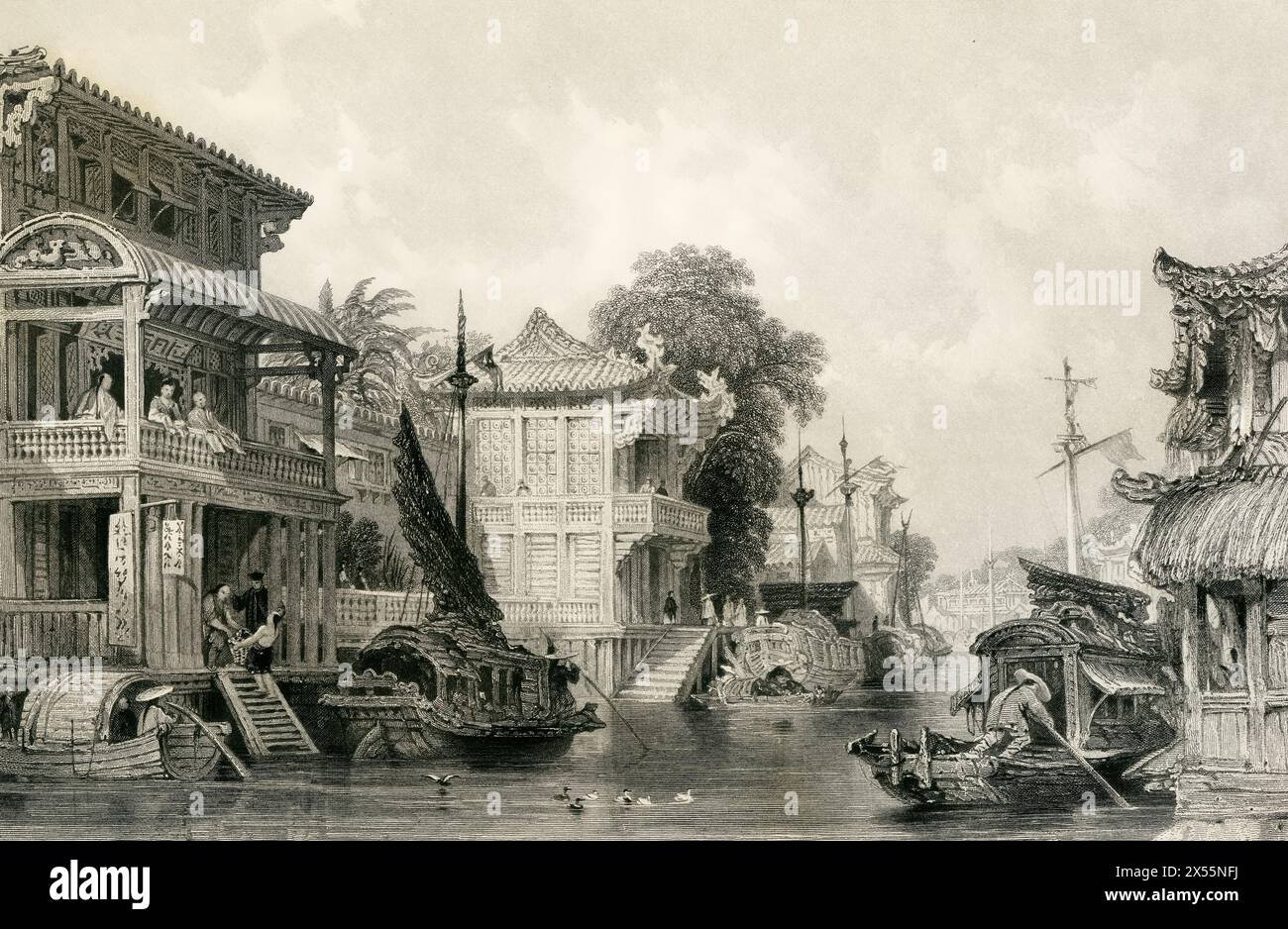
SCENE ON THE HONAN CANAL, NEAR CANTON
Cover Image: Scene on the Honan Canal, near Canton / Pearl River GuangZhou GuangDong China / Drawn by T. Allom Engraved by J.B.Allen – ALAMY Image ID:2X55NFJ
*The status of the Pearl River in Guangzhou is very important. The Pearl River is the largest river in southern China, flowing through Guangdong Province, and Guangzhou is located in the downstream area of the Pearl River. The Pearl River South Bank region has a rich and ancient history.
And here the wide earth’s treasure
Shall merchants bring – spices, and gems, and gold;
All precious wares for pride, and pomp, and pleasure,
Shall here be bought and sold.
MARY HOWITT.
NOT far from the celebrated temple is the embouchure of the Honan Canal, a principal highway of traffic, and an avenue to scenes of beauty, industry, and cultivation. Villas erected at immense cost line the banks in many places, their balconies being decked with fragrant flowers, adorned with fantastic lanterns, and distinguished by various other productions of an ancient refinement. Like the palaces of Venice, each villa has a separate cove, or fairy port, where the barge of its wealthy owner lies moored, until the sounds of pleasure once more call it into service. In some places the store, or factory, of a merchant stands on the margin of the water, a broad ladder descending from the lowest verandah, for the convenient delivery or reception of merchandise; while tablets hanging from the pillars indicate the name, and quality, and particular business of the proprietor. Those who have made a tour of the Venetian lagoons, are prepared to appreciate the pleasant character of such watery ways, where familiarity soon obliterates the idea of danger, and nobody insensibly adds zest to enjoyment. Immediately above the locality represented in Mr. Allom’s view, is a bridge of unequalled grandeur—the proud architectural boast of the Cantonese. Here the Fan-kwei has always been allowed the privilege of mixing with the subjects of the celestial empire: gazing on their singular costume, their splendid parasols, and their impressive countenances, while he is himself, in turn, the object of an unenviable examination. On this grand rialto, fortune-tellers and begging bonzes make their stations. The former either move amongst the passing crowd, or seat themselves at a table, on which writing materials are laid, and, for a few cash, unfold the mysteries of time to come. Husbands who have forfeited their wives’ affections, lovers who would ensure the regard of their Dulcineas, mothers who burn with solicitude for their children’s happiness, and children who have been discarded by their parents, these, and other varieties of suitors, are seen about the magical table, and likewise, in seasonable suggestions, they turn their full attention to consideration.
Above and below this favourite promenade the scenery of the canal is remarkably picturesque. The character of the architecture, the species of foliage, and the sleepy surface of the liquid way itself, are similar all along for many a mile, but nowhere so strikingly beautiful and agreeable as in the immediate vicinity of Ta-jin’s pavilion. The principal front is sustained and decorated by colonnades so light, and delicate, that a breath would appear sufficient to blow them away, yet so solid and secure, formed of bamboo, that they are competent to resist the rudest visitations of weather. Colours the most bright, smiling, and gaudily enliven the upper stories, from the gilded lattices of which the females observe all passengers, without being themselves discovered by the objects of their curiosity.
As your boat is pulled leisurely along, you may peep into the interior, and witness the glowing reign of luxury. There a multitude of sparkling lustres, twinkling lamps, and glaring lanterns depend from the ceiling, while everything that can minister to social enjoyment is spread around these grand saloons. Let the eye but turn to the opposite shore, and dwell upon the contrast in place and circumstances: there riches are succeeded by poverty—leisure by industry—perhaps also affectation by real happiness. Fronting the villa of the prince-merchant of Honan, is the poor-man’s hut, built on piles that out-top the water; and beside it is a narrow space, overshadowed by the branches of a full-grown tree, where all his commercial negociations are conducted. Here the poor but civilized Chinaman, with a species of practical philosophy, peculiar to countries where the necessities of life are few in number and easily obtained, leads a kind of nomadic existence. His embowered wharf is equally adapted to the transactions of trade and the pleadings of pleasure; and thus he whiles away one day after another, regardless of what the following may require.
But the Chinese, or rather Cantonese, population do not restrict their residences to land, nor to houses resting on piles near the shore; multitudes have their homes upon the deep, for they actually dwell in barges moored in the river, and never abandon that amphibious locality for the safer land. In some parts of the river the number of fixed barges is so great, as to conceal the greater portion of the channel’s breadth, and present a solid jumbled mass. In others they are arranged with their sides contiguous, and extending from shore to shore, with the exception of a narrow passage for the shipping. Groups are often detached from the land and moored in tiers, admitting of communication amongst themselves, but preventing intercourse with the shore. This aquatic race of human beings is viewed by their brethren of the terra firma with suspicion and unkindness. They are believed to have had a separate origin—considered as aliens of contemptible talents, and prohibited from intermarrying with lands-people. Tradition, most foolish tradition, ascribes their origin to the wide-spread space beyond the embouchure of the Choo-keang, an idea as childish as the fable of mermen, or sons of the sea. It is to the grandfather of Teaou-kwang that the water-population of China are indebted, not only for being admitted to citizenship, but even for permission to set foot on the soil of the celestial empire.
![[VOL IV] THE VALLEY OF CHUSAN](https://i0.wp.com/arclumiva.com/wp-content/uploads/2025/09/valley-of-ting-hai-chusan-dinghai-zhoushan-zhejiang-china-drawn-by-t-allom-engraved-by-s-bradshaw-2X55NJ3.jpg?resize=870%2C570&ssl=1)
![[VOL IV] ANCIENT BRIDGE, CHAPOO](https://i0.wp.com/arclumiva.com/wp-content/uploads/2025/09/ancient-bridge-chapoo-haiyan-jiaxing-zhejiang-china-drawn-by-t-allom-engraved-by-rsands-2X55NHK.jpg?resize=600%2C600&ssl=1)
![[VOL IV] HONG-KONG, FROM KOW-LOON](https://i0.wp.com/arclumiva.com/wp-content/uploads/2025/09/hong-kong-from-kow-loon-kowloon-hong-kong-china-drawn-by-t-allom-engraved-by-sfisher-2X55NGM.jpg?resize=600%2C600&ssl=1)
![[VOL IV] CHINESE BOATMAN ECONOMIZING TIME AND LABOUR, POO-KEOU](https://i0.wp.com/arclumiva.com/wp-content/uploads/2025/09/chinese-boatman-economizing-time-labour-poo-kow-nanjing-jiangsu-china-drawn-by-t-allom-engraved-by-awillmore-2X55NGD.jpg?resize=600%2C600&ssl=1)