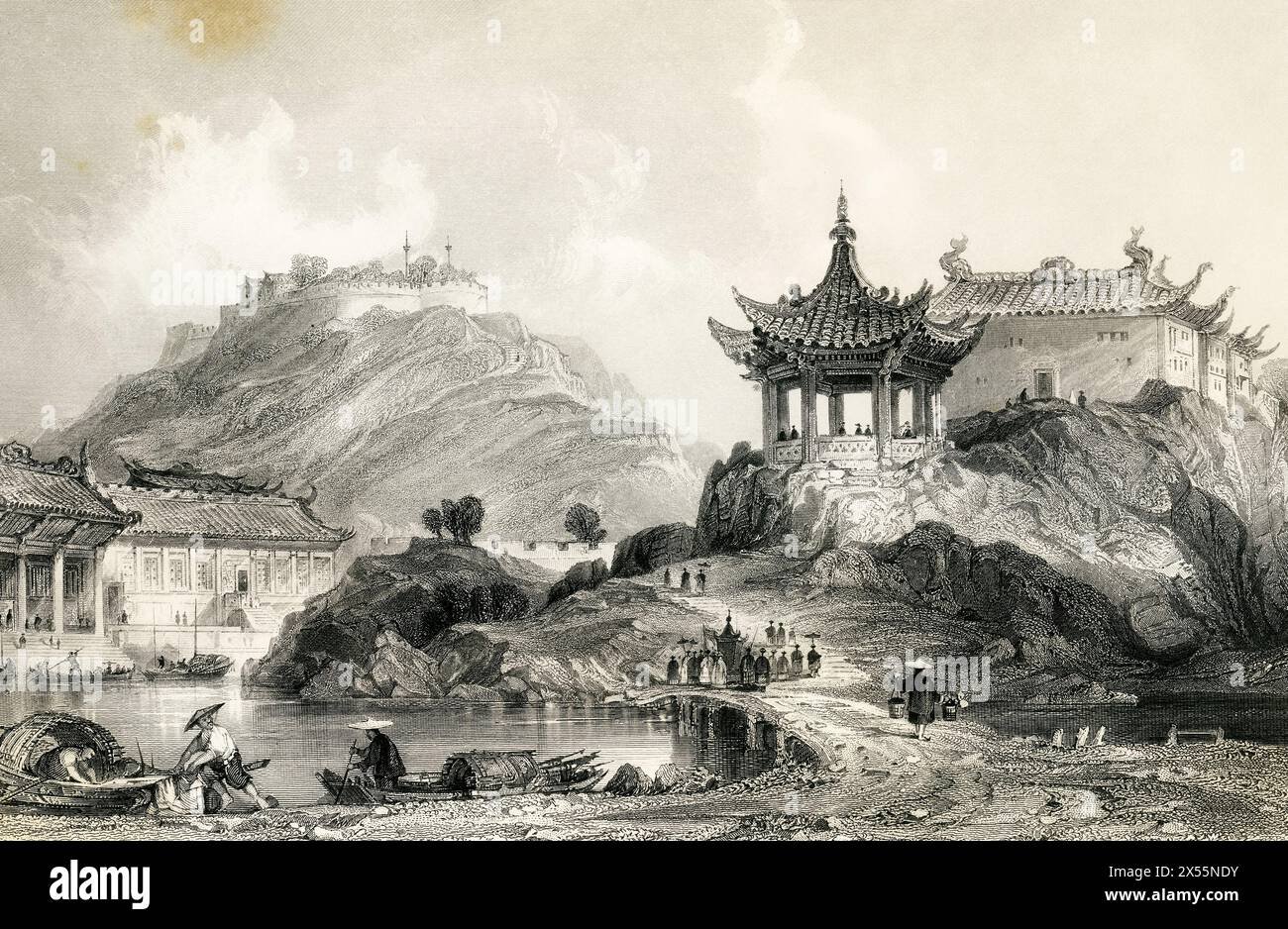
THE FORTRESS OF TERROR, TING-HAI
(*Vide Vol. I. p. 91. Vol. II. p. 43, & 52. Vol. III. p. 53.)
Cover Image: The Fortress of Terror, Ting-hai / DingHai ZhouShan ZheJiang China / Drawn by T. Allom Engraved by E.Brandard – ALAMY Image ID:2X55NDY
*Dinghai Ancient City is a thousand-year-old historical city with numerous historical sites and, at the same time, is an important military fortress. / Sketched on the Spot by Capt Stoddart R.N.
Go, standard of England, go forth to the battle,
Go, meet the proud foes in their hostile array;
The heat of the action where loud cannons rattle,
Is where I have borne thee through many a day.”
The Soldier’s Farewell to his Flag.
NOWHERE, during the British descent upon the coast of China, was the destruction of life and property greater than at Ting-hai. Situated in the entrance to the bay of Hang-chow-foo, Chusan might operate as a breakwater against the ocean’s waves, a fortress against foreign wars; but in the latter capacity it proved lamentably deficient. In the preceding pages of these descriptions, the fall of Ting-hai is recorded, almost in the language of an eye-witness; and, in subsequent passages, the site and scenery of the locality dwelt on with some degree of minuteness. It is remarkable that those places which the Chinese government believed to be impregnable, yielded bravely to British arms, while positions of less reputation afforded more obstinate resistance. Every hill on the coast in the vicinity of Ting-hai, is crowned with a battery of apparent strength; some too elevated to be effective, others too much exposed to the fire of an enemy. At the entrance of a defile, watered by a rivulet flowing from the valley of Chae-hu, and on an eminence about two hundred feet above the level of the bay, stands one of those deceptive structures, misnamed “The Fortress of Terror,” in which the Chinese so lucklessly reposed entire confidence, when the British fleet cast anchor in the roads beneath.
No troops, however armed or disciplined, could have acted with more eminent personal gallantry, than the Tartar garrison of the fort of Terror, yet none ever encountered a more signal overthrow. Two circumstances contributed to produce this result, one, the scientific principles, perfect discipline, and national courage of the British; the other, ignorance on the part of the Chinese, of all modern improvements in the destructive art of war. Hereafter these hill-forts may be strengthened, and rendered serviceable; yet even this hope would appear to be extinguished by the extensive application of steam in the British navy. In one of the picturesque and rocky glens of Chusan, and immediately behind the city of Ting-hai, where several spacious villas are erected, stands a grotesque-looking Hall of Ancestors,—octagonal in form, and covered with a lotus-shaped roof, having dragon finials; it is open beneath, and, from its pleasant position on an elevated rock overhanging the glen, and commanding a prospect of the fortress in front, and of the sea at its base, is a constant scene of visitation. In Chusan, generally, there are many indications of a very ancient occupation, perhaps none more obvious and useful than the old paved roadsleading up every glen, and often climbing to the summits of the hills; the best examples of these may be seen in Anstruther’s Valley, and at Pih-chuaa.
One well known paved-way, crossing an artificial river by a wooden bridge, ascends the ridge of rock on which the open temple rests, and, descending on the other side, passes the lower walls of the fort, and continues to Ting-hai. Although a mandarin of some consequence, as his retinue implies, is seen approaching the temple in his sedan of ceremony, the roads of Chusan were not constructed for the convenience of visitors, the gratification of travellers, or the mere objects of pleasure. Every hill is cultivated to its summit, every valley, from the mountain’s foot to the river’s margin; and, as industry and fertility are here happily concomitant, a large surplus arises for the enrichment of the labourers.
These productions, including rice, cotton, sweet potatoes, coarse tea, and candles made from the seeds of the tallow-tree, are conveyed along the canals in barges, and afterwards carried to the sea-ports by the usual mode of transport in China, the bamboo-pole laid across the shoulders, with buckets, or baskets, or boxes suspended from its extremities. In the agreeable scene, with which the faithful pencil of Captain Stoddart has made the western world familiar, little boats are just arriving at a convenient place for landing or receiving burdens; and, beyond the pool, a picture still more animated presents itself, in the bustle of the boatmen and porters belonging to a large farm-house, the paddy grounds of which are supposed to lie within. This pleasing scene is stylistically characteristic of Chusan; luxuriance and sterility, are seen in contrast; and, the precise beau-ideal of romantic beauty amongst Chinamen,—the end, so eternally pursued in their landscape-gardening, namely, the introduction of rocky-groups, and forest-trees, and running waters, amidst the highest state of refinement and cultivation, is effected in Chusan, by a generous co-operation of nature.
![[VOL IV] THE VALLEY OF CHUSAN](https://i0.wp.com/arclumiva.com/wp-content/uploads/2025/09/valley-of-ting-hai-chusan-dinghai-zhoushan-zhejiang-china-drawn-by-t-allom-engraved-by-s-bradshaw-2X55NJ3.jpg?resize=870%2C570&ssl=1)
![[VOL IV] ANCIENT BRIDGE, CHAPOO](https://i0.wp.com/arclumiva.com/wp-content/uploads/2025/09/ancient-bridge-chapoo-haiyan-jiaxing-zhejiang-china-drawn-by-t-allom-engraved-by-rsands-2X55NHK.jpg?resize=600%2C600&ssl=1)
![[VOL IV] HONG-KONG, FROM KOW-LOON](https://i0.wp.com/arclumiva.com/wp-content/uploads/2025/09/hong-kong-from-kow-loon-kowloon-hong-kong-china-drawn-by-t-allom-engraved-by-sfisher-2X55NGM.jpg?resize=600%2C600&ssl=1)
![[VOL IV] CHINESE BOATMAN ECONOMIZING TIME AND LABOUR, POO-KEOU](https://i0.wp.com/arclumiva.com/wp-content/uploads/2025/09/chinese-boatman-economizing-time-labour-poo-kow-nanjing-jiangsu-china-drawn-by-t-allom-engraved-by-awillmore-2X55NGD.jpg?resize=600%2C600&ssl=1)