THE VALLEY OF CHUSAN
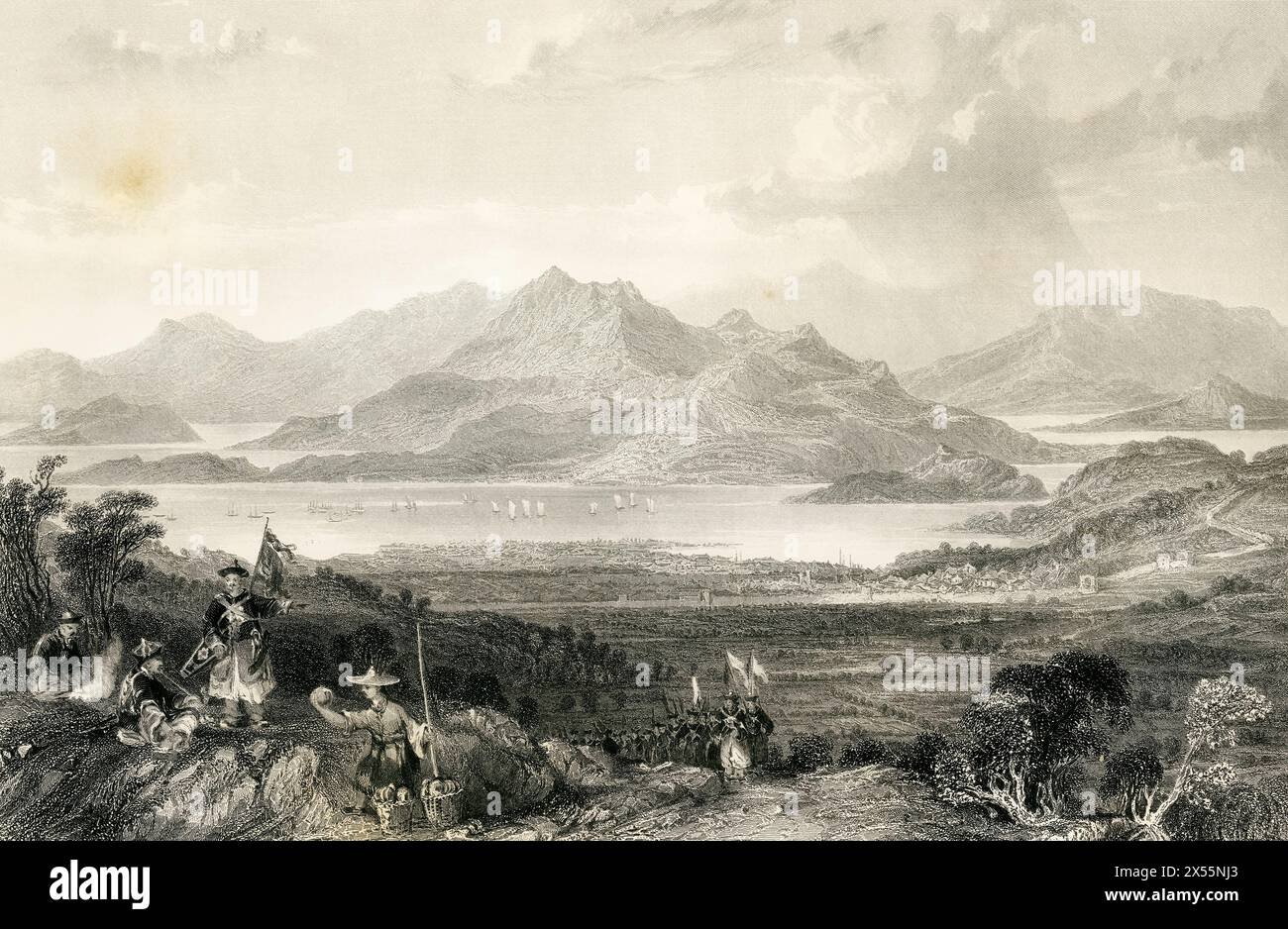
Cover Image: Valley of Ting-hai, Chusan / DingHai ZhouShan ZheJiang China / Drawn by T. Allom Engraved by S. Bradshaw – ALAMY Image ID:2X55NJ3
*Overlooking Dinghai and the Zhoushan Archipelago. / Sketched on the Spot by Capt Stoddart R.N..
The uplands sloping deck the mountain’s side,
Woods over woods in gay theatric pride,
While oft some temple’s mouldering tops between,
With memorable grandeur mark the scene.
GOLDSMITH.
THIS beautiful panorama displays the majestic character of the scenery amongst the Chusan group with the best effect and the most entire truth. It presents all the happy combinations of mountain, water, wood, waste, and cultivated lands, that occur in the landscapes of this archipelago; and, although detached from the continental territories of the empire, Chusan is in every respect a true evidence of the cultivated condition to which the Chinese people have attained by their long and undisturbed repose. Nowhere could a scene be found more fully developing climate, agriculture, and national habits than the accompanying comprehensive view. Neither chilled by the colds of a Peking winter, nor debilitated by the heat of a Canton summer-sun, the Chusan peasant improves every moment of each revolving season, by putting in crop after crop, into the soil which his labour has fertilized; and it is a fact of which the British were ignorant when they made a descent upon these islands, that a life, accompanied by temperance, is here usually prolonged to many years, and seldom interrupted by the visitations of disease.
At the close of these Volumes, in which as much has been attempted as the limits to which each illustration confined the illustrator would permit, it may not, probably, be unacceptable to give a general outline of Chinese statistics, topography, and religion— and to touch slightly, also, upon the peculiarities of their character and language. We are assured that China Proper, which native writers call “The Centre of the World,” covers a million and a half square miles, and maintains a hundred and forty-six millions of inhabitants; of these, two millions live permanently on the water. Their sailors do not exceed thirty thousand in number; they have an army consisting of eight hundred thousand infantry, with half that number of cavalry, and their civil and military officers amount to about twelve thousand. The Eastern ocean confines this vast empire on one side – political limits are prescribed to the wanderings of the Kalmucs or Eleuthes on the other – the south is also bounded by the sea – but the great wall of Mongolia is fixed between the Chinese and the Tartars on the north. This extraordinary work, which has been described in the preceding pages, was erected two thousand years ago, extends fifteen-hundred miles, is thirty-feet in height, and twenty in thickness. Within China Proper are 1572 towns, the principal of which are Peking, Nanking, and Canton; 1193 fortresses, which, however, afford no protection against foreign invasion; 2796 temples, in which idolatry prevails to a melancholy extent; 2606 convents; and 32 imperial palaces. Two vast mountain-chains may be said to subdivide the empire – one in the south-east, the other in the north-west. These districts are difficult of access; nor is the attempt unattended with danger, from the savage tribes by which they are still inhabited. Travellers have not extended their inquiries beyond the Meiling mountains, the scenery of which is remarkably picturesque, especially in the vicinity of the Poyang lake, over which they tower to a height of 3000 feet. Granite, sandstone, slate, and limestone occur in all those mountainous regions, and coal beds in Shan-tung, and various other places, convenient for working and for transport. Besides lofty and extended mountains, China also includes wide-spread plains; of these, the greatest lie between the Hoang-ho and Yang-tse-kiang rivers.
These great arteries of health, fertility, and commerce, traverse some thousands of miles before they reach the sea, receiving supplies from many tributary streams, and themselves feeding innumerable canals. One line of still-water navigation, known as the Imperial canal, is fourteen hundred miles in length, and forms a communication between Peking and Canton, with the interruption of a single day’s journey only.
Agriculture continues to be an honoured occupation; and prosperity has accordingly attended its pursuit. The principal production is rice, except in the colder latitudes, where its place is supplied by wheat and other grains. Yams, potatoes, beans, turnips, and white cabbage, (petsae) are grown commonly; tillage is universally spread over the surface, the steepest hills being subdued by cultivation, and artificially watered. No fences divide the farms; no gates give entrance to them; and the manner in which the peasants’ dwellings are situated—not collected into hamlets, but scattered over the country – contributes to the agreeable character of the picture, to the promotion of agriculture, and the protection of property from wild animals, or midnight depredations. To preserve inviolate this reverence for agriculture, the emperor in person opens the spring season of each returning year, by holding the plough, and turning over several furrows in an appointed field.
Horticulture also is extensively practised, but it has not been studied with that diligence or depth which it requires. Few foreign plants are found in the gardens of the mandarins, or of the rural population, but nature has been bountiful in dispersing arborical and vegetable treasures of other kinds, amongst the various classes of this wide-spread empire. Here the tea-plant, camphor, aloe, sugar-cane, bamboo, indigo, cotton, rhubarb, and many other useful productions, are cultivated with much care. With these, however, either a vast amount of foreign revenue is derived, or an incalculable advantage at home. The camel is the usual beast of burden; and amongst the untamed kinds are the elephant, rhinoceros, tiger, musk-ox, boar, fox, deer, and ape. Pheasants and peacocks claim this part of the globe as their native home; and the brilliancy of their plumage first suggested to the artists of China, those gaudy colours that so universally prevail in every object of decoration.
Mineral treasures lie buried in the depths of the mountain-masses, but they are drawn forth seldom, and with little skill. Gold is procured from the sands of the rivers in Se-chuen, and Yun-nan, and silver might be raised in various places, but as neither is coined in China, their discovery or possession is of less value: copper, arsenic, and quicksilver are procured here; lapis lazuli, rock-crystal, the loadstone, and beautifully variegated marbles, constitute articles of trade and export.
The government is an absolute monarchy, the autocrat being styled “holy son of heaven, sole guardian of the earth, father of his people.” Offerings are made to him. When he appears in public, he is attended by two thousand lictors, bearing chains, axes, and other emblems of Oriental despotism. He has three wives, of whom one only bears the title of empress; and mandarins of the first class, alone have the privilege of approaching the royal person, and communicating complaints from his injured subjects. As to the wise laws of this ancient people, they may be more properly characterized as prudent police regulations, accompanied with useful moral precepts. They place in the hands of the emperor, and also of his mandarins, unlimited power over the liberty of the subject, who is required to pay a blind obedience to his august masters.
Mechanical skill has been carried to a great degree of perfection, and their dexterity and industry in the manufacture of silks, stuffs, porcelain, lacquered ware, and other articles, is so astonishing, that it can only be compared with their own great labour in digging canals, laying out gardens, levelling mountains, and constructing bridges. Very many of the most useful inventions employed in other countries, originated with the Chinese. They printed books before that art was known in Europe, by means of characters carved on wooden blocks, which is their present practice. They have been long acquainted with the use of gunpowder, and were familiar with the properties of the magnet many centuries before the Western world applied it in traversing the pathless seas.
In literature the Chinese are by no means deficient; their language abounds in works of every description, both in verse and prose. They study moral philosophy with diligence, and have very many interesting volumes on history, geography, voyages, drama, romance, and fictions of various kinds. The works of Confucius, and his successor Meng-tseu, have been translated from the Chinese, and the original accompanied by a Latin version, has been published at Paris.
The Chinese are an ancient, civilized, and polished nation, the most remarkable instance of a people so powerful, continuing so long excluded, that universal history presents. They offer examples for imitation to a large portion of the human race, while they have themselves also much to learn. England has broken in upon the historic silence that shaded them from the observation of ambitious nations, and exposed them, consequently, to the continued importunities of foreign powers, seeking treaties of alliance, friendship, or commerce. It is the duty, therefore, of England, to guard her victim from the danger to which she has been exposed, and in doing so, her own national interests will be most advantageously promoted.
THE END OF VOL IV
![[VOL IV] ANCIENT BRIDGE, CHAPOO](https://i0.wp.com/arclumiva.com/wp-content/uploads/2025/09/ancient-bridge-chapoo-haiyan-jiaxing-zhejiang-china-drawn-by-t-allom-engraved-by-rsands-2X55NHK.jpg?resize=870%2C570&ssl=1)
![[VOL IV] HONG-KONG, FROM KOW-LOON](https://i0.wp.com/arclumiva.com/wp-content/uploads/2025/09/hong-kong-from-kow-loon-kowloon-hong-kong-china-drawn-by-t-allom-engraved-by-sfisher-2X55NGM.jpg?resize=600%2C600&ssl=1)
![[VOL IV] CHINESE BOATMAN ECONOMIZING TIME AND LABOUR, POO-KEOU](https://i0.wp.com/arclumiva.com/wp-content/uploads/2025/09/chinese-boatman-economizing-time-labour-poo-kow-nanjing-jiangsu-china-drawn-by-t-allom-engraved-by-awillmore-2X55NGD.jpg?resize=600%2C600&ssl=1)
![[VOL IV] ENTRANCE TO THE CHIN-CHEW RIVER, FOKIEN](https://i0.wp.com/arclumiva.com/wp-content/uploads/2025/09/entrance-to-the-chin-chew-river-fokien-jinjiang-quanzhou-fujian-china-drawn-by-t-allom-engraved-by-ctdixon-2X55NG7.jpg?resize=600%2C600&ssl=1)