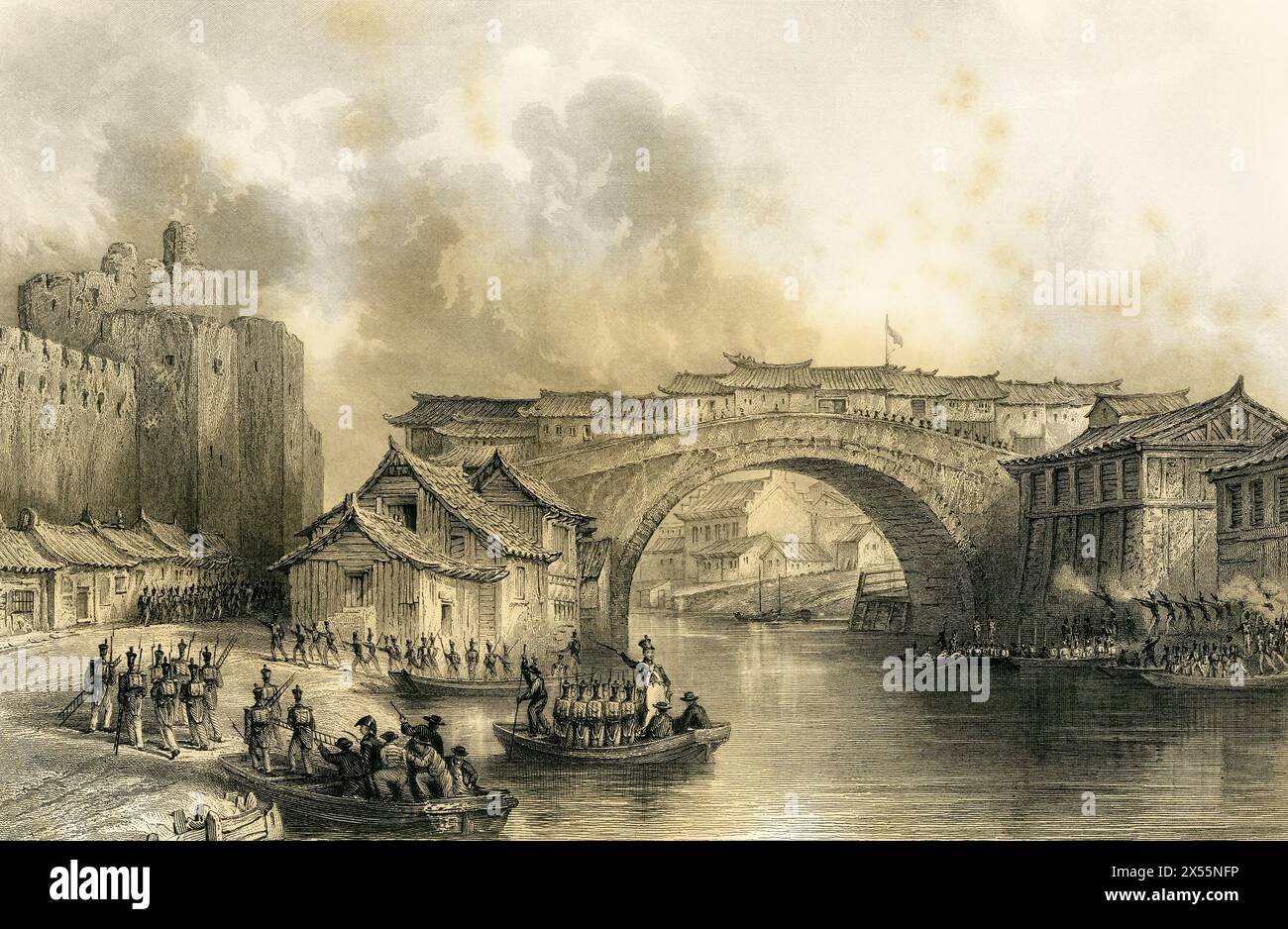
WEST GATE OF CHING-KEANG-FOO
Cover Image: West Gate of Ching-keang-foo / ZhenJiang JiangSu China / Drawn by T. Allom Engraved by J.M.Starling – ALAMY Image ID:2X55NFP
*Zhenjiang is located in the central-southern part of Jiangsu Province, situated on the southern bank of the Yangtze River. Zhenjiang has a long and ancient history that can be traced back to ancient times. It holds a significant place in Chinese history, having served as the capital of the Wu Kingdom and being a famous military stronghold in Chinese history. On July 21, 1842, during the First Opium War, British forces attacked Zhenjiang. / Sketched on the Spot by Capt Stoddart R.N..
Now came that awful conflict big with fate:
The band, in order, in their barges sate;
By sounding oars, and sinewy arms impelled
Their course, to reach that field of war they held.
ARGON. EXPED.
WHERE the Imperial Canal enters the Yang-tse-kiang river on the south, and where a broad and beautiful nautical basin is formed by the river’s sinuosities and expansions, a vast trade has been contracted, and large cities have grown up. In the centre of the river, at its widest part, stands the Golden Island, clothed to its tapering summit with the most luxuriant foliage; on the northern shore is seated the city of Quangtchou, and, on the southern Ching-keang-foo. Ridge after ridge of rocky mountains stretches away from the borders of the bay into the remotest distance, producing a remarkable contrast of imagined retirement and sterility, with the smiling and animated picture which the river, here a league in breadth, presents to the eye. The surface is varied by the presence of vessels, differing in size, shape, and objects. Some sailing with, others against the current; many crossing from one adit of the canal to the opposite; and countless numbers lying at anchor.
Ching-keang-foo being the key to the southern provinces, the out-port on which Nanking depends for its security against foreign aggression, was deemed of corresponding importance to the British troops in the subjugation of the Chinese empire. Being strongly protected by walls, thirty feet in height, and five in thickness, containing a large and actively population, and being garrisoned by a body of resolute Tartars, its reduction was considered both the more necessary and more glorious to our army. Ascending the canal, and effecting a safe landing on both sides of the water, at the foot of a lofty and noble bridge of one arch, the British commenced a vigorous assault upon the west gate of the city. A much warmer reception than was anticipated, at first threw the assailants into some confusion, and the Blonde’s boats, after a desperate resistance, were actually for a while in the enemy’s hands. From this perilous position, however, they were soon released, by a party of marines and seamen belonging to the Cornwallis.
This momentary discomfiture only lent new resolution to those who were its victims; and, under cover of a destructive fire from the opposite bank of the canal, Captain Richardson led up a scaling party to the walls. Rockets and heavy guns soon overthrew the gate-towers, and the gates themselves becoming a mass of flame, destroyed all prospect of future resistance. Submission now was the sole remaining portion of the Tartars, who had fought with courage and devotion.
Only four miles in circuit, Ching-keang-foo is but a minor city, indeed it is the fifth in magnitude in Kiang-nan; however, from its geographical position, it is always esteemed one of the first in commercial rank. The streets are narrow, paved with marble, and contain many well-supplied shops, in which horn for lanterns forms a prominent article of sale; and the suburbs are nearly equal to the enclosed city in extent.
![[VOL IV] THE VALLEY OF CHUSAN](https://i0.wp.com/arclumiva.com/wp-content/uploads/2025/09/valley-of-ting-hai-chusan-dinghai-zhoushan-zhejiang-china-drawn-by-t-allom-engraved-by-s-bradshaw-2X55NJ3.jpg?resize=870%2C570&ssl=1)
![[VOL IV] ANCIENT BRIDGE, CHAPOO](https://i0.wp.com/arclumiva.com/wp-content/uploads/2025/09/ancient-bridge-chapoo-haiyan-jiaxing-zhejiang-china-drawn-by-t-allom-engraved-by-rsands-2X55NHK.jpg?resize=600%2C600&ssl=1)
![[VOL IV] HONG-KONG, FROM KOW-LOON](https://i0.wp.com/arclumiva.com/wp-content/uploads/2025/09/hong-kong-from-kow-loon-kowloon-hong-kong-china-drawn-by-t-allom-engraved-by-sfisher-2X55NGM.jpg?resize=600%2C600&ssl=1)
![[VOL IV] CHINESE BOATMAN ECONOMIZING TIME AND LABOUR, POO-KEOU](https://i0.wp.com/arclumiva.com/wp-content/uploads/2025/09/chinese-boatman-economizing-time-labour-poo-kow-nanjing-jiangsu-china-drawn-by-t-allom-engraved-by-awillmore-2X55NGD.jpg?resize=600%2C600&ssl=1)