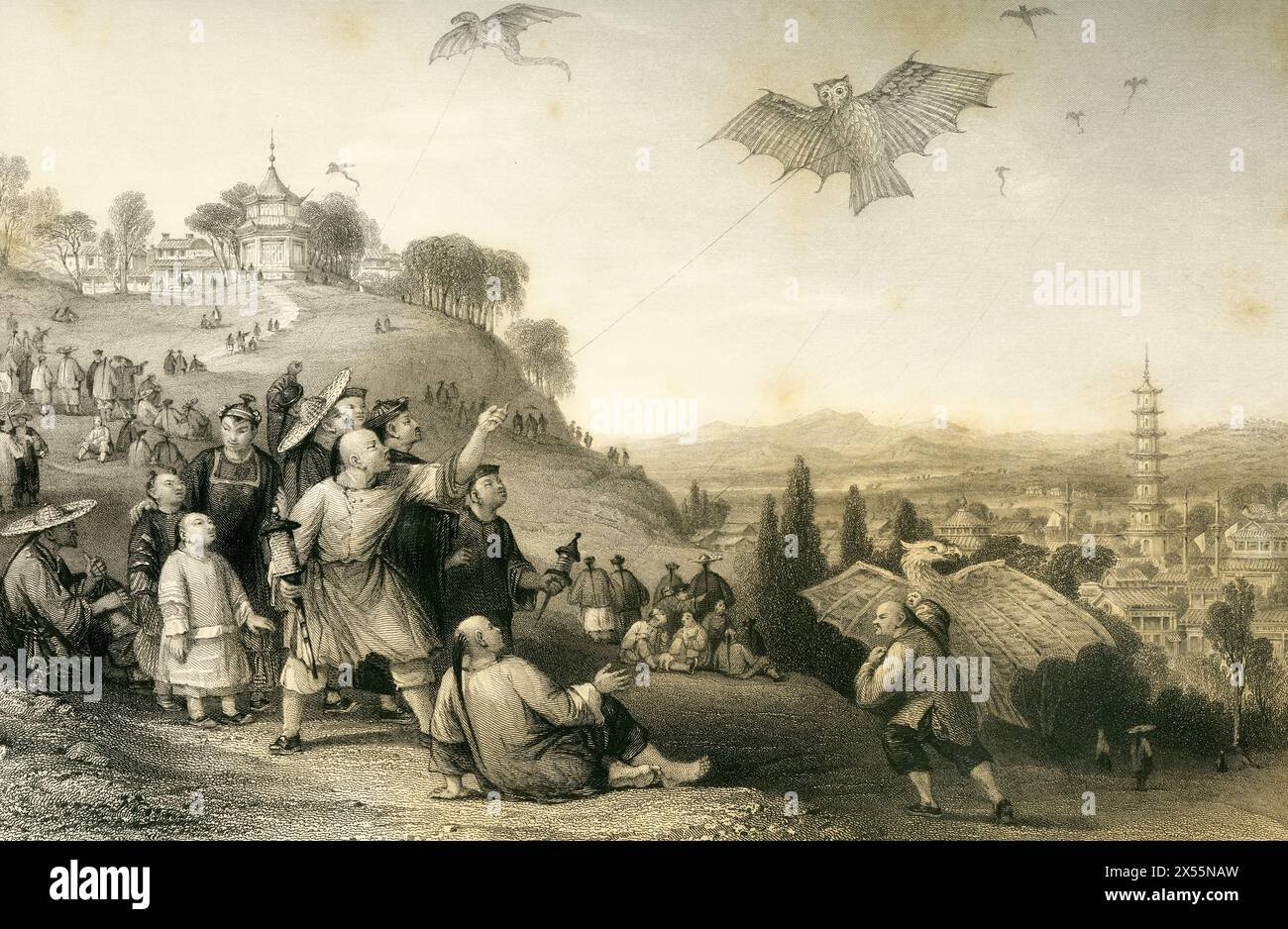
KITE-FLYING AT HAE-KWAN
Cover Image: The Cataract of Shih-tan ( Province of Kiang-nan ) / ShiTan HuangShan AnHui China / Drawn by T. Allom Engraved by S. Bradshaw – ALAMY Image ID:2X55NAW
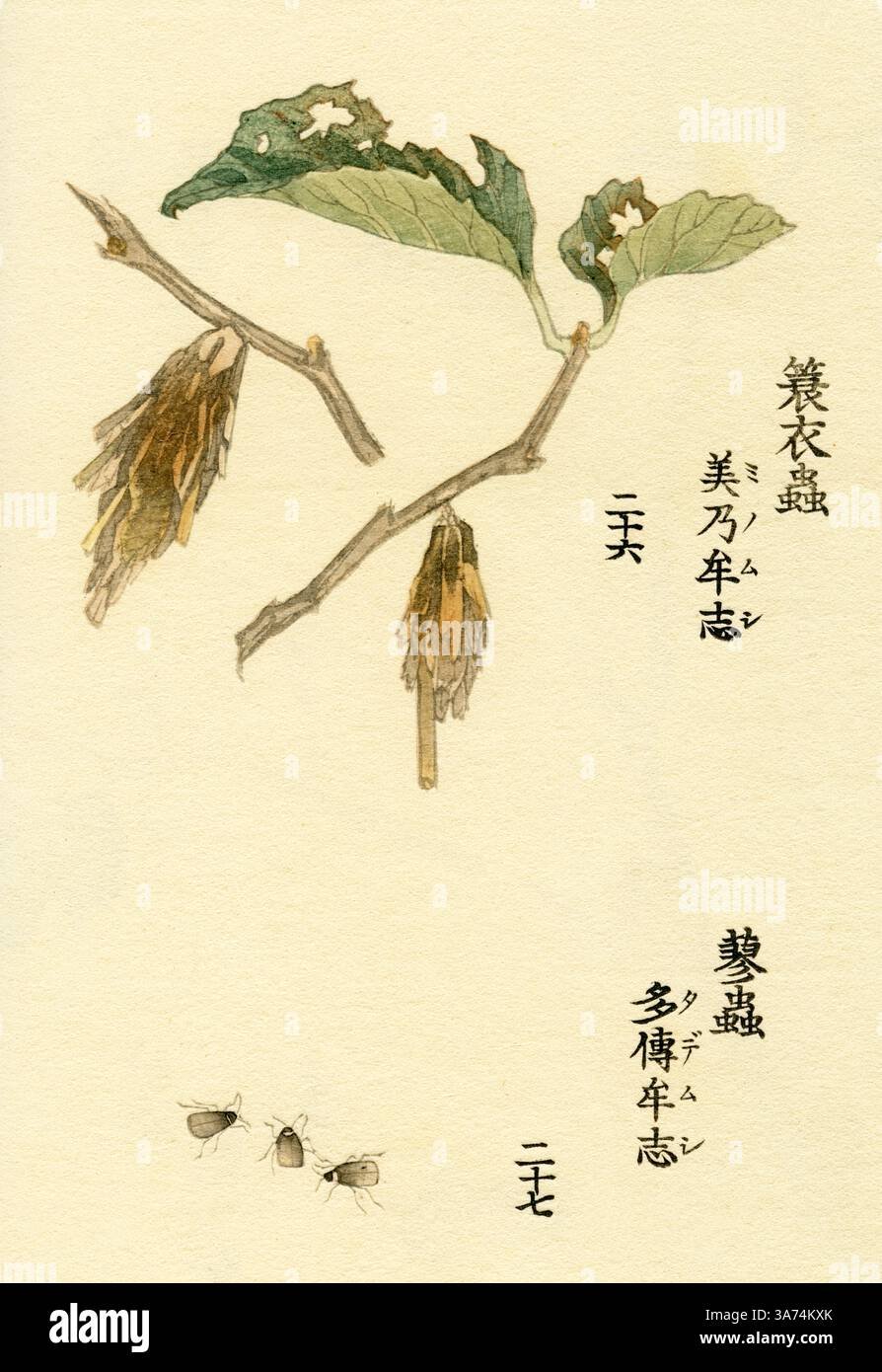
*Kites are a traditional game with a long history in China, also known as “fengzheng,” “paper kites,” “paper eagles,” and other names. In ancient times, they were called “yao” in the south and “yuan” in the north, often referred to as “nan yao, bei yuan.” During the late Tang Dynasty, people began attaching whistles to kites, and the sound produced resembled the music of a zither or an organ. This led to the names “fengzheng” or “fengou,” which are now used to describe kites in general, including those without whistles. Kite flying remains a popular traditional activity in China, enjoyed by people of all ages.
O royal sport! O, mirth-engendering play!
To cut his cord, and send his kite away.
SALZMANN.
cricket and quail-fighting, shuttlecock-playing, the game of mora, or odd and even, prevail in every province of the empire: and to these very ancient, but most juvenile indulgences, is to be added the favourite amusement of kite-flying. Fond of tricks, sleight of hand, display of muscular flexibility on all occasions, the kite-flyer endeavours to infuse some share of these qualities into his favourite employment. Bamboo-cane is peculiarly suitable, from its levity and flexibility, as the leader and cross-piece of a kite; and there is a species of paper, made from the floss or refuse of silk, that is both tough and light, which is particularly serviceable in covering a skeleton made of cane and cord. Dexterous in every manipulatory art, the Chinaman has of course attained to excellence in the construction of kites, and he proceeds to decorate them with the most fanciful ornaments, as well as to shape them into forms borrowed from those of the animal kingdom.
Eagles, owls, and the whole feathered tribe, furnish originals for imitation in the structure of a kite; and when raised on high with outspread wings, and painted feathers, and eyes of transparent glass, they represent their prototype with the most ludicrous fidelity. It is an established custom to devote the ninth day of the ninth moon, as the special festival of this amusement; and on this joyous occasion children and aged men unite in the exhilarating pleasures of a whole holiday’s kite-flying, on the most elevated place in the suburbs of each town. The panoramic view from “the hill of beauty,” that hangs over the rich valley of Hae-kwan, cannot fail to increase the pleasurable feelings that attend the sport; and the townspeople themselves feel fully sensible of the charms of the spot, by the fulness of their attendance at these ancient festivities. When the appetite for mirth and fun, as well as the hours of the day itself, are nearly exhausted, the performers endeavour to bring their kites into collision, or rather try to break each other’s strings by crossing. Should they not succeed in this attempt, as children tired of toys, they give the sportive effigies to the wind, to be borne whither their destinies may lead them. One of the chief improvements in this manufacture, which the Chinese arrogate to themselves, is the introduction of numerous cords strained across apertures in the paper. The resistance of the air acting on these little bars, as the wind on the strings of an Æolian harp, produces a continued humming noise; and when many kites are flown in company, the combined tones are both loud and agreeable.
The Chinese have, in many instances, taken a first step in the progress towards some great invention, or sown the seeds of some valuable harvest, leaving the consummation, the collection, to wiser heads, although probably less dexterous hands. They discovered the magnetic needle, but failed to extend its usefulness;—they have long possessed a mode of printing, but it has brought them little benefit;—they have known for ages the composition of gunpowder, yet made no advances in the art of war; their ancient familiarity with kite-flying gave them frequent opportunities of communication with the higher regions; but it does not appear that, by these means, they ever became acquainted with the possibility of drawing down to the earth they trod, that most subtle fluid, lightning, which they have so often witnessed in its shadowy kingdom. Yet it was by means of a kite that American Franklin established the identity of lightning and electricity; and by repeated experiments with the same toy, that De Romas was enabled to construct an electrometer. In later years the kite has been enlisted by Captain Dansy, in the legion of inventions for forming a communication between a stranded ship and the neighbouring shore, whenever all ordinary means shall have proved abortive.
![[VOL IV] THE VALLEY OF CHUSAN](https://i0.wp.com/arclumiva.com/wp-content/uploads/2025/09/valley-of-ting-hai-chusan-dinghai-zhoushan-zhejiang-china-drawn-by-t-allom-engraved-by-s-bradshaw-2X55NJ3.jpg?resize=870%2C570&ssl=1)
![[VOL IV] ANCIENT BRIDGE, CHAPOO](https://i0.wp.com/arclumiva.com/wp-content/uploads/2025/09/ancient-bridge-chapoo-haiyan-jiaxing-zhejiang-china-drawn-by-t-allom-engraved-by-rsands-2X55NHK.jpg?resize=600%2C600&ssl=1)
![[VOL IV] HONG-KONG, FROM KOW-LOON](https://i0.wp.com/arclumiva.com/wp-content/uploads/2025/09/hong-kong-from-kow-loon-kowloon-hong-kong-china-drawn-by-t-allom-engraved-by-sfisher-2X55NGM.jpg?resize=600%2C600&ssl=1)
![[VOL IV] CHINESE BOATMAN ECONOMIZING TIME AND LABOUR, POO-KEOU](https://i0.wp.com/arclumiva.com/wp-content/uploads/2025/09/chinese-boatman-economizing-time-labour-poo-kow-nanjing-jiangsu-china-drawn-by-t-allom-engraved-by-awillmore-2X55NGD.jpg?resize=600%2C600&ssl=1)